


한식에 대한 다채로운 이야기를 전하는 온라인 매거진
Vol 61. Mountains and Nature
Three Seasonal Dishes Presented with the Spring Breeze
The Tasteful Table
After overcoming the cold, windy winter, the spring breeze comes with the fragrant scent of flowers. There are dishes that bring heartwarming flavors to our table as much as the warm spring breeze. Let's make the day full of energy with a full meal made with seasonal vegetables.
Article Cha Yeji (Editorial Team)
Meat from the mountains
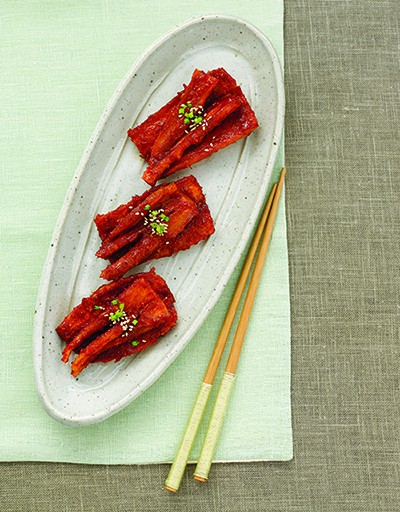
Deodeokgui
Deodeok is said to be as effective as wild ginseng, and has been used as a valuable food ingredient since the ancient times. It was used not only as food but also as medicine, and nothing was wasted, from its leaves to its roots. Thus, deodeok was also called “meat from the mountain,” and it has many benefits as much as it is used as a medicine.
Deodeok can be made into dishes, such as gui (grilled), saengchae (salad), jangajji (pickled), as well as jeonggwa (braised in sweet sauce), liquor, and tea. The characteristic of deodeok is that each dish has a different taste, depending on how it is cooked. Among them, deodeokgui (grilled deodeok) is a healthy Korean food that has been loved for a long time.
First, peel it well and beat it with a rolling pin, then tear it lengthwise and flatten it. After trimming the deodeok, apply a seasoning made with red chili paste and grill it front and back on a gridiron to make a traditional deodeokgui. In the process of peeling and flattening it, the bitter flavor that is unique to deodeok and the astringent taste of its skin disappear, and a savory side dish with red chili paste seasoning is made. Deodeokgui, with a smokey flavor from being grilled on a gridiron, has a fragrant and chewy texture when eaten with rice. It is the best side dish to announce the arrival of spring.
Spring in a bowl,
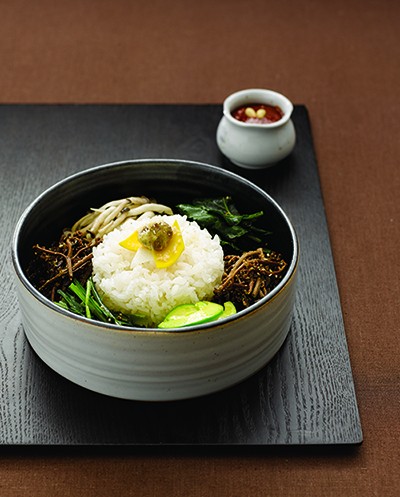
Sanchae bibimbap
Among the types of bibimbap, which is a dish made by mixing rice and various seasoned wild greens together, sanchae bibimbap (wild vegetable bibimbap) is made with mountain greens as the main ingredient. The ingredients for sanchae bibimbap are not clearly defined. However, it focuses on mountain greens that are in season. Thus, namul from famous mountains located in each region are used. Sanchae bibimbap made in the Hadong area uses greens from the foot of Jirisan Mountain, and the one made near Muju uses greens from Deogyusan Mountain.
Sanchae bibimbap drew attention as the public’s interest in vegetarian food increased. Due to the nature of the dish using wild greens from the mountains as the main ingredient, it is common to eat this dish at temples, and temple food has received particular attention. Sanchae bibimbap eaten at temples is gaining popularity both at home and abroad because it does not contain meat or osinchae (five herbs with a pungent scent). It has a clean taste that is not pungent.
Seasonal vegetables are sometimes added to the dish. Gosari, (bracken), doraji (bellflower root), kongnamul (bean sprouts), and pyogobeoseot (golden oak mushroom) are the basic ingredients of sanchae bibimbap, and deodeok, dureup (fatsia shoot), chwinamul (aster leaf), etc., that are in season in the spring are added for flavors. Special vegetables that are unique to each region are also added. It is said that in Irwolsan Mountain, Yeongyang, Gyeongbuk, the sanchae bibimbap made with rare vegetables, such as geumjuk (amur angelica), saridae (bush clover stem), chamtakju (maple-leaf ainsliaea), etc., was made and presented to the king.
Best pairing with meat,
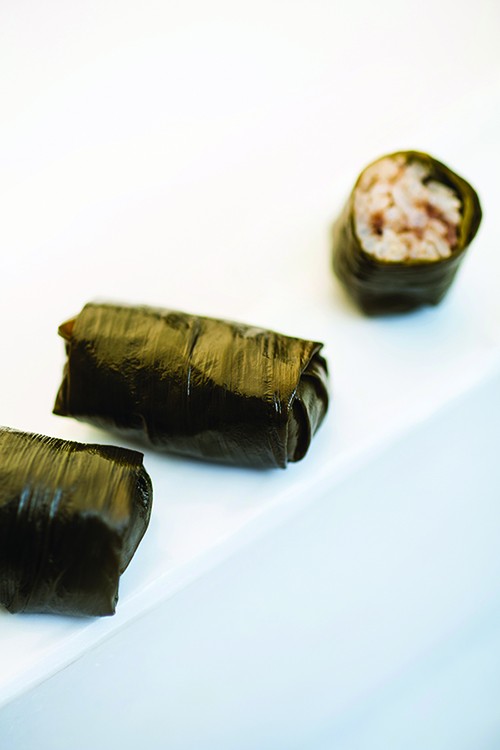
Myeonginamul bulgogi ssambap
Myeonginamul jangajji (pickled victory onion) is one of the side dishes that always accompanies grilled meat. The myeonginamul is also called sanmanul (mountain garlic) because its leaves smell like garlic. It is said that the name myeonginamul was derived from the fact that the people of Ulleungdo Island ate this namul to survive during the period of spring poverty. It is mainly produced in the Ulleung region and Yeongyang-gun of Gyeongsangbuk-do, the vicinity of Pyeongchang and Inje in Gangwon-do, and Hadong of Gyeongsangnam-do. It is a perennial plant belonging to the genus of Allium, and is a mountain green that grows wild in the alpine regions in the Far East, Russia, China, Korea, and Japan.
Myeonginamul does not have a strong flavor or aroma, but it has a crunchy texture and pairs well with meat, especially pork. This is why myeonginamul jangajji is served when grilling pork belly or pork ribs. It is rich in fiber, so it aids in digestion by helping promote regular bowel movement. As its leaf has the scent of garlic, it also has the antioxidant properties of garlic.
Myeonginamul is often eaten as pickled, but it is also used as a wrap or eaten deep-fried. Among the traditional dishes using myeonginamul, there is myeonginamul bulgogi ssambap (Victory onion bulgogi leaf wraps and rice). It is a dish made by mixing well-minced bulgogi grilled over charcoal with rice and sesame oil, then placing it on a pickled myeonginamul and rolling it. You can enjoy a variety of flavors from the smoky flavor of charcoal-grilled meat and the rich flavor of soy sauce that are added to the pungent and savory flavors of fermented pickled greens.