

한식에 대한 다채로운 이야기를 전하는 온라인 매거진
Vol 60. The Joy of Grilling
From Suwon to LA: The Delectable Journey of Grilled Galbi
Facts about HANSIK
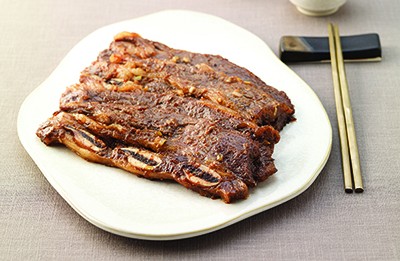
The pre-1945 meaning of “galbi” was the steamed or grilled version of beef ribs. Even longer ago than that, when galbi was called “gari,” it referred exclusively to grilled beef ribs. This month, we trace the journey of grilled galbi, which is still regarded as a high-end Korean dish.
Article Seo Dongchul (Editorial Team) Sources Encyclopedia of Korean Culture, Doopedia, 100 Korean Foods You Must Know II (Han Bokjin, Han Bokryeo, Hwang Hyeseong), Bulgogi: The Cultural History of Meat-Grilling in Korea (Lee Gyujin, Cho Misuk)
The unchanging value of grilled beef
Records of grilled galbi go back as far as the Joseon dynasty. Mention of it is found in Siuijeonseo, a cookbook published in late Joseon that arranges recipes by cooking method, and Imwonsipyukji, a collection of 16 encyclopedias on farming by Seo Yugu (scholar of late Joseon). A cookbook compiled by Lee Yonggi, an intellectual of the Japanese colonial period, includes a detailed explanation of how to season and eat grilled galbi.
Beef ribs are very widespread today, but in pre-modern Korea, beef was an exceedingly rare ingredient. In the agrarian society at the time, the government managed all of the cows in the country. This meant that those who owned a cow were not free to butcher it when they wished. The cow was first and foremost a valued farm laborer. In late Goryeo, in the 12th year of King Chungsuk’s reign (1325), a royal decree was issued that guaranteed punishment for anyone who butchered a cow or horse. Efforts were also made in the Joseon dynasty to protect cows, such as through a similar decree preventing the arbitrary butchering of cows. These were, alas, of little use in keeping people from enjoying grilled ribs. Supposedly, there were many cases where people, despite the royal decrees, secretly butchered a cow or did so after lying that it had died of disease. It is not difficult to imagine how satisfying it would have been, to the point that people were willing to engage in illegal activity to do so, to enjoy grilled beef ribs around a charcoal brazier.
Until relatively recently, ribs were rarely seen at the dinner table unless there was a village banquet or it was Chuseok or Lunar New Year. Butcher shops sold ribs only in “jjak,” or as a rack (one side). Because, obviously, there were only two jjak per cow, ribs were something that many people saw only a couple of times per year. This situation changed around 1939, when a Pyeongyang naengmyeon restaurant in Seoul’s Nagwon-dong district began selling naengmyeon with a side of grilled gari. It was also around this time that “gari” began being replaced with the word “galbi.”
The renaissance of Suwon wanggalbi
One major player in the history of grilled galbi is Suwon wanggalbi. In the 1940s, Lee Gwiseong opened Hwachoonok, the first restaurant to serve Suwon wanggalbi. It initially became popular through the haejangguk (hangover soup) in which the ribs were served and started attracting foodies from neighboring cities by selling grilled ribs in 1956. The restaurant became even more famous for being frequented by politicians such as Shin Ikhee and Park Chung Hee. In 1979, Hwachoonok was razed to make room for a department store. This marked the end of an era for the restaurant, but the reputation of Suwon wanggalbi was (and still is) maintained by a group of galbi restaurants located along a major thoroughfare in east Suwon. Suwon’s galbi is characterized by its name (wanggalbi means “large galbi”) and the fact that it is much longer than other types of ribs (at 10 to 13 centimeters).
Another defining trait is the use of only a little bit of salt for seasoning in lieu of soy sauce and/or other condiments—in other words, it offers an experience of beef ribs’ innate flavors. One reason for Suwon becoming a “galbi mecca” is Suwon Fortress. During the construction of the fortress, King Jeongjo ordered royally-affiliated rice fields to be established nearby. Farmers were each given one calf and required to repay the cost after three years. This resulted in a growing number of cows in Suwon and, eventually, the formation of a village at Hwaseong’s eastern gate that was nicknamed “the village full of cows” and is today known as Uman-dong. This is why one of Korea’s three largest cow markets is based in Suwon. Another reason is the synergy created by the fact that nearby cities (Anseong, Yongin, Yeoju, Icheon, Pyeongtaek, etc.) were located on the road leading to the capital city, Hanyang, and therefore became hubs of agricultural produce that was brought from all over Joseon.
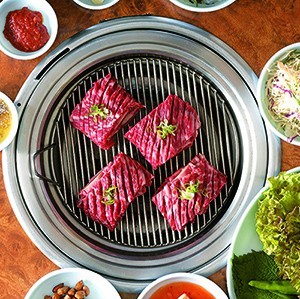
The flowering of grilled ribs in Suwon soon spread to other regions. In the 1950s and 1960s, Pocheon-gun, Gyeonggi-do, became a center for “idong galbi.” Initially, the main clientele was soldiers stationed in northern Gyeonggi-do. After most roads were paved in the 1970s, the improved driving conditions brought customers from all over the Seoul/Gyeonggi region. Busan’s “Haeundae galbi” is also famous. Having become a household name in the early 1960s, Haeundae galbi is seasoned and then grilled on a round grill rack. After the meat is grilled, the leftover sauce is mixed with rice to complete the meal.
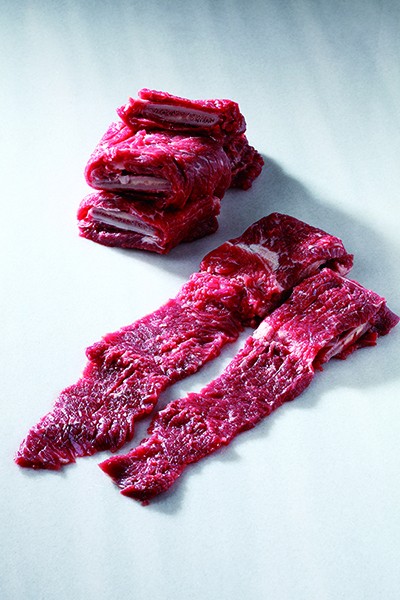
Perhaps the most widely-known version of galbi is “LA galbi,” which became popular in the 1990s. There are many theories about the etymology of LA galbi, which refers to the perpendicular slicing of a rack so that each piece has a row of small, elliptical bones at the top. Some say that the name comes from how Korean residents of Los Angeles cut and seasoned galbi, while others say that the name was intentionally based on an American city with a thriving Korean population to counter the notion that American beef is unsafe. The most convincing theory is that “LA” is the first two letters of “lateral,” the direction in which the rack is cut.
Regardless of the differences in the cutting direction or seasoning techniques, one thing that has stayed the same over the centuries is the fact that galbi is a universally-accepted high-end food. This indicates that the possibilities for galbi’s evolution in the coming years are endless.