


한식에 대한 다채로운 이야기를 전하는 온라인 매거진
Vol 60. The Joy of Grilling
The Harshness of Daily Life Embodied by the Agunggi and Buttumak
HANSIK at the Sayings
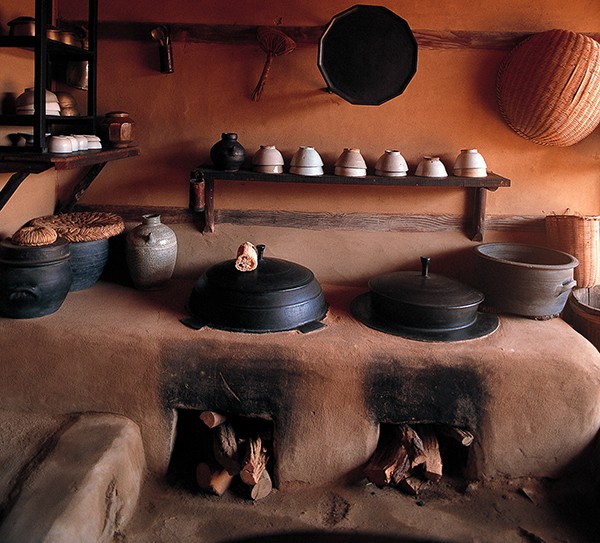
The buttumak and agunggi, although nowhere to be found in modern-day homes, were essential parts of the traditional Korean kitchen. This month, we collected sayings featuring them (which were plentiful!) that give us invaluable insights into daily life in pre-modern Korea.
Article Noh Yunyoung (Editorial Team) Source Encyclopedia of Korean Folk Culture, National Institute of Korean Language’s website
Necessities of cooking and heating: Agunggi and buttumak
The agunggi is, simply put, a hole that was dug to make it possible to light a fire in the kitchen or any other room of the home. The buttumak is a sort of kitchen work surface—a flat, raised structure placed over the agunggi and made with clay and stones to hang the cast-iron cauldron from. In pre-modern Korea, and until the kitchen became fully Westernized, cooking was done by lighting a fire in the agunggi. The agunggi was also a necessity for heating indoor areas. Firewood was stuffed into it to light a fire, which was then used to heat the gudeul (underfloor heating system) and, ultimately, the floor, via convection. In areas that did not require a kitchen (e.g. men’s quarters, servants’ quarters), there was sometimes only an agunggi and no buttumak. The buttumak, which simultaneously handles cooking and heating, is an element of Korean culture so unique that it is not found in even neighboring China or Japan.
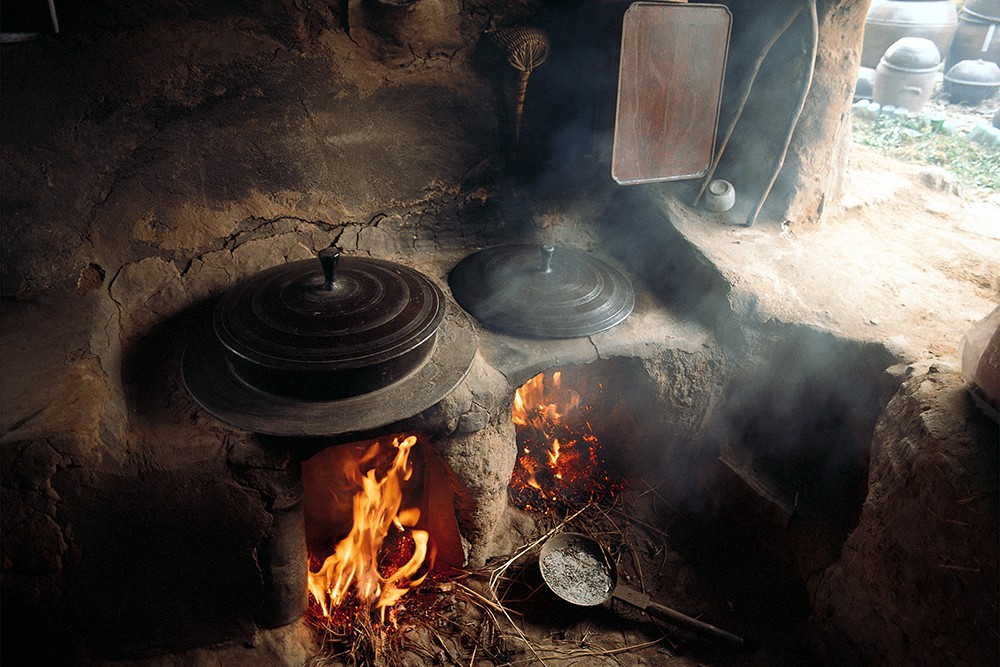
Agunggi and Buttumak
Sayings that reflect the realities of everyday life
Because the buttumak and agunggi were essential features of Koreans’ daily environment, there are many sayings that developed around them. The most famous is “no smoke from an unstoked chimney,” which refers to the fact that smoke will come out of a chimney if a fire is lit in the agunggi and, not surprisingly, means that everything happens for a reason. In “cooking rice with a gunbul,” gunbul is a fire lit in the agunggi not to cook with but solely to heat a room. Thus, the saying refers to a person taking advantage of an existing situation for personal gain. The similar “making rice with someone else’s gunbul” is also an admonishment of the desire to free-ride on others.
“A monk who is not skilled at chanting lights a fire in the agunggi” emphasizes the importance of doing work that best fits one’s disposition. In other words, it implies that a person can gain respect only by working according to one’s ability. “The agunggi eats the rice” refers to the fact that it was difficult to collect the massive amounts of wood needed to fuel an agunggi. It was thus not uncommon to sell rice to purchase wood—creating a vicious cycle that, logically, seems backward but was necessary to obtain firewood. This saying is a sad reminder of how difficult it was for commoners to make a living: to live, one had to eat, but to eat, one needed a fire in the agunggi with which to cook. “The kitchen is the first to know whether it is raining outside” refers to the fact that when it rains, atmospheric pressure decreases. This, compounded with the damp air, made it difficult to light a fire.
The most widely-used saying about the buttumak is “the buttumak must be managed well for grain to become commonplace,” a maxim that emphasizes the importance of being economical in order to make sure there is enough food for the family. Other sayings are mostly about the buttumak’s shape or role. “The quiet cat goes onto the buttumak first” refers to how a usually-complacent cat will jump onto the buttumak in search of food. The comparison is a metaphor for those who pretend to be virtuous but are often quick to act cunningly when necessary. “The bad dog goes on top of the buttumak” refers to a dog that has no interest in protecting the house from robbers but has no qualms about jumping up onto the buttumak with dirty feet, which is a metaphor for those who engage in unsavory activities while neglecting their responsibilities. “He who cannot wipe his nose worries about the neighbor’s buttumak” is a sarcastic reference to someone who is unable to handle his own affairs but is constantly interested in those of others.
As we have seen, sayings related to the buttumak are often critical or sarcastic/ironic in tone, including: “starving to death while sitting on the buttumak” (criticism of someone who has no means of supporting oneself while being extremely lazy) and “like placing a dog on a buttumak” (metaphor for someone who, like a dog running around haphazardly near a buttumak, knows no shame). “Daughter-in-law who does not know how to repair a buttumak spends all of her time plucking hairs from her forehead” and “daughter-in-law who cannot sew on a collar brushes her hair after spraying water on it” (deriding someone who is unable to perform everyday tasks and instead chooses to devote oneself to one’s appearance) reflect the hardships endured by women in a rigidly patriarchal society. Circumstances were especially harsh for a daughter-in-law, who was tasked with caring for not only her husband but also the elders of her husband’s family, in addition to cooking and cleaning, all while enduring her mother-in-law’s criticism.
For pre-modern Koreans, who did not have the modern conveniences available to us today, the agunggi and buttumak were tools needed simply to be able to cook meals and stay warm. Each day would have passed in a flurry of activity but, in the lulls between such activities, daughters-in-law would have spent some time staring blankly into the agunggi’s flames. Their day would have ended long after sunset, after everyone else in the family had gone to bed. Sayings featuring such aspects of the traditional Korean kitchen are, in a sense, a reminder that we living in the 21st century should be grateful for what we have.