


한식에 대한 다채로운 이야기를 전하는 온라인 매거진
Vol 59. Tteok, an Age-old Korean Delicacy
Tteok, a Companion of Daily Life and Social Interaction
Facts about HANSIK
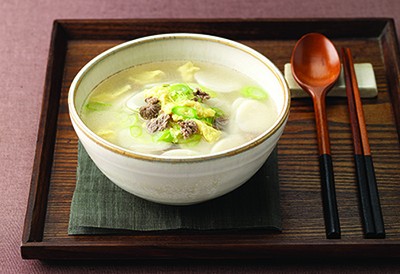
In Korea, rice cakes are just as much a part of daily life as the bowls of rice eaten at almost every meal. There is a different rice cake for births, marriages, aging, and death as well as the many holidays and seasonal divisions throughout the year. Another important element of rice cakes is sharing them with one’s neighbors. Rice cakes have, and will continue to be, a constant presence in Korean culinary culture.
Article Seo Dongchul (Editorial Team) Sources Cultural Heritage Administration, Doopedia, Encyclopedia of Korean Culture, K FOOD: Secrets of Korean Cuisine (Design House)
A gift for all special occasions
After Koreans began eating rice as their staple food, rice cakes became a delicacy that was reserved for special occasions. This reality is reflected in the countless Korean sayings related to rice cakes (e.g. “Gain rice cake while sleeping,” “How did we get this rice cake in the middle of the night?” “Making a display of kindness with someone else’s rice cake,” “Those who are fortunate fall into a rice cake bowl,” “One’s neighbor’s rice cake looks bigger than one’s own”).
In premodern Korea, rice cakes were served for important life markers or after having undergone hardship. After a baby survived to its 100th day, the celebratory meal included baekseolgi and patsusu gyeongdan. The former, which symbolizes purity and sacredness, represented hopes for the baby’s health and bright future, while the latter (whose red color was believed to dispel evil spirits) represented a blocking out of evil influences from the baby’s life. After the party, both rice cakes were shared with 100 families based on the belief that such sharing would contribute to the baby’s fortunes and longevity.
When the baby grew up and got married, the families of the bride and groom would eat what is called “bongchitteok” as an expression of congratulations and to pray for the new couple’s happiness. It is a two-layered rice cake made with glutinous rice, to symbolize marital harmony, and coated in red bean powder. Goimtteok, a multi-level rice cake that was stacked very high and used for ancestral rites and 60th birthday celebrations, embodies the value that was placed on filial piety (as the number of layers signifies the extent to which one wishes to honor the family’s elders).
Rice cakes were also, of course, served for every major seasonal division and holiday. The first day of the lunar year is when Koreans believe that they turn one year older, but only after having finished a bowl of tteokguk (sliced rice cake soup) made with garaetteok. On Jeongwol Daeboreum, the day of the year’s first full moon, rice steamed with jujubes, chestnuts, and pine nuts was eaten in hopes of keeping evil spirits away for the rest of the year.
In the fourth lunar month, which is in the Korean spring, people enjoyed the flowers by making white, round rice cakes and then grilling them after pressing a flower (usually, with all of its petals intact) onto it. On Dano Day, which is in the fifth lunar month, people ate surichwitteok, which was made by decorating a batter of rice and ground mugwort with a wheel-shaped stamp. Mugwort, which appears in the legend of Dangun (Korea’s mythological founding father), was believed to prevent misfortune. The use of a wheel-shaped stamp represented the hope for everything in life to go smoothly, like a rolling wheel. Songpyeon, the rice cake for Chuseok, was made as a sign of gratitude to one’s ancestors and the heavens for permitting a plentiful harvest of fruit and grain.
Fun customs related to rice cakes
Rice cakes were such a vital part of everyday culture that many customs were developed in relation to them. First, there was a practice, called “tteokjeom,” of using rice cakes for fortune telling. On Jeongwol Daeboreum, villagers would each bring rice to be ground. After making rice cakes, they would be steamed in one siru, with each family’s rice cakes placed on a sheet of paper labeled on the bottom with the family’s name. The state of the steamed rice cakes would be used to predict the family’s fortunes for the year: fully-cooked rice cakes were a sign that the year would go smoothly, with the opposite being true for rice cakes that were not fully cooked. Sometimes, those whose rice cakes did not cook fully would, to prevent misfortune from visiting them, refuse to eat the rice cakes or throw them out into the street. At Chuseok, women would use songpyeon in a similar way. Depending on the appearance of their songpyeon, unmarried women would predict whether their husband would be handsome or homely, while pregnant women would predict the appearance of their baby.
There was also a rice cake called ttongtteok, or “feces rice cake.” Before modern plumbing, toilets had very large holes that small children sometimes fell through. The story goes that, to prevent children from falling into the toilet, parents fed them ttongtteok. One hundred rice cakes would be made to appease the toilet spirit, after which the child who fell in would distribute them throughout the neighborhood. It was believed that the child must shout “Ttongtteok!” very loudly and share it with as many people as possible to repel the misfortune brought by the toilet spirit.
Even in the 21st century, customs related to rice cakes persist. It is still very common to distribute rice cakes (usually, baekseolgi or sirutteok) to one’s neighbors after moving to a new home or corporate address or to one’s coworkers after getting married.
In 2021, “Tteok Making” was designated as a National Intangible Cultural Heritage in recognition of the unique sociocultural practices related to rice cakes. Other reasons included the fact that rice cakes have been made and passed down throughout the Korean Peninsula for millennia, that documents from as early as the Three Kingdoms Period contain descriptions of how to make rice cakes, and that diverse players (research centers, manufacturers, private households, etc.) continue to preserve and pass down rice cake-related traditions. Rice cakes are a symbol of ancient Koreans’ community-mindedness and spirit of sharing as well as a medium for strengthening bonds among members of a community—making this age-old food still very much worth our attention.
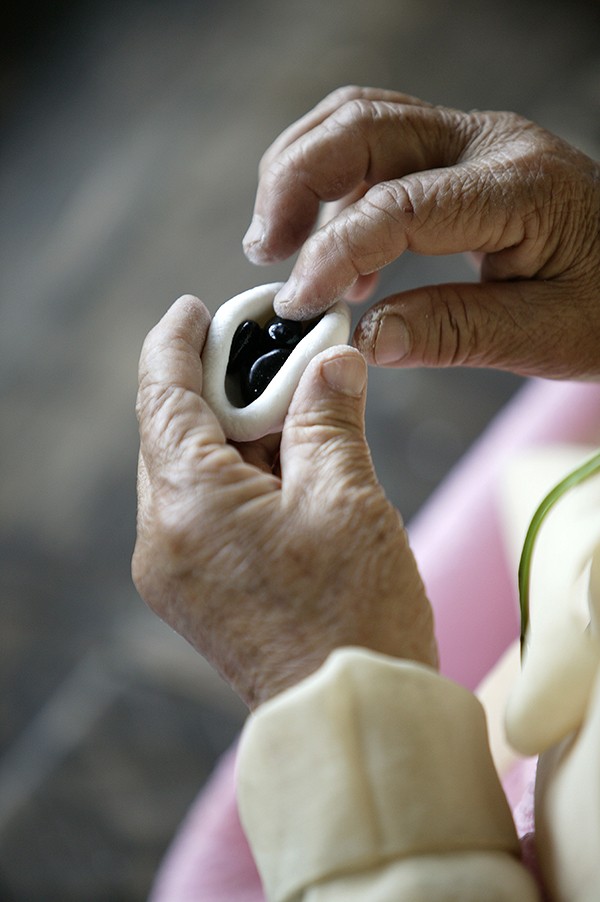
Making songpyeon in the head household of Ryu Seongryong (Confucian scholar and official of the Joseon dynasty) (C) Cultural Heritage Administration
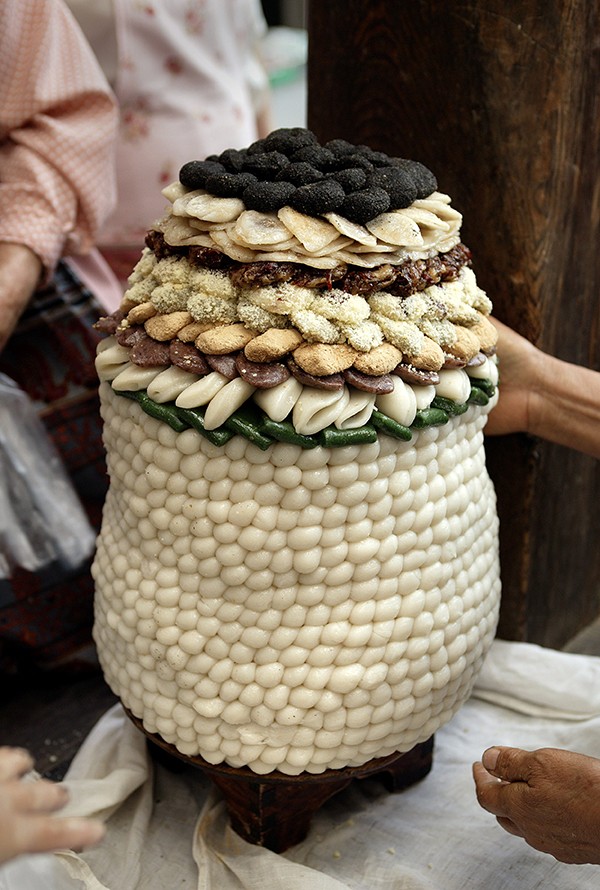
Goimtteok made by descendants of Kwon Beol (C) Cultural Heritage Administration