


한식에 대한 다채로운 이야기를 전하는 온라인 매거진
Vol 53. Korean Food from the Oceans and Rivers
Korean Food Made with Fresh Ingredients from the Ocean and Rivers
Water and HANSIK
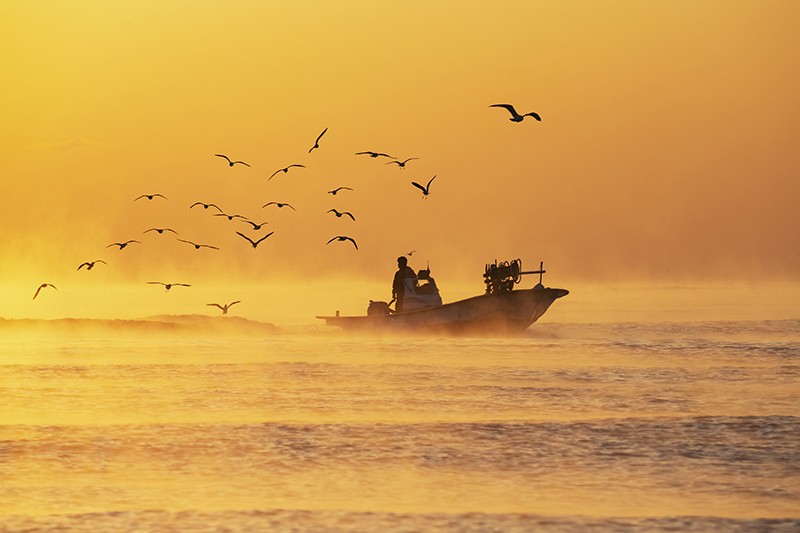
Throughout Korea’s history, water was granted the same degree of respect that is normally given, in other countries, to gods. Farming could be done only if it rained: the oceans and rivers, which sustained life by providing a wealth of seafood but could take life if they overflowed, were subjects of awe. Bodies of water were also worshipped as the “dragon god.” As such, Korea’s three coasts and many rivers were the source of life, backbone of the country’s two main industries—farming and fishing—and repositories of delicious, fascinating ingredients.
Article Seo Dongchul (Editorial Team) Sources Encyclopedia of Korean Culture, Encyclopedia of Korean Folk Culture
Water as an object and medium of religion
Generally, humankind created the first settled communities near rivers based on agriculture and industrial technology. This was how each of the four major civilizations—Mesopotamia (Tigris and Euphrates Rivers), Egypt (Nile River), India (Indus River), and Huang He (Huang He River)—got its start. The reason is simple: humans need water every day to drink, farm, and fish.
Ancient Koreans, who came to the Korean Peninsula from the northern regions of Asia, settled near river basins to farm the land or along the coast to fish. Because water was essential for both farming and fishing, it naturally became an object of worship. Until as recently as the 20th century, Korean women woke at dawn, set out a bowl of clean water (called “jeonghwasu” in Korean), and prayed in front of it while rubbing their hands in a circular motion. Clean water was thus, in and of itself, something that could be prayed to—a medium linking the gods with humans—and believed to have the power to chase away evil spirits. People also believed that sprinkling clean water three times with the fingertips could protect one’s family from misfortune and disease.
The act of sprinkling water in private was later expanded into a ritual act of protection for an entire village called “umulje,” “yongwangje,” or “yongwang meogigi,” which was usually practiced on Jeongwol Daeboreum (15th day of the lunar year). Umulje was a ritual held for the dragon god who lived in the village’s well. Food would be set out near the well, with prayers made for an abundance of water and crops, protection from evil spirits, and health and longevity. In coastal areas, this ritual was held for the dragon god of the sea to pray for plentiful catches.
The long history of fishing on the Korean Peninsula
The Korean Peninsula is blessed with many sources of water: namely, the ocean that surrounds it on three sides and the wide, deep rivers that crisscross it. The earliest settlers took full advantage of these fishing-conducive natural conditions, using the fish, shellfish, and marine plants they caught in streams and the ocean as their primary food source. Fishing, the history of which began on the Korean Peninsula almost as soon as the land was settled, dates as far back as the Paleolithic Age.
What we know about fishing after the Neolithic Age is gleaned from discarded clam shells and objects created with shellfish remains that have been excavated along the coasts. Such remains have revealed that early Koreans enjoyed many types of shellfish, most of which are still consumed today and the most common being oysters and large clams. The neolithic remains of ocean life that have been discovered thus far include snapper, spotted mackerel, codfish, skate, panther puffer, sea urchin, barnacles, whale, and seal. Remains from the Bronze Age are mostly of pollack, yellowtail, shark, plaice, and sweetfish, while those of the early Iron Age are of sea bream, bass, tuna, and codfish.
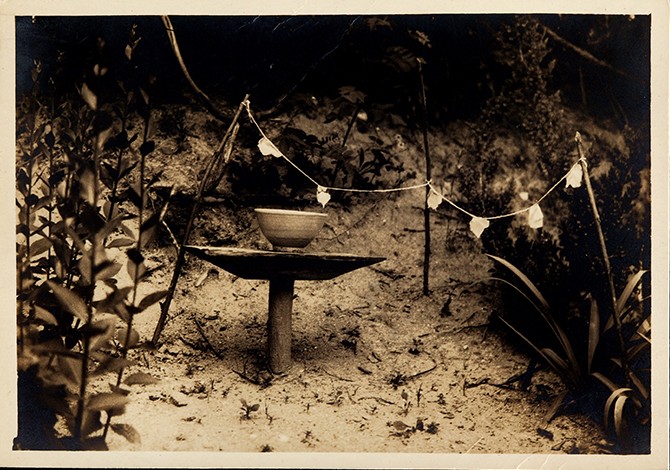
Jeonghwasu, or fresh water from well ⒸNational Folk Museum of Korea
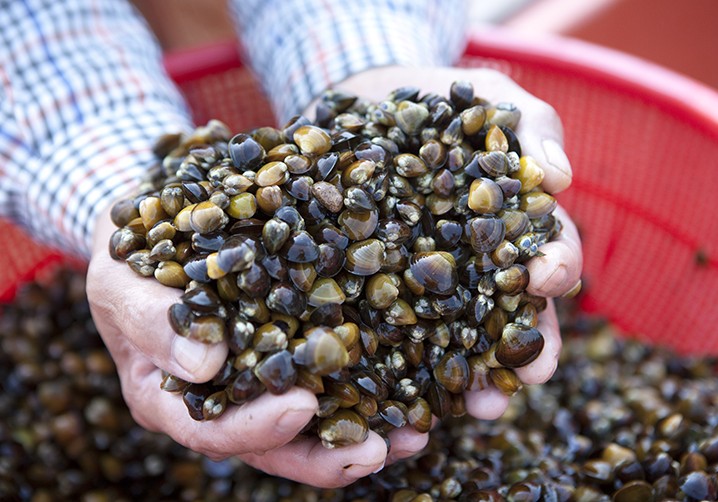
Marsh clams, called jaecheop in Korean
The lush diversity of the southern, eastern, and western coasts
Korea’s territory spans approximately 10 million hectares: ranked 100th in the world by size, it is 1/170th the size of the world’s largest country, Russia (approx. 1.7 billion hectares). This, however, does not detract in the slightest from the sheer range of Korean food ingredients. The waters of each of Korea’s three coasts provide delicious ingredients, year-round, based on their unique characteristics and environment.
The blue waters of Korea’s eastern coast are characterized by their mild ebb and flood tides, wide beaches, and absence of mudflats. Running from north to south, the coastline has little variation, and there are only two islands: Ulleungdo and Dokdo. The most commonly-caught types of fish are mackerel pike, yellowtail, spotted mackerel, mackerel, sardines, codfish, and sailfin sandfish, with squid and snow crab being famous as local specialties. Sokcho and Jumunjin host squid festivals: a popular way of cooking it in Gangwon-do is as squid sundae, which involves stuffing the body with a meat-and-vegetable filling. Every winter, counties such as Yeongdeok-gun and Uljin-gun are visited by foodies looking to eat snow crab.
Pollack used to be the most frequently-caught fish on the eastern coast: recently, catches have decreased significantly due to rising sea temperatures and the effect of warm currents. The deokjang, or places that have many racks for drying hwangtae (pollack), in Inje and Daegwallyeong, however, still see quite a bit of business. The fish (albeit, mostly from Russia), after having undergone several cycles of freezing and drying deep inside the mountains of Gwangwon-do, take on a quality that is on par with pollack caught in Korea’s own waters. Used in stews, braised, and season-grilled, hwangtae is popular for its chewiness and savory flavor.
The western coast is much more rugged (ria) and has shallow waters and swift currents. It is often called hwanghae (literally, “yellow sea”) because of the murkiness of the seawater. The most defining trait of the western coast is its well-developed mudflats. Mudflats are created when sediment sinks to the bottom in places where the sea is relatively wave-free and currents are mild. They are often referred to as “nature’s repository”: in Korea, mudflats are home to over 720 types of sea life. Indeed, merely picking away at the surface of a mudflat soon reveals clams, nakji (octopus), and many other types of seafood.
The western coast is also where many temperate species, such as croaker, horse mackerel, anchovies, halibut, mackerel, and snapper, spawn and grow, with the impact of the continental shelf making it the perfect habitat for many types of shellfish (e.g. clam, Asian hard clam, mussel, abalone, fan mussel, blood arkshell, manila clam, scallop). Nakji, jukkumi (webfoot octopus), blue crab, and jumbo shrimp are seasonal species that populate Korea’s western seas throughout the year. Every spring, Seocheon-gun hosts a jukkumi festival. In the fall, Hongseong and Taean host jumbo shrimp festivals. Nonsan and Ganggyeong are famous for their jeotgal (salted seafood) that is made with sea life caught on the western coast, such as shrimp, yellow corvina, and sand lance.
Like the western coast, Korea’s southern coastline is rugged. It accounts for over 60 percent of Korea’s islands and, due to the frequent warm currents, has a water temperature that is ideal for fishing. The center of Korea’s fishing industry, the southern seas are home to anchovies and cutlassfish. Anchovies, which are called myeolchi in Korean, are caught throughout the southern seas but are found in the largest quantities near Jinhae, a district of the city of Changwon. Mackerel, shark, snapper, halibut, yellow corvina, gray mullet, pufferfish, octopus, and squid are also commonly caught in this area.
In the southern coast, aquaculture (fish farms) focuses on shellfish (e.g. oyster, clam, mussel) and marine plants (e.g. laver, seaweed, kelp). Southern Korea is especially known for oysters and laver: oysters are cultivated largely in Tongyeong and other areas with clean waters (Geoje, Jinhae), while laver is grown primarily in Wando and Goheung.
Freshwater delicacies
In Korea, rivers are categorized into five basins: Hangang River, Nakdonggang River, Geumgang River, Seomjingang River, and Yeongsangang River. Each of them wind through different areas of the country, with the land along the rivers being nutrient-rich, which quickly resulted in villages being established on them. The rivers were also a reliable source of food with flavors and fragrances that were different from those of the ocean.
Crab (“chamge” in Korean), which make their home in estuaries, are either marinated in gejang (soy sauce marinated crab) or used in maeuntang (spicy fish stew). Daseulgi (marsh snail), called “olgaenggi” in the Chungcheong Provinces and “daesari” in the southernmost regions, adds a unique flavor to haejangguk (hangover soup), jeon, and sujebi (hand-pulled dough soup). Hwangbok (river puffer), which is caught mostly in the Hangang and Imjingang Rivers, is enjoyed as sashimi, in soup, or fried. While it has a poison that is over 10 times stronger than potassium cyanide and therefore must be cooked by a professional, the river puffer was reputably so delicious that the Chinese poet Su Shi described the taste as “worthy of exchanging one’s life for.”
Okcheon, Muju, and Geumsan, counties through which Geumgang River flows, are famous for dishes (noodles, seasoned and fried, etc.) made with finger-sized fish. The use of such small fish dates back to the region’s practice of river fishing: on a particularly hot day, after finishing the day’s farming, people would go to the river to catch fish. Seomjingang River teems with river oysters, marsh clams, and sweetfish that attract foodies and fishing enthusiasts throughout the year. River oyster grows in estuaries (where the river and ocean meet) in groups of three or four: the shape of these small groups of oysters was said to resemble a cherry blossom, leading to the nickname “beotgul” (beot means cherry blossom). It is a springtime delicacy that is the size of an adult’s palm and popular for not having an unpleasant fishy odor. Marsh clams, called jaecheop in Korean, contain taurine (which detoxifies the liver), making them a common ingredient of hangover soup. Sweetfish (euneo in Korean), which is in season in summer, was sent to the king as a local specialty. Its lack of fishy odor and mild taste makes sweetfish popular as sashimi or fried or grilled.