

한식에 대한 다채로운 이야기를 전하는 온라인 매거진
Vol 49. Namul, Food for People, Food That Spares
Curious about Korean Food? Let’s Take a Look at Korean Food with Bapdol
Korean Food Trivia Talk
How much do we know about Korean food? Let’s solve our curiosity about Korean food.
Reference.
① <Life History of Korea Read Through Food>(Yoon Deokno, Deep Tree)
② <Story of Namul From Mountains and Fields>(Kim Joohye, Yoo Jiwon, Hansalim)
③ <Noodle Road>(Lee Wookjung, Wisdom House)
④ <Korean History on the Table>(Joo Youngha, Humanist)
Q. In spring, we see various types of namul(wild greens) in the mountains. Can anyone collect namul?
You should not collect namul carelessly just because you find them because it could be a crime. The national park prohibits people from collecting namul without a permit. To collect wild greens, you must get a permit from the Korea Forest Service or the local government, and if you are caught stealing forest products without the consent of the owner, you will be punished by imprisonment for not more than five years or a fine not exceeding 50 million won in accordance with Article 73 of the [Creation and Management of Forest Resources Act]. Even if you have a permit, there are many wild plants and poisonous plants in the mountains that can be mistaken for wild greens, so you need to be careful when collecting them.
Q. What should we check to choose delicious namul, and how should we store them after purchase?
When choosing namul, make sure that its color is vivid, its leaves are not too large or harsh, it’s not soft or wilted, and it has a unique scent. When storing raw greens, wrap them in a kitchen towel, and with newspaper once more, and put them in a plastic bag to keep them fresh for about a week. If you want to keep it for a long time, blanch and freeze it in a container for the amount you want to use at one time without squeezing out the water. The reason for not squeezing the water is to freeze the excess water together so that its texture does not become tough later.
Q. The seasoning for namul is particularly difficult. Is there a simple seasoning recipe?
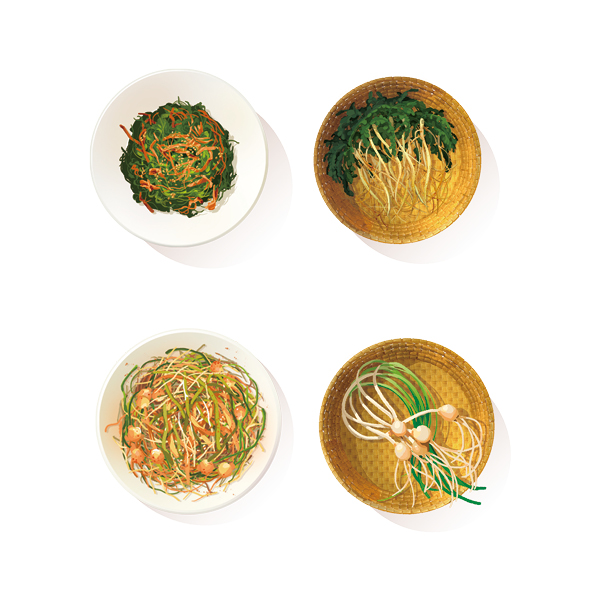
If you learn about four seasonings and mix them with namul, you can have delicious seasoned namul. Doenjang(soybean paste) seasoning is suitable for naenginamul(shepherd’s purse) and yuchaenamul(canola), gochujang(red chili paste) seasoning is suitable for bitter greens, such as dolnamul(stringy stonecrop) and sseumbagwi(ixeris dentata), aekjeot(fish sauce) seasoning is suitable for raw greens such as bomdong(fresh winter cabbage), chives, and chamnamul(short-fruit pimpinella), and ganjang(soy sauce) seasoning is suitable for spinach and chwinamul(aster leaf).
- Doenjang seasoning: 1 tbsp soybean paste, 1/2 tbsp grain syrup, 1 tbsp chopped garlic, 2 tbsp sesame oil
- Gochujang seasoning: 1 tbsp red chili paste, 2 tsp vinegar, 1 tsp sugar, 1 tsp red chili powder, 2 tsp chopped green onion, 1 tbsp chopped garlic, 1 tsp sesame oil, 1 tsp sesame seeds
- Aekjeot seasoning: 1 tbsp anchovy fish sauce, 1 tbsp red chili powder, 1 tsp chopped garlic, 1 tsp chopped green onion, 1 tbsp sesame salt, 1/2 tsp sugar, 2 tsp sesame oil
- Ganjang seasoning: 2 tbsp soy sauce, 1 tbsp chopped green onion, 1 tsp chopped garlic, 1 tsp sesame seeds, 1 tbsp perilla oil
Q. When did Korean people start eating noodles?
Scholars estimate that the first appearance of the word “myeon(麵: noodles)” in Korean records was during the Joseon Dynasty. In fact, myeon referring to noodles appear frequently in the literature of the Joseon Dynasty, and one of them is an example of making noodles with mung bean starch recorded in the early Joseon literature. According to the record, nokmalmuk(jellied starch) was rinsed in ice water, drained, rolled like a kalguksu(handmade chopped noodles) dough, and cut and eaten with omija soup or sesame soup. The noodles in omija soup were called “chakmyeon,” and the noodles in sesame soup were called “tojang nokdu hwana.” The detailed recipe for these dishes was recorded in <Eumsik Dimibang>, a Korean cookbook published in the 1670s. <Eumsik Dimibang> was a cookbook written by Lady Jang from the Andong clan, the wife of Lee Simyung, a famous Confucian scholar during the reign of King Hyeonjong. It is the first cookbook written by a woman, and is the first cookbook written in Korean. In <Eumsik Dimibang>, there is another noodle dish called “simyun,” which is made by placing mushy mung bean starch made by mixing with water in a holy gourd and dropping it into boiling water to form noodles.
Q. Noodles in anchovy broth are sometimes called “janchiguksu(banquet noodles),” and from a long time ago, noodles were eaten on feast days such as weddings. Why did noodles become a banquet dish?
In the Joseon Dynasty, wheat was a precious food ingredient that was called jingaru(眞末), meaning real powder. Thus, on special occasions such as one’s 60th birthday or the first birthday party, people ate wheat noodles and prayed for longevity. Now that noodles have become so common, such dishes are rarely served on feast days, and there is a misconception that noodles were prepared for feast days because they are cheap and easy to prepare. However, in the days when flour was scarce, janchiguksu was the most valuable and the best dish than any other food, so it was served as a treat for guests who came to celebrate the feast day.
Q. There are few countries that eat noodles cold like naengmyeon. When did Korea start eating naengmyeon?
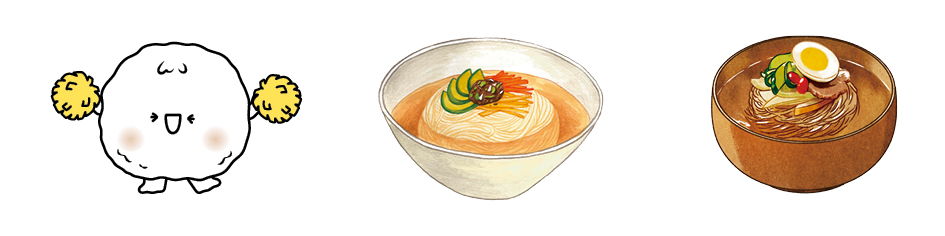
Finding the origin of naengmyeon(cold buckwheat noodles) is not easy. Naengmyeon(冷麪), literally meaning cold noodles, appears in the literature in the early 17th century, <Gyegokjip> by Jang Yu, a writer during the reign of King Injo. It is a poem while eating naengmyeon, and the poet described the flavor while eating naengmyeon in purple broth as a unique taste. Going back further, you can find a dish called naengdo(冷淘). At the end of the Goryeo Dynasty, Yi Saek, who went by the pen name Mogeun, recited a poem that said eating naengdo made him cool. However, naengdo was a cold wheat noodle dish or a type of chansujebi(cold hand-pulled dough soup) dish eaten in China, so it is very different from our naengmyun. It is after the 18th century that the record of naengmyeon as it is now appeared in earnest. Dasan Jeong Yak-yong said that he ate long naengmyeon and seungjeo, a type of kimchi. A Silhak(realist school) scholar, Yu Deuk-gong, who lived in the same era as Jeong Yak-yong, also traveled to Pyongyang, and said that the price of naengmyeon in Pyongyang went up in the fall, which tells us that the people of Pyongyang ate plenty of naengmyun.
Q. Why is naengmyeon called a winter food?
The custom of eating naengmyeon in the winter was very familiar to the people of Pyeongan-do and Hwanghae-do in the late Joseon Dynasty. The people in Pyeongan-do and northern Hwanghae-do enjoyed naengmyeon as a seasonal food in November of the lunar calendar. Ice was needed to make cold noodles like naengmyeon, but in the winter, the dongchimi(radish water kimchi) juice froze, so no separate ice was needed. However, with the introduction of modern ice-making technology in the 1910s, people began to enjoy naengmyeon as a summer food, and now, naengmyeon has become a seasonal food eaten not only in the winter and in the summer, but also in the spring and in the autumn.