

한식에 대한 다채로운 이야기를 전하는 온라인 매거진
Vol 45. Gukbap, the Epitome of
Origin and History of Gukbap as seen in the humanities
New Discovery of Korean Food
In the season when the cold wind blows like these days, I often think of a bowl of hot gukbap.
When did the Koreans start to enjoy eating this gukbap, a true friend of the ordinary people that fills the stomach at a good price?
Article. Jung Younhye(History Columnist)
Searching for the Record of Gukbap
Gukbap is a dish served with rice in the soup, and it was called tangban(湯飯), gukmali, and janggukbap. The traditional Korean table setting is based on gaengban(羹飯), which refers to soup and rice.
Moreover, guk was also called tang(湯), depending on the ingredients it is made from. Gaeng refers to a dish made by boiling vegetables and meat together, and seasoning with soy sauce, while tang refers to tangguk made by boiling fish and meat over high heat. Gukbap was a dish made by putting the rice in the gaeng, which was usually eaten separately, for convenient consumption.
The first mention of gukbap in Korean literature is in <Seungjeongwon Ilgi(Journal of the Royal Secretariat)>. If we look at Seungjeongwon Ilgi during the reign of King Sukjong, there is content where a uinyeo(female physician) recommended rice porridge, tangban, yeomju, etc., to King Sukjong. There is also a record that since King Yeongjo didn't like gukbap when he was unwell, he only ate the rice in water. However, at this time, gukbap was not a common dish. In fact, it was rarely served in the yangban(noble) household. Lee Ik, a Silhak(realist) scholar during the reign of King Yeongjo, said in <Seonghoseseol> that gukbap was the best dish to fill one’s stomach, but it was also the food of the common people.
Gukbap Favored by Common People
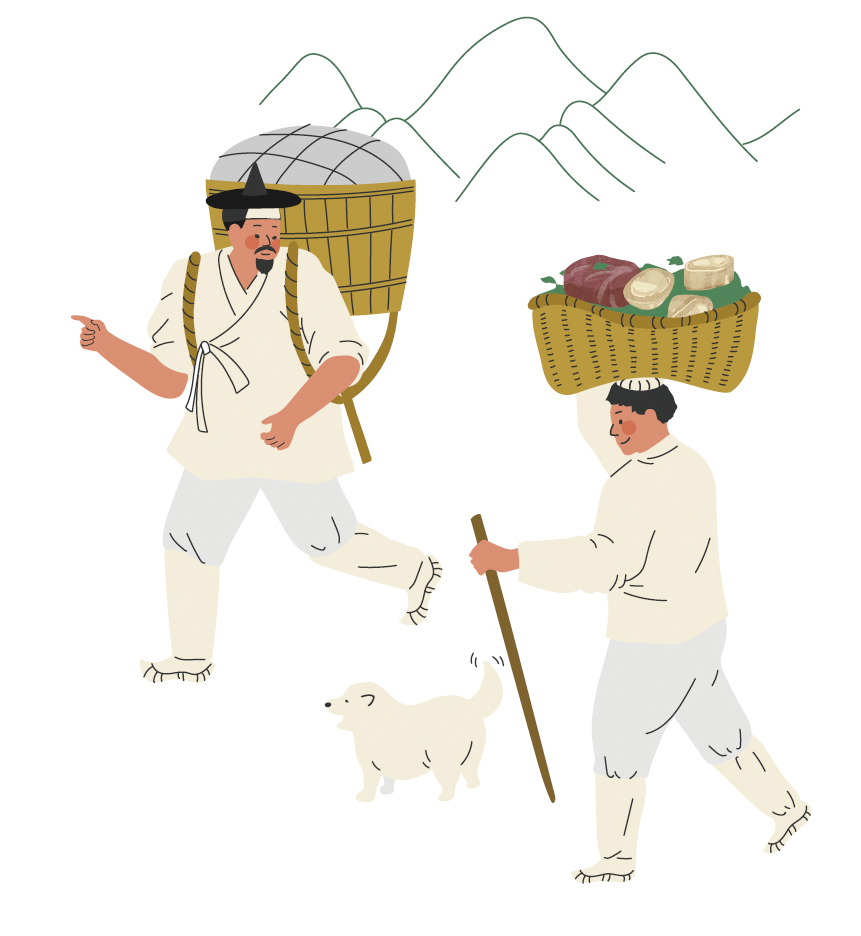 In the late Joseon Dynasty, gukbap became common. After the Imjin War(Japanese Invasion of Joseon) and Byeongja Horan(Qing Invasion of Joseon), Joseon's productivity increased significantly, and markets and inns developed nationwide. After the 18th century, when the trade with the Qing dynasty became active, the five-day markets, which opened every five days, opened nationwide. According to <Mangiyoram>, which was published to verify the national finances in the 19th century, there were 1,061 five-day markets across the country.
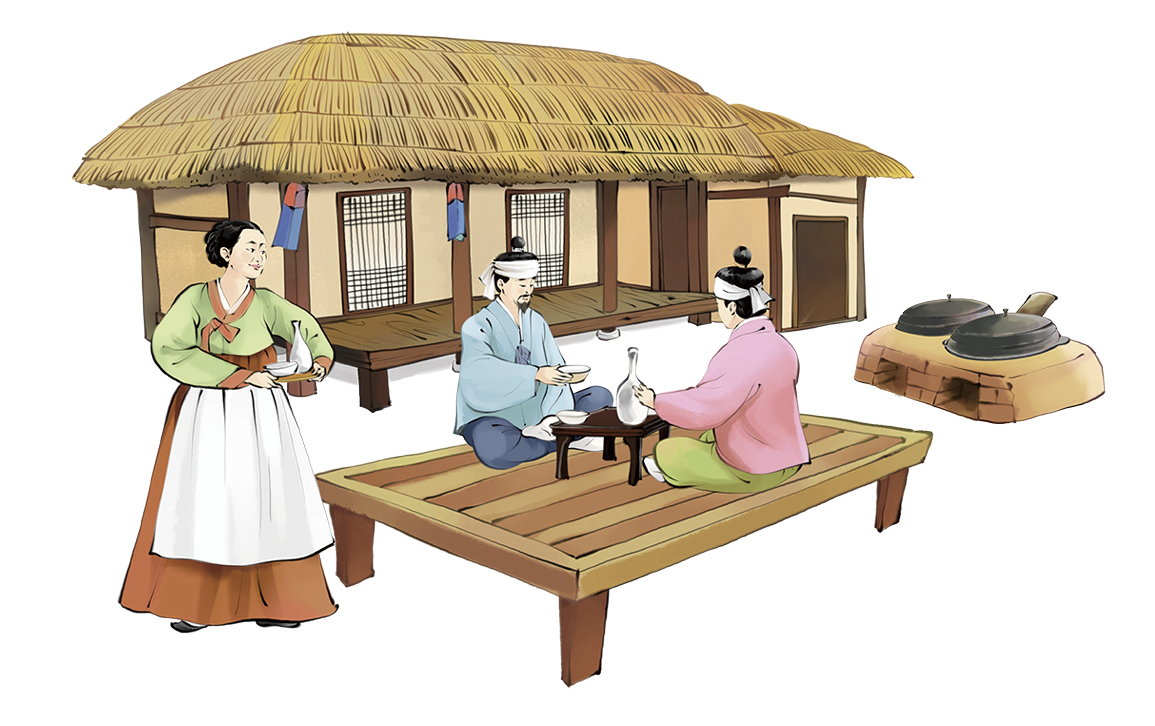
At the same time, the number of peddlers also increased significantly. Peddlers sold goods by going around the markets that opened on different dates every five days. In Lee Hyo-seok's short story <When Buckwheat Flowers Bloom>, the lives of these peddlers are depicted well. At the time, gaekju, or tavern, played the role of an intermediary, connecting the goods sold by the peddlers. At the same time, these taverns took over the functions of an inn and a restaurant. As taverns were built along the roadside where peddlers came and went, a tavern village was naturally formed, selling gukbap and liquor. This is the reason why gukbap is called janggukbap, that is, gukbap sold in jangsi(market).
If you look at Kim Hong-do(金弘道)’s genre painting <Jumak 酒幕(Tavern)>, you can take a closer look at the state of the tavern during this period. In the painting, jumo(barmaid) is sitting near a furnace selling gukbap and liquor. A man who is opening his drawstring pouch to pay for his meal to the jumo has a long pipe in his mouth and a bundle on his back. This is the typical form of a peddler with a bundle. Like this, gukbap became commercialized and was catered for in earnest through markets and taverns.
Then, around the 19th century, tangbanga specializing in only tangban(rice in soup) appeared. In Seoul, where markets were established in a large scale, there were gukbap stores lining up across Supyodari Bridge and Baekmokdari Bridge. The stores on the Supyodari were frequented by government officials and noble men, and the ones on the Baekmokdari were visited by rich merchants and loafers. Among them, Mugyo Tangban in Mugyo-dong and Janggukbak in Anseong, Gyeonggi
-do were the most famous. A seolleongtang place in front of a government office in Chungju was also known to be famous nationwide.
The Types of Gukbap That Our Ancestors Ate
 What types of gukbap were eaten at the time? <Gyugon Yoram(Yonsei University edition)>, which was published around the 18th century, described the gukbap recipe for the first time in Korean literature. It states that it is made by placing oily meat stewed in a sauce over the rice. The cookbook published in the late 19th century, <Siuijeonseo> states a more detailed recipe.
“Cook the rice by rinsing good white rice, and make the soup by adding the radish and vegetable greens. Mix in the rice in the soup, top it with the seasoned vegetables and yaksanjeok, and season with pepper and red chili powder.”
If you look at these two recipes, you can see that the meat is included in both dishes. In fact, it is said that at “Yangbo Jangguk Bapjip” owned by Yang Bo during the Gabo Reform, the broth was made with brisket only.
The meat was mainly used as an ingredient for gukbap because the Joseon Dynasty emphasized rituals through ancestral rites. At the ancestral rites, there were always meat dishes that were made by using sacrificial animals
(犧牲獸). And the main sacrificial animals used in Joseon were pigs and cattle. For this reason, it was easy to get the meat for ancestral rites as well as the meat by-products, such as intestines and ox head, so the meat-eating culture developed naturally. Thus, among the soups flavored with various ingredients in Joseon, the meat-based soup was rated most highly. Gomtang, a type of soup made with meat, was called daegaeng(大羹) or taegaeng(太羹). It meant the best soup. The soup made with vegetable greens was called hyeonggaeng(鉶羹), and it was considered inferior in taste compared to daegaeng. It was precisely because of the Joseon food cultur e in which meat was mainly used as an ingredient for soup.
In addition to brisket, the Joseon people used ribs, cartilages, ox feet, ox head, ox tail, tripe, and skin, and they became galbitang(short rib soup), ujoktang(ox feet soup), seolleongtang, kkorigomtang(oxtail soup), gomtang, etc. <Joseon Manhwa>, published in 1909, described tangbanga well with a detailed illustration of ox heads placed in front of a gukbap store.
“The soup is made by slowly boiling the ox heads, bones, skins, and feet, and it is then poured into a small separate pot, seasoned with soy sauce, and topped with red chili powder before serving.”
Even in the records left by the Japanese at the time, it is easy to find the contents praising the taste and the nutrition of the soup. Through these records, we can see that gukbap was a popular and readily available dish for common people at the time.
Gukbap Culture in Daily Life
In the late 1920s, there were even stores that delivered gukbap. In the 1930s, there was a fistfight between a delivery man and a customer. At the time, the seolleongtang deliveryman said that there were 300 seolleongtang deliverymen in Gyeongseong. We do not know for sure whether the number is true, but we can see that there were many seolleongtang deliverymen in Seoul. Also, in the magazine <Byeolgeongon> at the time, there was an article that discussed those days when couples got up late, and ate seolleongtang that was delivered rather than cooked at home. This is a historical record of the gukbap, represented by seolleongtang, as a popular delivery food at the time.
However, gukbap stores at the time still hovered in the vicinity of markets rather than entering into the city center. This is the reason people had it delivered, instead of going to gukbap stores themselves.
Due to the modernization and mechanization of slaughterhouses in the 1960s and 1970s, these gukbap stores entered the city center. Gukbap became a more popular dish with the increase in meat consumption and the activation of meat distribution. As a result, stores could enter the city away from the markets. Since then, gukbap developed with small differences in each region. Consequently, gomtang, seolleongtang, seonjigukbap(ox blood rice soup), and someorigukbap mainly developed in Seoul and in the Gyeongin region, dwaejigukbap in the Gyeongsang-do region, and kongnamulgukbap in the Jeolla-do region, exhibiting regional characteristics.
Likewise, gukbap, which developed along with the history of Korea, has established itself as a representative food for dining out, and being the food of the common people, due to its abundant nutrition and low price, which has not changed even today.