


한식에 대한 다채로운 이야기를 전하는 온라인 매거진
Vol 43. Harmony The Flavor and Beauty of Hansik
Store-bought Holiday Food is Trending
Today’s Generation Today’s Holidays
Holidays are days for feasting. The joy of having bountiful fruits filled the hands that prepared for a Chuseok feast, and extended to the footsteps of people who were heading to their hometowns. However, times have changed, and the holiday mood also changed. The changes triggered by COVID-19 are also significant. Still, it doesn’t mean that the meaning of Chuseok, which is about people sharing their hearts, has changed.
 New Cultural Landscape of the Holidays
The cultural landscape of Korean holidays, including Chuseok, has changed over time. With the changes in the times and the generations, the thoughts on the meaning and the culture of holidays have changed, thus creating “the new cultural landscape of holidays.”
Images of people taking a trip instead of visiting their hometown or taking a break on their own have become common news during the holidays. The terms “honchujok(people spending Chuseok alone)” and “homechujok(people spending Chuseok at home),” which means people spending Chuseok alone without going to one’s hometown, also appeared in the news as new cultural trends during the holidays.
The “D-turn group,” who visit their hometown, parents, and relatives, and then stop by a travel destination or resort during the holidays to relax, are associated with the way millennials spend their holidays.
Thus, the culture of all relatives gathering together on holidays, such as Chuseok, gradually decreased, and spending the holidays with immediate family members became more common.
However, after the outbreak of COVID-19, it has become difficult to celebrate holidays with immediate family members. The implementation of quarantine rules for the holidays to prevent the spread of infectious diseases, such as refraining from visiting one’s hometowns and relatives and non-face-to-face visits to one’s ancestral graves or performing ancestral rites, led many people to give up on plans to return home for the holidays. Non-contact holidays, such as celebrating holidays at home, sending one’s best wishes via video, and performing ancestral rites online, have shaped the new cultural landscapes that we encountered in the midst of COVID-19.
New Trend of Holiday Food
Following the change in holiday culture, the holiday food culture also changed. With the change in the times and the generations, the custom of making holiday food changed significantly. The culture of making and sharing bountiful food after spending days preparing them to the point that people start to suffer from “holiday syndrome” has gradually been minimized and simplified.
With the reduction in quantity and types of food, it became natural to buy ready-made holiday food from large-scale distributors, such as traditional markets, department stores, or large supermarkets, and preparing them as convenient meal dishes. More people are relying on agencies that make and deliver such dishes to celebrate ancestral rites and holidays.
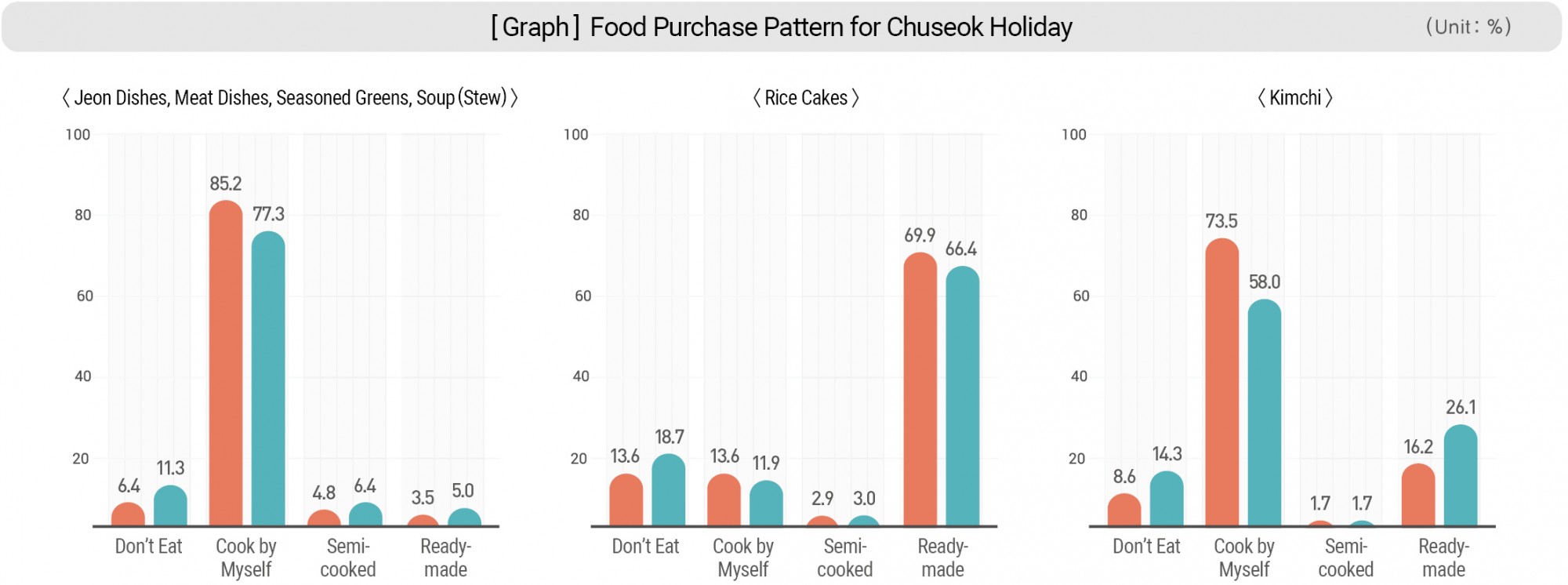
In September last year, the Rural Development Administration announced the results of its analysis on agri-food items that people intend to purchase, where the items were purchased, and expected expenditure to verify the purchasing patterns of agri-food for Chuseok. It stated, “The overall trend is more consumers purchase semi-cooked or ready-made food rather than cooking the dishes themselves.” The response rate toward making kimchi, jeon, namul, and guk(or tang), with the exception of rice cakes, was still high, but the ratio has decreased. <See the graph>
In 2016, a news report cited the presentation material released by a distributor: Compared to the same period in 2015, the sales of frying powder and pancake powder decreased by 25% and 30%, respectively, two weeks before Chuseok, while the sales of refrigerated and frozen processed foods, including dumplings, meat fritters, and meatballs, and deep-fried food increased by a whopping 37%.
Convenience store holiday lunch boxes, which consist of holiday foods, such as japchae, jeon, and braised ribs, are consistently loved by people who spend the Chuseok holidays alone. These small, packaged holiday food products, which can be easily enjoyed by one or two people, have also become a trend, and are continuously released one after another. According to the data released by a convenient store company early this year, the sales of such packaged lunch boxed during the holidays(New Year’s + Chuseok) in 2020 has increased by 35.0%, proving that the convenient food product released during the holiday season remained popular.
With an increasing number of people who choose to stay home during Chuseok, instead of visiting their hometown, the preference for store-bought holiday food became more natural. When the number of honchujok and homechujok who buy ready-made and semi-cooked holiday food products in small portions increased, and the number of people visiting their hometown or relatives decreased, the number of people who choose to buy only the necessary amount of holiday food, rather than making them on their own, also increased.
Deeper Sharing of Hearts
“Mass migration of holiday food”
It is said that many people sent and received food by courier during the last New Year’s holidays because they opted to send food to family members who couldn’t come home via courier.
After the outbreak of COVID-19, it has become a trend to express gratitude to parents and acquaintances in a non-face-to-face manner during the holidays. The number of people sending gifts to express their wistfulness and regrets for not being able to visit in person has also increased.
Chuseok is the most prosperous season of the year, and is a day to share the joy and excitement of harvesting bountiful fruits. Since the COVID-19 pandemic, the distance between people might have increased, but the meaning of Chuseok, which is about sharing, has deepened. This is another new trend that we experienced in the midst of COVID-19.