


한식에 대한 다채로운 이야기를 전하는 온라인 매거진
Vol 39. Jang
Jang(Korean Sauces) Becomes a Family Tradition
“Make a Good Sauce and Relieve One Year of Worries”
It is estimated that it was during the “Period of the Three States” when our country started to eat jang (sauce). The pieces of evidence point to the record of “Goguryeo people make a fermented food called sunjangyang well,” as stated in Goguryeojo of 《Dong-i Jeon in the History of Three States》 and the Goguryeo Anak Tomb No. 3 Ancient Mural Paintings (4th century), depicting a water jar that appeared to contain fermented food and a long wooden pail for dish-washing laid around a well. It is not without the opinion that the starting point began before this. Our country’s “jang,” which boasts of such a long history, became our way of life.
Reference. 「The Intangible Cultural Heritage Value of Soybean Paste Culture in Northeast Asia and Korean Traditional
Jang (Sauce) Culture」, Yoon Deokin, Emeritus Professor, Catholic Kwandong University
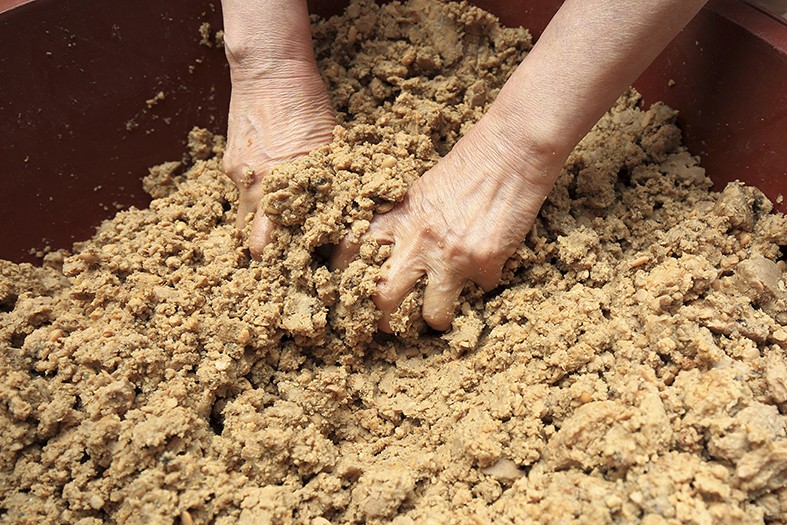
The first record of the Korean sauce can be found in 《The Chronicles of the Three States》. When King Sinmoon of Silla took Kim Hoonwoon’s daughter as a wife, he received basic food, such as rice (米), liquor (酒), oil (油), honey (密), dried fish (脯), and salted seafood (醢), as well as jang (醬) and meju (fermented soybean lump) (䜴) as the pyebaek (formal greetings to the groom’s family) items. This is a passage that can fully estimate how much “jang” was prized.
Making Jang, Extending Courtesy
“Jang is for seasoning and producing tastes by putting in various dishes. Thus, it comes first among all food, and is regarded as the priority in housekeeping because it is made with devotion. It must be made in the right season.”
- From 《Joseon Moosang Sinsik Yori Jebeop》 –
The making of jang was a major event in a house, together with kimchi. Since the taste of jang (korean sauce) was directly related to the taste of the food in the house, the act of making jang was very sacred.
People observed the proprieties, such as “Avoid wrongful things three days before making jang. A housewife who makes jang must be prudent in her conduct by refraining from going out, and meeting a misfortune four days before making jang. She must not scold dogs.
She must perform a purification on the day of making jang. She must cover her mouth with hanji (Korean traditional paper) to avoid emanating the yin energy (陰氣). Also, a few days after making jang, the makers must not go home, and it was prohibited for women who gave birth to go near the jang and the jangdokdae (a platform where the crocks of sauces and condiments are placed) or the jangdok (crock) in the house. They devoted themselves to making jang.
The Taste of Jang Continues. The Family Tradition is Passed on.
Korea’s jang culture developed around the family. This is a part that is in contrast to our traditional culture, which is characterized by a strong community culture. The taste of the food in the house was the house’s family custom, so the jang flavor, which determined the flavor of the house’s food, was strictly the domain of the family. This is the reason the main gate was carefully locked when making jang.
Even proverbs, such as “Jang is given to relatives but not to daughters,” fully contains the family-oriented jang culture.
This became the basis of the seeganjang (seed soy sauce) culture, which is Korea’s authentic jang culture. The seeganjang culture became the basis for the individuality and diversity of the Korean jang flavor. Professor Bae Youngdong of the Department of Folklore at Andong National University explained, “People thought that when a mother-in-law passed down the secret of making doenjang (soybean paste) well, the family tradition continued, and one’s family flourished,” in a report titled, “The Literary Tradition and Meaning of doenjang (soybean paste), the Oldest Food of the Korean People.”
It was the will and devotion of the people who wanted
to protect the taste of their jang as well as their family’s fortunes
The Jang Flavor is Good. The Family is Auspicious.
In <The Chronicles of the Three States> “Kim Yusin Jo,” there is an anecdote that goes, “A general stopped his horse about 50 steps from his house, and ordered his valet to fetch water (漿水) from his house. After he drank the water, he said that the taste of water from his home has not changed and left without stopping by.” The water (漿水) here is interpreted as a water mixed with ganjang (soy sauce). The taste of jang, which symbolizes the family and its custom, was a means to predict the fortunes of one’s family. This is why there are many proverbs related to jang containing the fortune of one’s family, such as “The jang of a talkative household has a bitter taste. A prosperous house has jang with a sweet taste. If the taste of the jang changes, a terrible thing will happen in the house.”
Such understanding soon led to the care for keeping and managing the taste of the family’s jang. This is equivalent to the meaning that the taste of jang is perfected with nature, time, and especially with people’s devotion.
Maintaining the Taste of Jang. Jangdokdae Becomes Sacred.
At the beginning of the lunar calendar, the Jishin stepping that suppresses the spirit of the earth and prays for the well-being and good harvest of the village was performed. Its sixth performance was “Jangdok Jishin Poori (shamanistic performance of stepping on the platform for sauce crocks).”
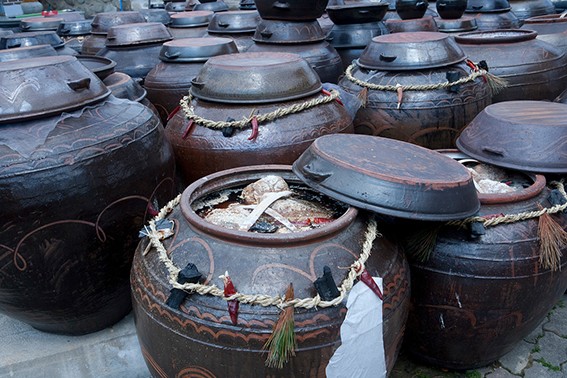
The desire for the good taste of jang was directly connected to the importance of managing jangdok (crock) and jangdokdae (platform for sauce crocks), which were regarded as sacred domains, or a sanctuary, beyond the power of human hands. This was shown in the form of faith in the god who governs jangdokdae, and the act of making a wish by placing a bowl of purified water on jangdokdae and bowing to it may have originated from this belief. Shamanistic acts were also performed to dispel anything sinister, such as sticking a paper sock pattern upside down and tying up braided red chilis and pine twigs in a straw rope to the jangdok.
Of course, this cannot be dismissed as an act of shamanism. It was the will and devotion of the people who wanted to protect the taste of their jang as well as their family’s fortunes.
Saving the People. Saving the Food.
The taste of the jang was a matter of the family’s devotion, but jang, which was rich in nutrients, such as protein, also took an important position in terms of national food security. There is a record in Goryeosa (The History of Goryeo) (1451) on the use of jang as an emergency food to address people’s hunger.
In the Choi Seungro Jo of Goryeosa, there are records that, in the 9th year of King Heonjong’s reign (1018), salt and jang were distributed to the people who were suffering from cold and hunger due to the invasion of Khitans. Then, in the 6th year of Munjong’s reign (1052), rice and water chestnut were distributed to 30,000 people in Gaegyeong.
For our ancestors, who overcame famine with herbs, vegetables, and bark, jang was “medicine.” 《Guhwang-Chalyo》, which describes how to cope with famine, recommends that you always make jang during famine, and those who are experiencing famine should mix jang juice in water and drink it, and eat cool porridge. The importance of making jang during the famine is also described in 《Jeungbo sallim gyeongje》 (1766). However, there was a difference in making guhwangjang (jang for emergency food) from traditional single soybean paste.
Moreover, as a seasoning, jang played a very important role in securing food. Kwon Daeyoung, the author of <Humanities in Korean Food>, explains in his book, “Korean fermentation technology was a way to overcome the problem of eating grass or grains that are difficult to eat deliciously, and food shortage during the hot summer and the cold winter.”