


한식에 대한 다채로운 이야기를 전하는 온라인 매거진
Educating on culture and restoring the soul through food: Chefs Kim Hee-eun and Yoon Dae-hyun
Protectors of flavor
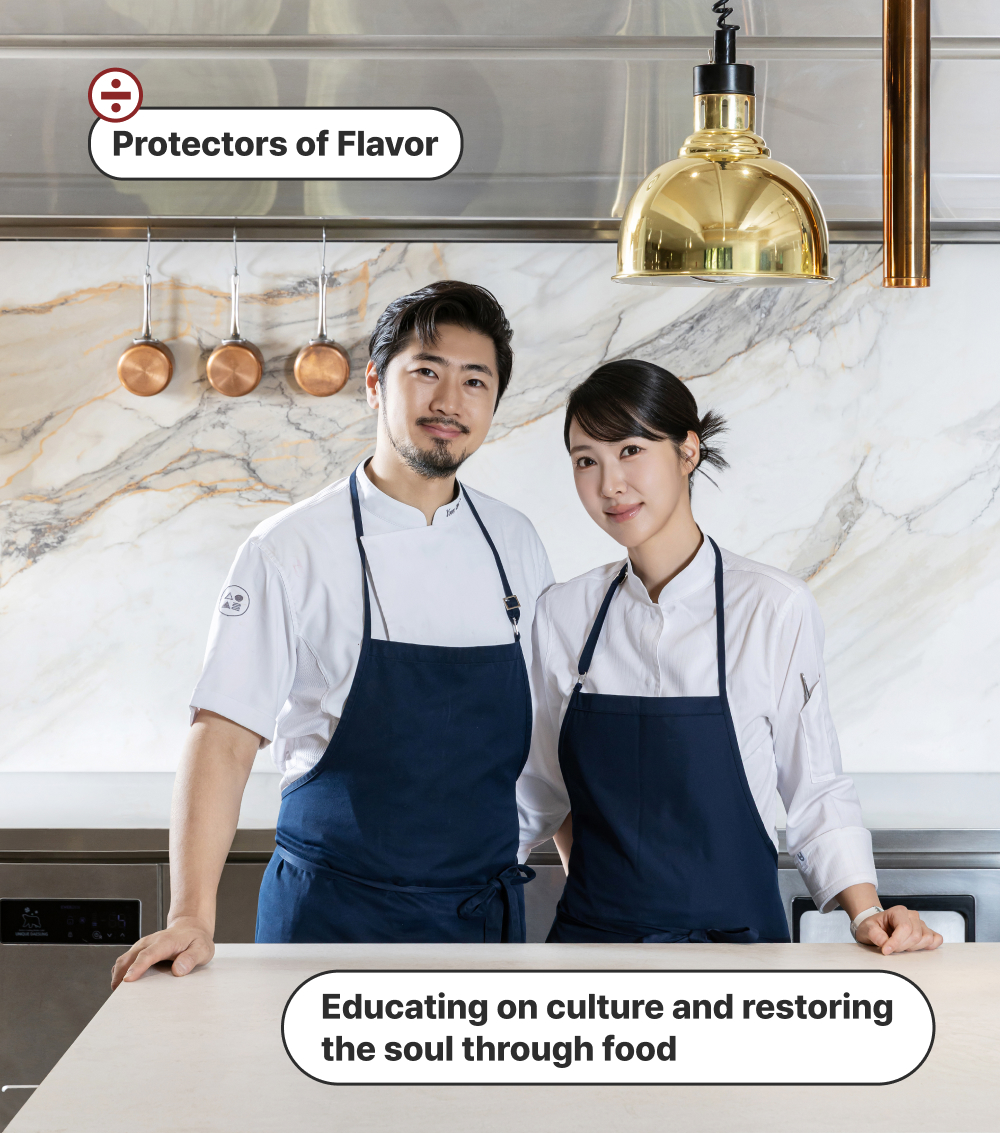
Educating on culture and restoring the soul through food: Chefs Kim Hee-eun and Yoon Dae-hyun
In Korea, the act of sharing a meal represents much more than eating. Sharing food is more like a language of kindness, a physical expression of the desire to stay informed about one another’s welfare. A restaurant operated by the husband-and-wife chef duo Yoon Dae-hyun and Kim Hee-eun, who were trained in Western and Korean cuisine, respectively, Soul visualizes such spirit of sharing in each of its exquisitely crafted dishes. Kim and Yoon are adept at not only preserving an ingredient’s natural flavors but also forging connections between food and people through Soul’s unique bar area. For this issue of Hansik Magazine, we sat down with the couple to hear about the richness of fermented flavors, what it really takes to serve a miyeokguk (seaweed soup) spread, and the waves they are making in the world of Korean fine dining.

Q. Please introduce yourselves and briefly tell us what you hope to convey to the world through your cooking.
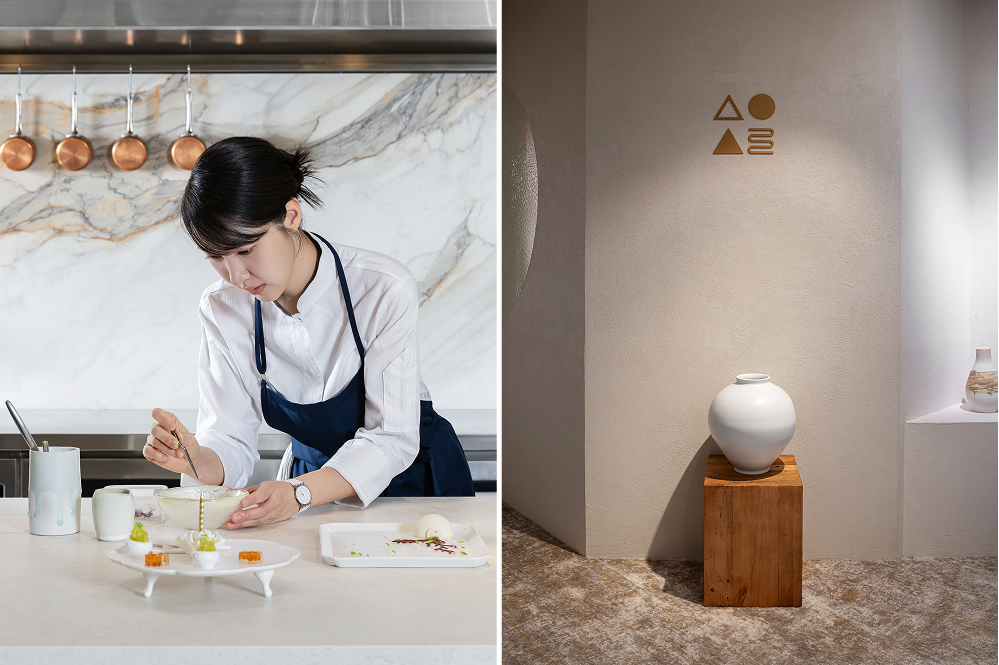
Chef Yoon Dae-hyun: Hee-eun and I are builders of a language: a language of food that is inspired largely by Korea’s culinary culture. As you may have guessed from the name of our restaurant, we want Soul to embody our mission of restoring the mind and spirit through food. Each plate is a work of art that achieves a harmony of seasonal ingredients from field, mountain, and ocean. It is also very important to us that we present Korean cuisine as a cultural element.
Q. How did you become interested in pursuing Korean food professionally?
Chef Kim Hee-eun: I thought a lot about one question: if I am going to cook for a living for the rest of my life, what is the food that I will be able to understand best? My early exposure to Korean cuisine made preparing the food feel so routine to me that I never dreamed it would form the foundation of a career. My grandmother’s kitchen was a playground: it was where I saw firsthand how to brew traditional Korean liquors and make fermented pastes. I spent some time studying pottery and painting in my teens but ended up coming back to Korean food. I think the pull that brought me back to my childhood experiences is woven into my DNA!
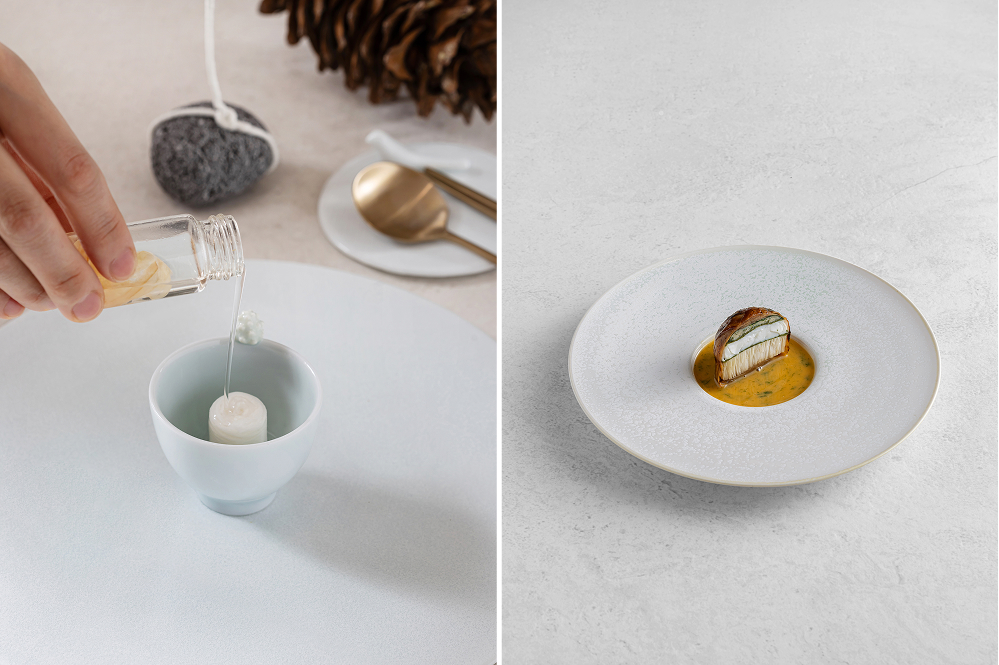
(left) Wet wipe infused with pine nut extract, (right) Pithivier made with burdock, fish, and gamtae
Q. Do you have an ingredient that you find yourself coming back to again and again and/or are inspired by?
Chef Kim: I really love ueong (burdock). Ueongjorim (braised burdock roots) is a staple, but desserts that incorporate it, like our ueong Earl Grey ice cream, are also quite popular with our customers. Our foreign customers are especially amazed by how we are able to extract a full-bodied flavor from this very common vegetable. I also like wonchuri (daylily), which blooms in spring, and any kind of fresh namul (wild greens).
Chef Yoon: I am deeply inspired by the potential and rich history of every Korean-grown ingredient and always hope that we are able to convey this to our customers. Korea, for example, is the king of pine nut-producing countries. We use pine nuts grown on a farm near Gariwangsan Mountain in Pyeongchang-gun, Gangwon State, that’s 1,100 meters above sea level (and that we personally go over and collect!). We use them because we know that they’ve survived the cold winter months entirely outdoors. There’s a wonderful fragrance you can get only from freshly harvested fall pine nuts, which amplify any ingredient they’re paired with. We provide our customers with a pre-meal welcome wet wipe infused with pine nut extract so they can enjoy the fragrance first-hand. It’s an attempt on our part to give a multi-sensory experience of nature that enhances the customer’s experience of our food.

Q. Sharing food also, in most cases, involves an exchange of emotional warmth. Is there anything you do, in terms of facilities or services, to build a rapport with your customers?
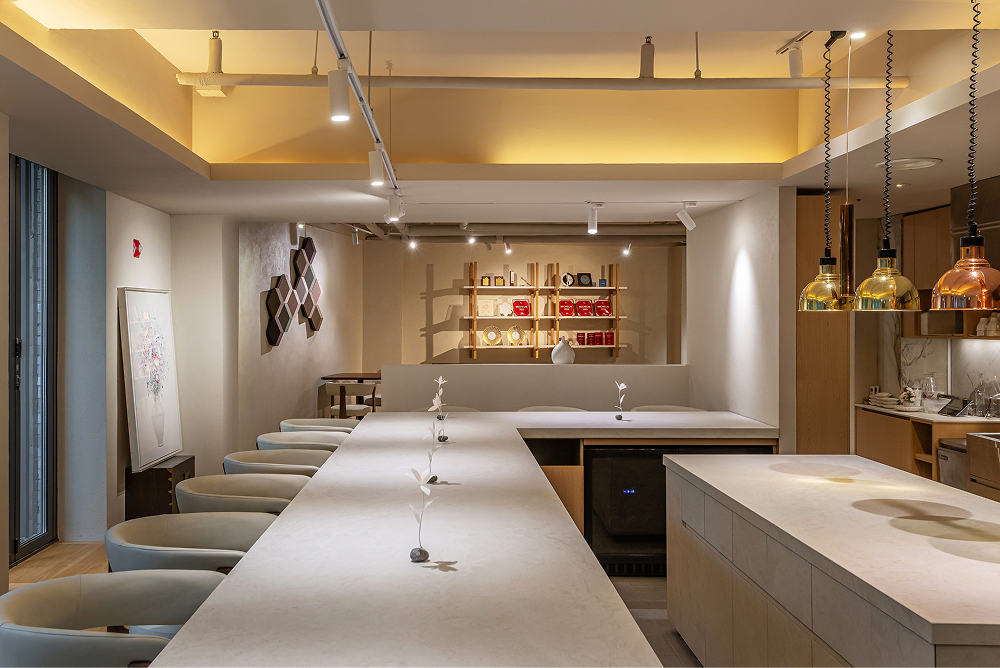
Chef Kim: For me, true sharing is a sharing of not only food but also emotions, including the feelings that are exchanged when we look into the eyes of our customers. That’s why we had our bar counter, including the space in the middle where the chefs work, built slightly lower than usual. The difference in floor height reflects our belief that the chef’s interaction with the customer—being at eye-level and therefore able to see the speed at which customers are eating or whether they are enjoying the food—is intricately linked to the quality of the food we serve.
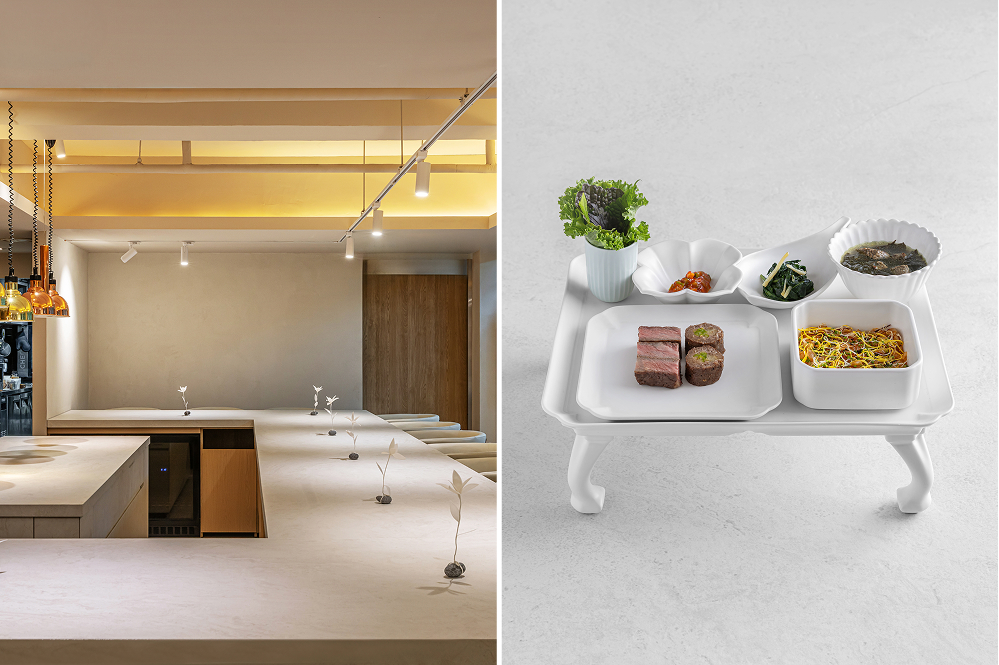
Chef Yoon: I try to always give customers an experience of jeong, the Korean idea of a deep emotional connection. One of our course meals is Hanwoo Bansang (Korean beef set meal), which combines Korean beef, bibimbap, ssam (leaf wraps), and namul. For customers who are pregnant or celebrating their birthday, we often provide a warm bowl of miyeokguk (seaweed soup). We believe it’s important to communicate to the customer that we care about them as much as we do the food.
Q. What do you think are the merits or attraction of Korea’s sharing/community-focused culinary culture?
Chef Kim: Koreans say “bapmeogeosseo?” (literally, “have you eaten rice?”) as a means of expressing interest in the other person’s welfare. To me, the essence of Korean cuisine is that food is a vehicle for building a sense of community. Soul does offer baekban (combination meals), but we are currently concentrating on procuring quality ingredients from all over the country and then conveying a concentrated version of that ingredient’s flavors and history. We think a lot about how to do less with more in order to present a well-structured dish that embodies where the ingredient comes from as well as its textures and flavors.
Q. Do you have any interesting stories about partaking in food with someone that you’d be willing to share with our readers?
Chef Yoon: What first comes to mind for me is lunch time at school when I was a kid, when everyone would take out their packed lunches and share the contents with one another. I, unfortunately, wasn’t able to bring a meat side dish very often (laughs). But I was able to have meat with most lunches anyway because my friends were generous with their side dishes. I also remember enjoying myeolchibokkeum (stir-fried dried anchovies) and mumallaengi (dried radish) that were prepared by someone’s very skilled mother. While sharing our food, we would ask about one another’s families, which would then lead to deeper conversations and friendships. This lunchtime sharing is a very special and era-specific cultural element that I believe is unique to Korea.
Q. How do foreign customers respond to Korean cuisine’s spirit of sharing? How do you think the status or visibility of Korean cuisine has changed overseas, based on your personal experience?
Chef Kim: Through the overseas pop-up events and collaborations I’ve worked on over the past few years, I’ve seen firsthand the explosion of interest in Korean food. It’s no longer a question of whether people enjoy the taste of Korean food; there’s now a lot more people who say that Korean food has made them more interested in the culture and spirit of the Korean people.
Chef Yoon: One thing that foreign customers often say about Korean food is that it has a depth of flavor they’ve never experienced anywhere else. There’s certainly savory and acidic flavors in Western cuisine. I firmly believe, however, that Korean cuisine is unparalleled in its richness of taste, which is the result of years-long fermentation. For example, adding a little bit of doenjang (soybean paste) to the butter-based sauce for a fish dish immediately deepens the flavor. Jeungpyeon (raised rice cake) that’s been fermented with makgeolli (unrefined rice wine) is also popular because of the pleasant acidic aftertaste and fluffy texture reminiscent of sourdough.

Q. Do you have any new items for your autumn menu or something you’d like to recommend as a shared dish?
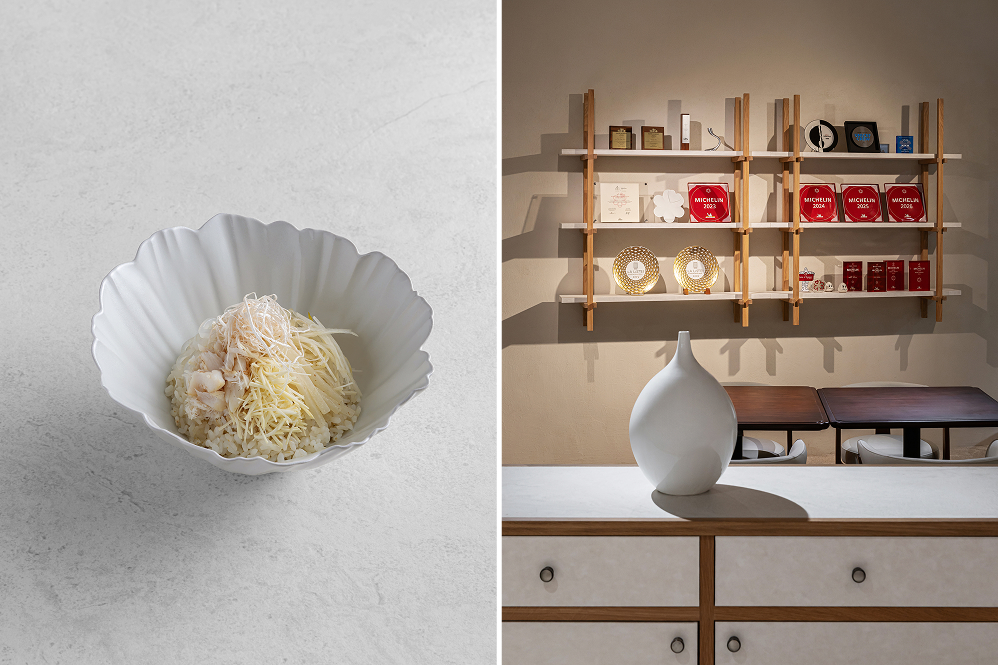
Chef Kim: I recommend Baekhwaban (白花飯), which is a bibimbap made with mostly white ingredients, in line with its name (baekhwa literally means “white flower”), and baekganjang (literally, “white soy sauce”). The base is made with baekganjang and perilla oil extracted by a mill in Gwangju from domestic perilla that my mother grew herself, and it is topped with half-dried white fish, such as tilefish or yellow croaker, for added flavor. Baekhwaban is the perfect dish to share with your friends on a beautiful autumn day!
Q. What is the soul food you gravitate toward at the end of a long day?
Chef Kim: I like mulhoe (cold raw fish soup) when I’m looking for something light. If I’ve had a stressful day, I go for a meat, like samgyeopsal (grilled pork belly), chadolbagi (beef brisket), or chaekkeut (sirloin), or a roll of gimbap. The soul food that both of us love best, however, is gomtang (beef bone soup). We enjoy both the traditional non-spicy and extra-spicy versions or when it’s paired with things like rice cakes or laver oil that one doesn’t usually find with this dish. I feel replenished in body and soul after a hot bowl of gomtang!
Q. Are there any other experiments you’d like to try in the field of Korean cuisine? Do you have a vision for broadening its horizons?
Chef Kim: I want more opportunities for face-to-face encounters with people in many different countries. I want people who may have never heard of Korea before to realize that Korean cuisine is not at all difficult to enjoy and that it can be presented in diverse or very elegant ways. My goal is to be a bridgehead for the larger work of broadening the spectrum of Korean cuisine.
Chef Yoon: I want to concentrate on creating a brand of Korean food that is faithful to its historical roots and that people know can be experienced only in Korea. The goal is to move away from the rote copying of Western cooking techniques toward a modern interpretation of Korean ingredients. I would like to venture away from familiar dishes like bulgogi and bibimbap to discover and put my unique spin on lesser-known ingredients. I want to keep showing people the immense potential of Korean cuisine.