


한식에 대한 다채로운 이야기를 전하는 온라인 매거진
Flavors of culture enveloping the Korean table: Ssam
Hansik Insight
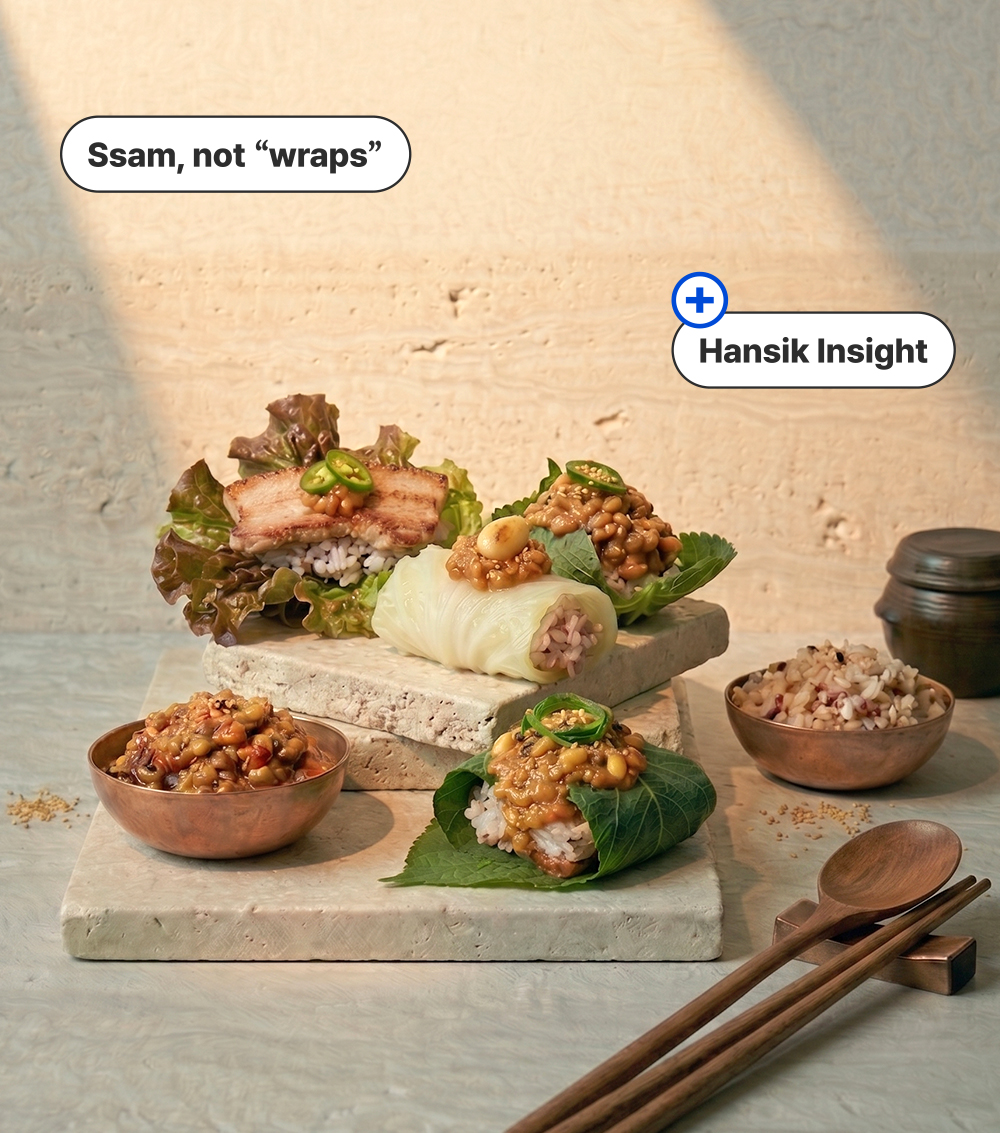
Ssam is a staple Korean dish that is also one of the most fun and one that requires the most creativity. It has been resilient throughout Korea’s history, wrapped with pumpkin leaves and eaten in the fields during harvest season, made with seaweed and sea urchin roe by haenyeo (women divers) hungry and tired after a long day of fishing, and served as samgyeopsal (grilled pork belly) in cabbage leaves accompanied by soju. Any wide-leafed vegetable, whether lettuce or pumpkin leaves, can be used for ssam, as can kelp, laver, or seaweed. The fun of wrapping various ingredients and a bit of ssamjang (red chili and soybean paste) in a leaf is second only to the explosion of delicious flavors in one’s mouth after biting into it.
Literature and culture critic Lee Eo-ryeong pointed to ssam as the dish that best embodies Korean cuisine’s adaptability. Because it is made by and according to the tastes of the person eating it, ssam is also used as an example of cultural accommodativeness. Embellished by the scent of flame-grilled samgyeopsal, ssam is a quintessentially Korean food, an amalgam of three (wood, metal, and fire) of the five traditional elements. How much do we actually know about this incredibly versatile and accommodating dish?

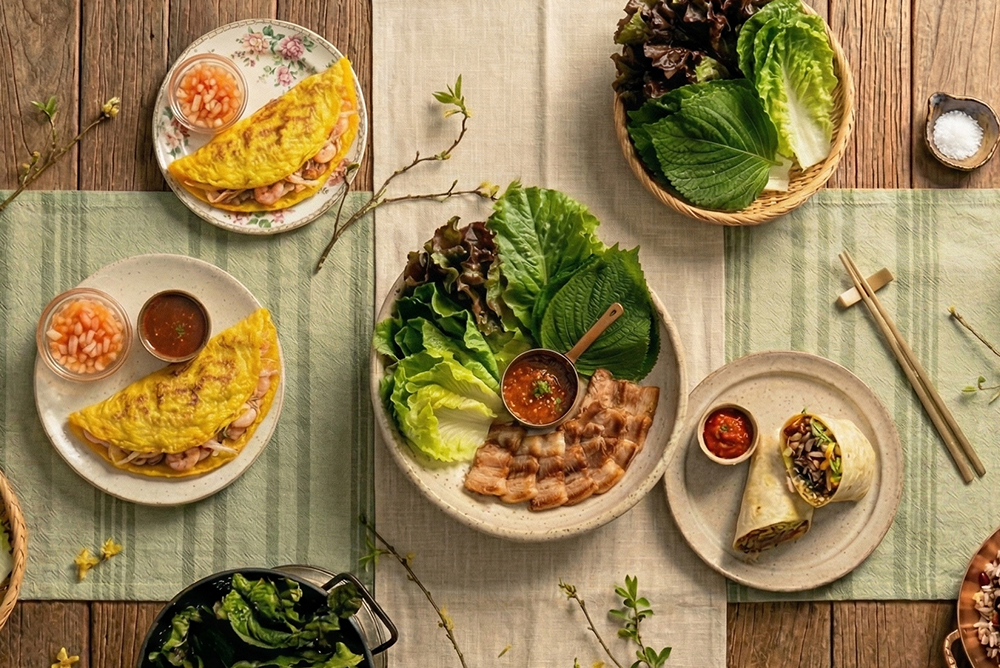
In the Korean language, verbs related to cooking become the root for the name of the food that results from such cooking technique (e.g. gubda (to grill) àgui (grilled dish), bokda (to stir fry) àbokkeum (stir-fried dish)). The verb pair for ssam is ssada (to wrap). It is an interesting pair because wrapping is the cooking technique as well as a descriptor for how the food is eaten—in other words, ssam occupies a unique position because it is simultaneously the means and the objective. Linguistic trends increasingly prefer the word “ssam” over “wrap,” as can be seen in the Collins Dictionary, suggesting that ssam is regarded as a Korean dish whose identity is distinct from similar Western versions.
The Mexican burrito and Vietnamese bánh xéo initially seem quite similar to ssam. They are, however, both mixtures of starch and non-starch ingredients that are best described as grain crepes. Miang kham, Thai bite-sized wraps made with betel leaves, or Greek dolmades, which are made with grape leaves, are closer but still distinct from the ssam because their leaves are steamed. Ssam is the only wrapped food in the world made with raw (uncooked) leaves—a quality that makes it more than deserving to be called by its original name instead of the generic “wrap.”

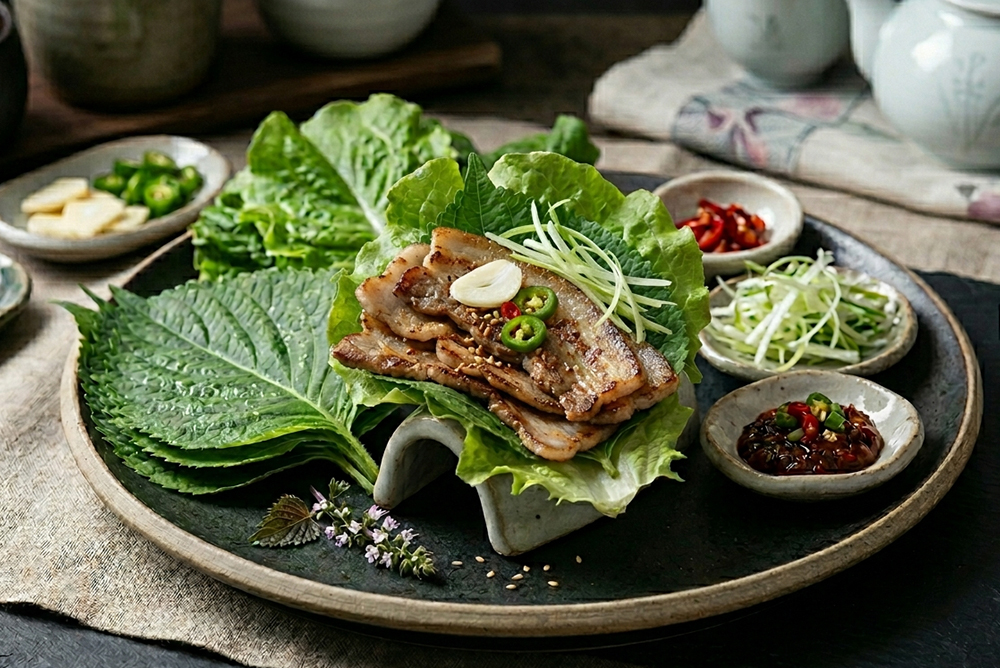
Lettuce, the “people’s favorite” ssam, has a surprisingly long history. Evidence that ssam has been enjoyed by Koreans since the Three Kingdoms Period, the Tian Lu Shi Yu, a two-volume work compiled by Qing scholar Gao Shiqi, refers to lettuce seeds brought by a Goryeo ambassador as “thousand gold kernels” because of their rarity. There is also anecdotal testimony of women sent from the Goguryeo Kingdom as offerings to Yuan China showing locals how to eat lettuce as ssam, resulting in skyrocketing lettuce seed prices.
Records show that ssam continued to be an important food during the Joseon dynasty. According to Seungjeongwon Ilgi (Diaries of the Royal Secretariat), there was an incident during the reign of King Sukjong where a kitchen employee was harshly punished for including tobacco leaves among the plate of lettuce leaves served to the Queen Mother. Nonggawolyeongga (Song of Farm Life) and Kim Ryo’s Sangwonligok (Poems of Jeongwol Daeboreum) both mention the custom of bokssam, or “good luck ssam,” made with lettuce or gomchwi (Fischer’s ragwort) leaves. A poem by Yu Deuk-gong, a literati official during the reign of King Jeongjo, compares lettuce ssam to flower buds and lotus blossoms, effectively elevating ssam to a food for enjoyment rather than simply nourishment. In the royal court and on the tables of the upper classes, ssam started to be served with yeonbyeong (also, gujeolpan (“platter of nine delicacies”)), or buckwheat crepes rolled up with various namul and sweetly seasoned sesame seeds or red beans.
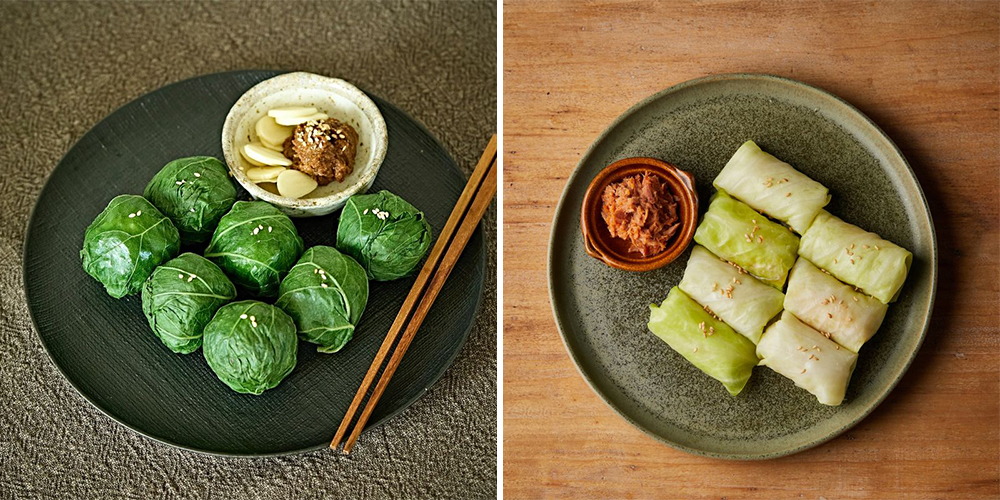
In the modern era, “people’s ssam” remained an unwavering favorite. The “samgyeopsal golden age,” which dovetailed with the growth of pig farms in the 1960s to increase exports to Japan, ended up also boosting demand for lettuce, cabbage, and various boiled namul. Ssam’s popularity also played a key role in Korea ranking first among OECD nations in terms of fruit and vegetable consumption in 2023, giving it an unofficial reputation as a vegetable-friendly cuisine. Today, ssam is no longer merely a convenient way to eat several types of food at once. It has become a recognized genre in and of itself, served by ssam restaurants and as “ssam platters” in line with the modern trend toward vegan/low-carbon eating.

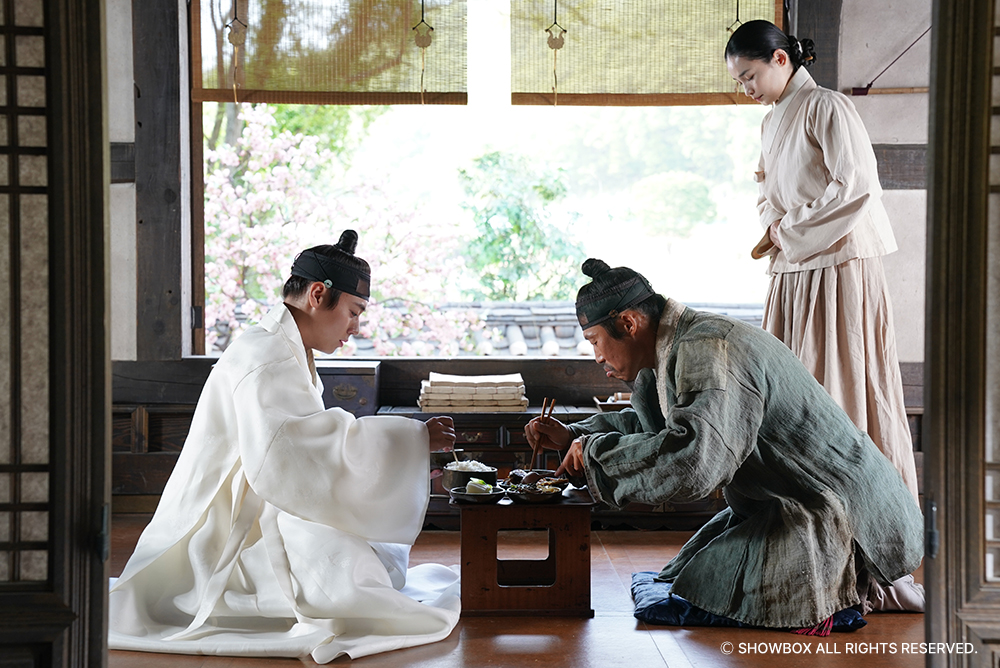
The immense popularity of the movie The King’s Warden is bringing about public interest in foods native to Yeongwol, the region of southern Gangwon-do where King Danjong lived in exile. One example is the eosuri namul meal, which the deposed king purportedly enjoyed while staying in Cheonryeongpo and whose name means “namul presented to the king.” Another is memiljeonbyeong, or buckwheat crepes. As the story goes, locals, noticing that Danjong wept every night while watching buckwheat flowers fall to the ground, prepared a batch of chongtteok (buckwheat crepes wrapped around julienned stir-fried meat, shiitake mushrooms, manna lichen, and cucumber). None of this information is found in official records on Danjong, which were almost entirely destroyed. What we nevertheless can glean is the spirit of community-mindedness and generosity that is the basis of ssam culture. In the 21st century, there is still no better food than ssam that simultaneously embodies separateness and togetherness—the merging of individual identities into a larger whole that is such a hallmark of traditional Korean cuisine.
References
Lee O-young, Words from Lee O-young; Dongguk Sesigi (Record of Seasonal Customs in the Eastern Kingdom); Yu Deuk-gong, Writings by Yeongjae
Photo source
Showbox