


한식에 대한 다채로운 이야기를 전하는 온라인 매거진
Vol 36. Songeo - Gyeonggi
Winter Songeo responsible for appetite and taste
Gourmet travel for regional food ingredients
Hansik glossary
Songeo - Trout
Sungeo - mullet
Sancheoneo - landlocked salmon
Songeo are fun to fish with heavy hands.
It is a cold-water fish that lives in cold water, so it tastes better in winter.
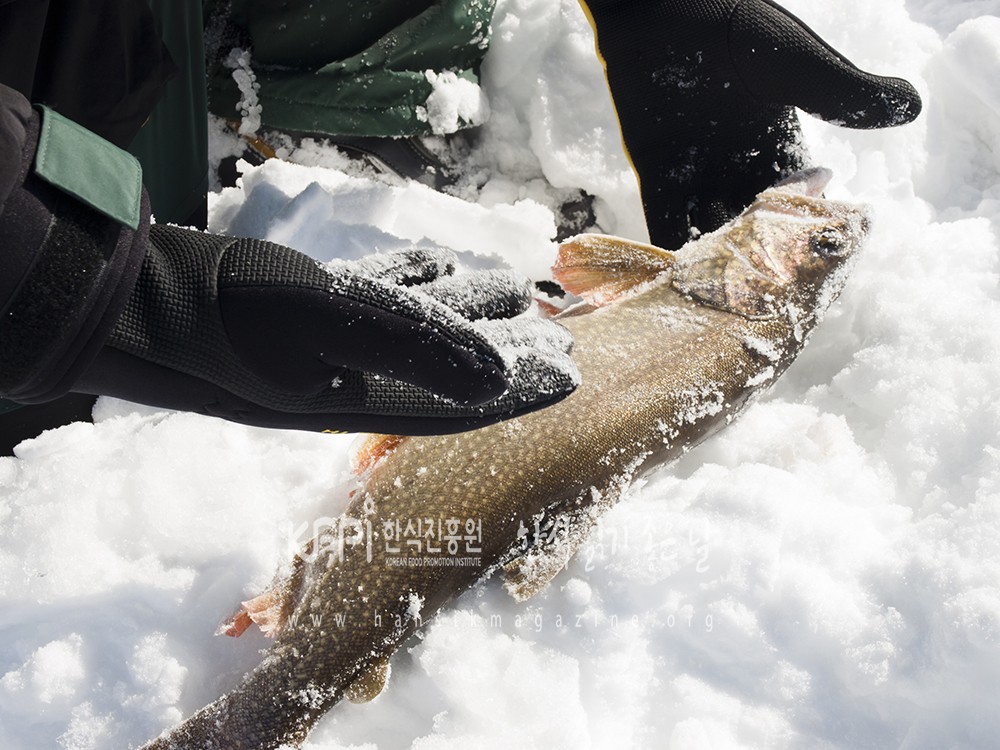
When the river and lake freeze hard, there is a fish that you can hear about. It is a songeo(trout) that has been established as part of the winter festival in Gyeonggi and Gangwon province. Songeo, which combines the fun of making holes in the ice and catching them with fishing rods and the fun of tasting raw fish or grilled fish on the spot, is now a familiar winter friend. More interesting facts are hidden in this songeo's ecological habits.
The truth of songeo living in fresh water and the sea
Although the name became familiar with the many songeo festivals starting from 10 to 20 years ago, how much do we know about songeo? There are quite a few people who are confused with sungeo(mullet) with similar names, and it is often said that freshwater songeo and sea songeo exist separately. What is the truth about songeo?
To answer the question, sungeo that lives in the sea and songeo that lives in freshwater are completely different species. Both can be confusing because they are often both eaten raw in winter, but when you take a look, the color of the flesh is completely different, so if you look at it once for sure, there won’t be a reason to be confused. Hoe(raw fish) mixed with white flesh overall with dark red parts is sungeo, and hoe with a red color like salmon is songeo.
Then, is it true that freshwater songeo and sea songeo exist separately? This is both right and wrong. Because songeo is both sea and freshwater fish. The hint regarding the truth of freshwater songeo and sea songeo is that songeo are fish belonging to the salmon family.
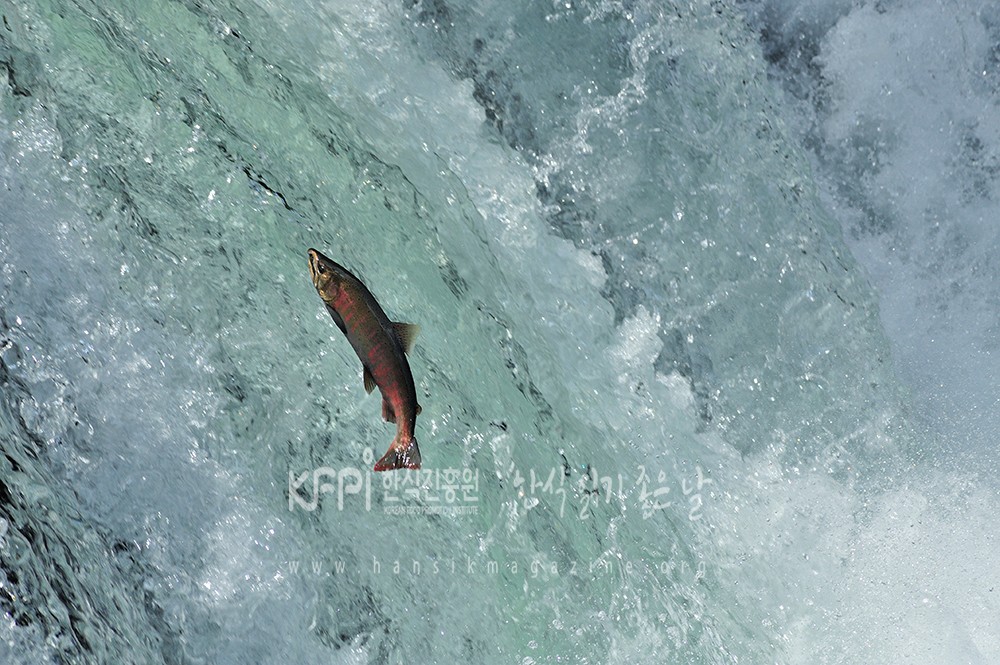
You will know the habits of salmon, which are born in fresh water and live in the sea and return to the river by the time they lay their eggs. Most fish in the salmon family have this habit. Among them, songeo go out to the sea, grow up, and return to fresh water, and some live only in fresh water. The type that goes out to sea is called 'Ganghae-type' songeo, and the type that continues to live in fresh water is called 'Yukbong-type' songeo.
The Ganghae-type songeo will live in the river for one to two years, then leave for the sea around September to October, spend two to three years in the sea, and return to the river where it was born around May to June for spawning. On the other hand, the yukbong-type songeo lives in the stream, then lays eggs and when the time comes it ends its life. Freshwater songeo and sea songeo are two different classes of different habits, and it is true that they are songeo of the same species.
On a lighter note, there was similar confusion in classical music. The debate is whether the title of the song, one of Schubert's representative symphonies, is "Sungeo" or "Songeo." The song, which is also familiar to our ears as it is used as the sound of the operation of a domestic brand washing machine, Schubert depicts a lively fish swimming in a river and a fisherman trying to catch the fish. It was a songeo, a fish swimming in the river.
In fact, the controversy only occurred in Korea, and the title of the song, "Die Forelle," is German for songeo. The reason for the confusion dates back to Japanese colonial era, it was only that someone translated the title incorrectly and that passed down for decades. Even in the textbook, this mistake continued, and until the late 2000s, it was written under the wrong title, "Sungeo." Therefore, many people in Korea may have learned it as “Sungeo" in the curriculum, but the exact title is "Songeo" and has now been modified in textbooks.
A misunderstood happening because of its appearance and name
The reason of confusion over the name of freshwater songeo and sea songeo can also be found in the difference between the appearance of the yukbong-type songeo and the Ganghae-type songeo. There is no difference in appearance when living together in fresh water, but the appearance of the Ganghae-type songeo changes while living out in the sea. As the size grows as big as a salmon, the head becomes hard and the lower jaw changes to protrude, so the Ganghae-type songeo is also called "steel head" in foreign countries.
The name called also caused problems. Ganghae-type songeo, a kind of sea-going out to the sea, is also called "Shima salmon," and the name "Shima" comes from the dialect of a region where many songeo come from Russia. In Korea, it is officially designated as the "Shima salmon" and songeo is said to be the second name.
However, the name in history has long been songeo. In the <Sejongsillokjiriji>, it is written as a native of several provinces in Hamgyeong-do, while in the <Shinjeungdonggukyeojiseungram>, it is said songeo as a native of Gangwon-do and some parts of Gyeongsang-do. In <Nanhoeomokji>, it is said to be 'appearing around the northeastern Ganghae and is similar in shape to salmon, but it is more fattening and delicious.' Also, it is written that 'their flesh has a vivid reddish color as the pine tree nodes, therefore named songeo.' The taste of their eggs is an extreme delicacy and is best among the East sea fishes.
In the literature <Ojuyeonmunjangjeonsango>, it is said that 'It comes from the sea of Bukgwan(Hamgyeong-do) and comes into the river in May and June every year.' 'When it meets a stone wall in the valley, it goes up and rub its body against rocks and pine trees, and falls, but its body smells like pine trees.' This is evidence that the name songeo was given and called by ancestors.
As a result, there is still controversy in academia. It is argued that the fish, which has already been recorded as songeo in the domestic literature, has been designated as the Shima salmon, was a case of contrary to usual order. Perhaps the misunderstanding that there is a separate sea songeo is a happening caused by a change in the name of the songeo as Shima salmon.
Are sancheoneo and songeo the same fish?
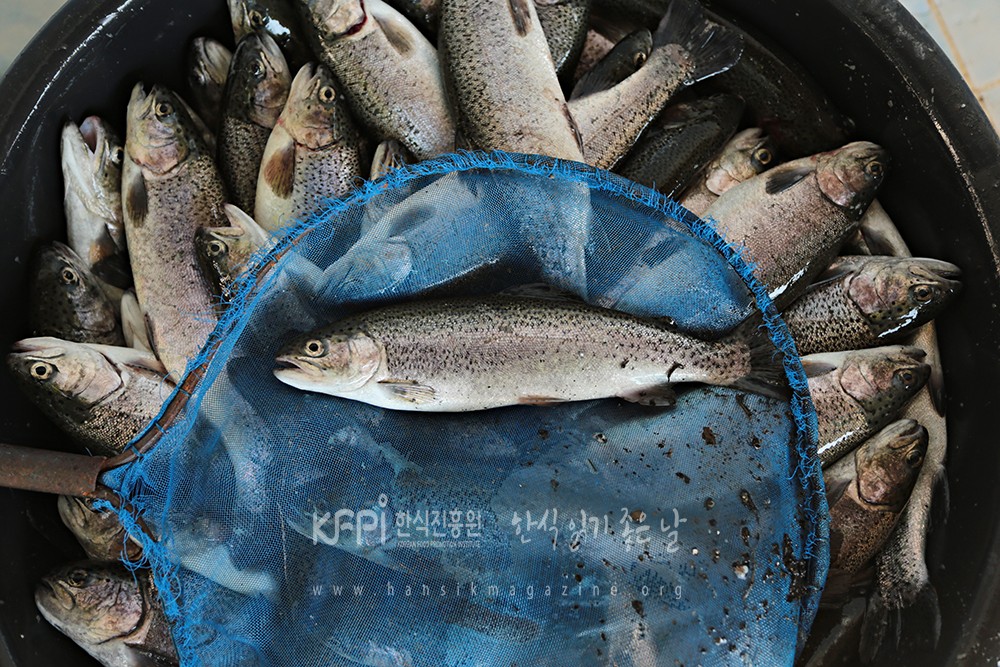
Along with the songeo festival, the sancheoneo(landlocked salmon) festival is also known as the festival representing winter. Perhaps people who got to know songeo through the festival knew sancheoneo before songeo. However, it is generally unknown that songeo and sancheoneo are of the same species. As there is a difference in name, you may know it as a different species of fish, but sancheoneo, the name of a fish that lives in the mountains and rivers, is a yukbong-type songeo that does not go out to the sea.
There are still complicated tasks about this left. Sancheoneo look similar to songeo, but they have different body colors and are only about half the length of songeo. Nevertheless, the academia sees it as the same species. This is because male sancheoneo and female songeo can mate. When songeo and sancheoneo meet in the valley, the place where sancheoneo live, they make one kind which is both songeo and sancheoneo’s baby. It is clear that this condition alone shows that it is the same type of fish, but it is not yet known why some remain in fresh water to become a yukbong-type of sancheoneo, and some go down to the sea to become a ganghae-type of songeo.
Songeo we eat and enjoy is rainbow songeo
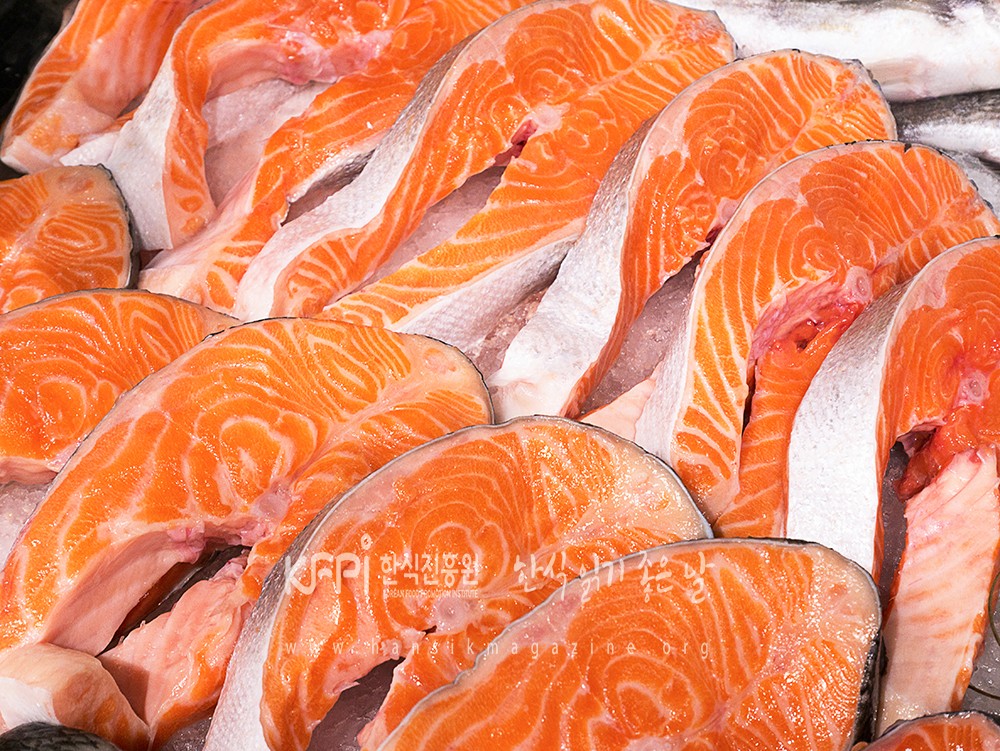
Songeo, which we usually meet and eat through festivals, is not a native songeo that has lived in Korea since the old days. Unfortunately, due to the construction of dams in rivers and water pollution, native songeo have become such a precious fish that it is said to have barren. Most of the songeo we commonly encounter now are farmed songeo with exotic species. Their name is also famous as the rainbow songeo.
Rainbow songeo is from North America, but it is similar in habits to the salmon family as the native songeo. However, rainbow songeo has a horizontal red line when it becomes an adult, and if you look at it at an angle, you can see the rainbow light, so it is known as the "rainbow songeo".
Rainbow songeo is also divided into Ganghae and Yukbong types, but most of the songeo used for farming in Korea are Yukbong-type songeo that only live in freshwater. Jo Jeonghyun, a researcher at the Central Inland Water Research Institute at the National Institute of Fisheries Science, said, "Rainbow songeo can produce a lot in a short period of time, and it is easy to grow because they eat mixed feed well even though they are carnivorous. Since taste good due to the high fat content, it has been researched for a long time and are grown by farming.” Rainbow songeo is said to be popular worldwide for farming as it can be easily raised in valleys, lakes, and reservoirs.
Songeo, freshwater fish. Will it be okay to eat as raw fish?
There is a saying that comes out every time when dealing with songeo as food ingredients. The question is whether it is safe to eat songeo, a freshwater fish, as raw fish. Along with the perception that freshwater fish are dangerous due to the large number of parasites, especially the fear of Gandistoma, which cannot be solved with general anthelmintic drug. In response, Ju Hongjun, chairman of the Korea Songeo Farm Association, asserts that "Farm songeo has no parasites, including Gandistoma." Chairman Ju said, "Gandistoma is the host of cowlings that freshwater fish eat as food, but there are no cowlings living in songeo farms," adding, "Farm songeo do not eat cowlings because they eat mixed feed that passed the Food Safety Management Certification Standards (HACCP)." Natural songeo caught by fishing in natural rivers can be dangerous, but farm songeo distributed through restaurants are 100% safe.
Meanwhile, there is one more story about food for farmed songeo. It is about the reason why songeo's flesh is red like salmon. Fish in the salmon family eat small crustaceans. Crustaceans change a substance called beta-carotene in taken from seaweed in the body to form a red pigment called astaxanthin. This is why the salmon and fish that eat them turn red.
Then why are even farmed songeo red in color? Originally, farmed songeo do not eat wild crustaceans, so it is normal to have a light skin color. In response, Chairman Ju said, "We mix the ingredients obtained from crustaceans in the mixture feed of the farm," adding, "It is intended to simply color them, but it is also good nutritionally such as preventing adult diseases."
A unique taste to enjoy songeo, bibimhoe
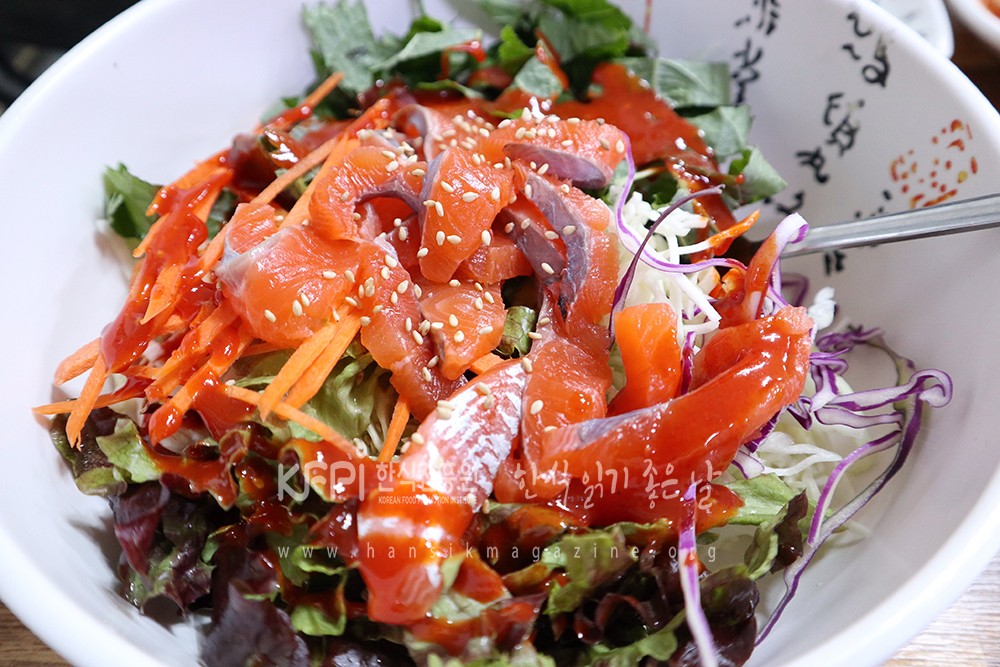
If you go to a restaurant that sells songeo, there are various ways to eat including songeohoe(sliced raw trout), songeogui(grilled trout), and songeomaeuntang(spicy trout stew). Among them, hoe(sliced raw fish) is definitely popular in Korea. Songeohoe, which is similar to salmon but has a redder color, tastes as savory and greasy as salmon. Some people find it difficult to endure the unique smell of freshwater fish, called "dirt flavor," but food delicacies varies from person to person. People who like songeohoe enjoy such scent accepting it as a part of the songeo scent.
There is also a way for people who hate the smell of freshwater fish. It's to eat as bibimhoe. It is a method of mixing vegetables such as lettuce and perilla leaves, red pepper paste, and bean powder and eating them like hoemuchim(spicy raw fish salad). If it is a little different from regular hoemuchim, mix vegetables and red pepper paste separately, and eat a piece of sliced raw fish with the vegetable seasoning. This is because mixing songeohoe together can cause watering while eating, weakening the taste of songeo. As a additional tip, if you get bored while eating, it is also recommended to taste the second taste by adding minced garlic to the vegetable seasoning. Meanwhile, Chairman Ju says, "It even tastes good if you grill or roast butter like steak by applying various methods of eating salmon to songeo."
Meanwhile, in recent years, the number of rainbow songeo has been increasing considerably as they have succeeded in cultivating them in the sea. In fact, it is just like as if a sea songeo was born. Songeo grown in the sea has no unique "dirt taste" of freshwater fish, so this would be good news for those who are reluctant to eat freshwater songeohoe.
A series of cancelled festivals due to Covid-19,
but there are still a fishing spots
Songeo festivals enjoying breaking ice on frozen rivers are all across the country. One year, it was common for the festival to be postponed because winter was not very cold, but songeo could be enjoyed through the festival for more than a month each year. This year, however, most songeo festivals have already been cancelled due to the persistent risk of infection with Covid-19. It's a pity.
Nevertheless, there is a way to enjoy a small songeo festival while keeping the quarantine rules. It is a way to use a fishing spot that also serves as a fish farm. One example, you can enjoy songeo and bingeo(pond smelt) fishing on a small scale at the Cheongpyeong Songeo Fishing Experience Center in Cheongpyeong-myeon, Gapyeong-gun, Gyeonggi-do, where the Seolbing Songeo Bingeo Festival was held. It is said to be operated similarly to the festival, such as fishing songeo and bingeo and catching songeo with bare hands in a space set up in the fishing experience center. As caught songeo are also trimmed as hoe and as grilled fish as they were during the festival, it would be good to visit in a family unit and experience songeo fishing this year as a small untact festival.
Edited by No Gyuyeop
No Gyuyeop
Former head of the monthly Mountain coverage team, and former editor of Travel Sketch. Currently working as a travel writer