


한식에 대한 다채로운 이야기를 전하는 온라인 매거진
Vol 35. Gotgam - Gyeongsangdo
Japchae is 'a group of variety of vegetables'
Hansik Archieve
Hansik glossary
Japchae-Stir-fried glass noodles and vegetablesDangmyeon - Chinese noodle
Namul - Green salad
Japchae is 'a group of variety of vegetables'.
Often, 'jap' is considered negative. 'japsureobda' is taken as a meaning of confusion, a mixture of various things. There is also a strange negative image that it is not orthodox. But that isn’t the case. Japchae is a mixture of many things, but it is not confusing or unorthodox. Japchae is simple. It's a variety of vegetables. Japchae is a food that puts various vegetables in a bowl. The common three-colored and five-colored namul(green salad) are japchae. 'variety' is rather a positive meaning.
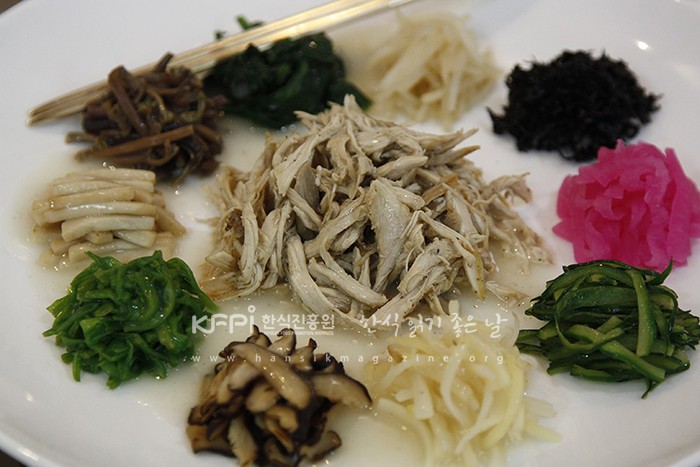
Variety is rather a positive meaning. ⓒ Photo. Hwang Kwang-hae
Dangmyeonjapchae is far from the original
The japchae we meet these days is dangmyeonjapchae. It is far from the original. It was distorted. There was no dangmyeon in the original japchae. Dangmyeon are not a vegetable. It is a kind of noodles. It is a food ingredient that was not related to japchae.
Dangmyeon is a food ingredient that originated in China. ‘Dang’ of Dangmyeon is the Tang Dynasty of China. The dangmyeon is also called the "homyeon". The same goes for "ho." "Ho" means barbarians. In the late 19th and early 20th centuries, China was the Qing Dynasty of Manchuria. This is why they called dangmyeon, homyeon.
"Gungjungjapchae(Royal Japchae)" is a comedy. Dangmyeon entered the Korean Peninsula at the end of the 19th century with the Chinese. There has always been exchanges with China, but it was around the Imogunran(1882) that many Chinese entered the Korean Peninsula. By this time, food with dangmyeon was still Chinese food. As the 1920s and 30s passed, dangmyeon factories were built in places where Chinese people frequented, pyeongando and hwanghaedo areas. It developed into a large-scale mass production of dangmyeon at the level of domestic industries. They started making and selling dangmyeon at factories, which were self-manufactured in Chinese restaurants.
In the 1930s, the Chinese continent became a battlefield through the Manchurian Incident. Many Chinese people return to their home countries. Koreans take over and operate Chinese dangmyeon factories. Dangmyeon gets widely popular. Dangmyeon is produced in a large amount centered in pyongyang. Many are exported to Japan. In this trend, dangmyeon is settled in the Korean Peninsula.
Dangmyeonjapchae developed as an neglecting of vegetables
The neglect of vegetables also encourages the development of dangmyeonjapchae. There is an expression called "eating chogeunmokpi". Chogeunmokpi is the grass roots and tree bark. Japan, which annexed Joseon, names the Joseon Dynasty lower. It is called the Yiwangga. Themselves are the emperor, and Joseon is the royal family of Yi dynasty. This means that the king of this royal family, or the corrupt official and high official ate meat, and the people continued their life by chogeunmokpi. This is where the "The royal court cuisine" and "King's Table" came out. They neglect namul(greens) as if they are not edible. We valued japchae, but the Japanese lowered it as grass root and tree bark.
Japanese people still don't know namul. They do eats vegetables, but most of them are Yachae, greens from the field. They do eat sanchae(greens from the mountain), but they are limited. Namul culture is not as broad and deep as ours. Japan does not use the word "sanchae." It is called "namuru" instead of sanchae. Even now, Japanese use it as ‘yachae+namuru’. Namuru is a foreign word written in the Japanese katakana way.
For the Japanese who occupied the Korean Peninsula, it would have been difficult for them to understand why Joseon girls harvested wild greens in early spring. The expression, "You poor and powerless people live by chogeunmokpi", was an accurate explanation for the Japanese. They go to the mountain where there is nothing to eat and dig up some grass and eat them. The Japanese ignorance of namul became an opportunity to lower greens on the Korean Peninsula.
The exact appearance of Japchae remains in the “Eumsikdimibang”
The exact appearance of a group of variety of vegetables 'japchae' remains in Jang gyehyang's "Eumsikdimibang."
"Sliced cucumber, radish, mushrooms(cham, seokyi, pyogo, songi), and mung bean sprouts are used raw and bellflower root, geoyeomog, bakgoji, shepherd’s purse, water parsley, green onion, fatsia shoot, bracken, angelica, eggplant, and pheasant meet are steamed and teared.
Add some namul and these totals to more than 20 kinds of namul. It's a heaven of namul. Jang Gyehyang, the grandmother of Andong Jang family, said, "We use these namul, but we do not necessarily need to use these particular namul." The choice of namul is left open. It is a characteristic of Korean food. They use what is easily accessible around, and they add to or take out according to their taste, and depending on their circumstances. Depending on the situation, it is up to the person who makes the food to add more and or to take out.
Ritual food is the best meal. Saengchae(fresh namul), sukchae(cooked namul), and chochae(cooked namul with vinegar) were all used for the ritual. Bracken, bellflower root, bean sprouts, radish salad, and spinach are often served at a ritual. People also do pack them separately in a bowl, but they also collect all of these greens in one bowl. After putting various namul on a tray, it is eventually a group of variety of vegetables, in other words, it is japchae. After adding japchae and a little bit of soy sauce, it becomes namulbibimbap and seasoned soy sauce namulbibimbap. Namul, japchae, and namulbibimbap are the front and back of a coin.
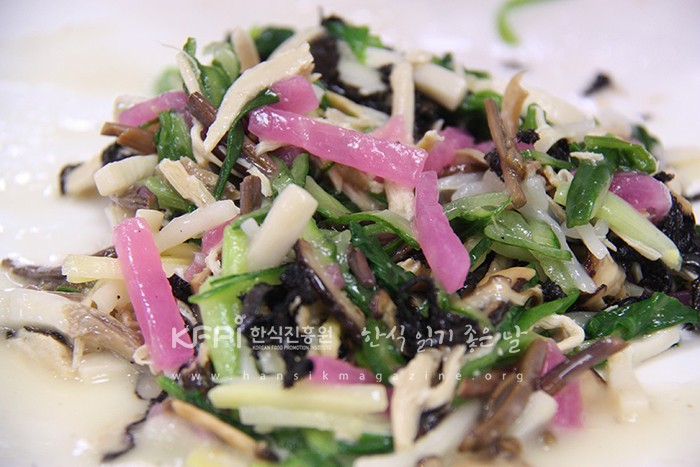
ⓒ Photo. Hwang Kwang-hae
Japchae is not just simply a type of Korean food.
It is a pity that this precious food is distorted as dangmyeonjapchae. Japchae is not simply a type of Korean food. It is connected to the characteristics of Korean food that uses namul widely and deeply.
A poem by Songdang Jojun(1346-1405), a meritorious retainer at the founding of joseon dynasty, remains. It is part of the <Songdangjip Vol.1> and "Thank you with good fortune that teacher Jangdan Yu sent poetry and fresh namul."
It's a basket full of fine spring light
The air is shimmering
Did it rain on the Jangdan last night
I can know that your house is covered with bush even from afar
There is a jangdan between hanyang and gaeseong. Teacher yu who lives at jangdan sent a poem as a gift along with spring namul to songdang Jojun. As he was called teacher yu, you can see that he was not a government official. Songdang is in power of the party. He is a high-ranking official who laid the foundation for Joseon economy along with Sambong Jeong dojeon. His official state was also high. He couldn’t go and meet him even if he wanted to. “I can know that your house is covered with bush even from afar,” he said. It was longing and a disappointment.
We valued namul. During the Joseon Dynasty, people exchanged gifts such as osinban, osinchae in the spring. It is a custom to share the namul from early spring with the neighbors. Osinchae is 'Five kinds of spicy namul. It was also called ohunchae because it has a strong scent and is spicy. They are a welsh onion grown in an pit, leaf mustard from the mountain, a sprout of Korean angelica and water parsley, radish. If you put five kinds of namul on a tray, it is 'Japchae'. Japchae is a rare Korean food, and it is a characteristic of Korean food. The main characters of japchae are mountain namul and wild namul. Dangmyeon isn’t. Japchae is not the roots of herbs and the barks of trees. It is a food ingredient with dignity that high-ranking officials exchanged as gifts.
Writing / Food critic Hwang Gwanghae