


한식에 대한 다채로운 이야기를 전하는 온라인 매거진
Vol 30. Mineo - Jeolla-do
Mineo, the taste making us wait for summer
Gourmet travel for regional food ingredients
Hansik glossary
Mineo - Croaker
Saeujeot - Salted Shrimp
Hoe - Raw Fish
While Samgyetang is the general trend these days,
the food considered the best to beat the midsummer heat in old days was Mineotang(Crocaker Stew).
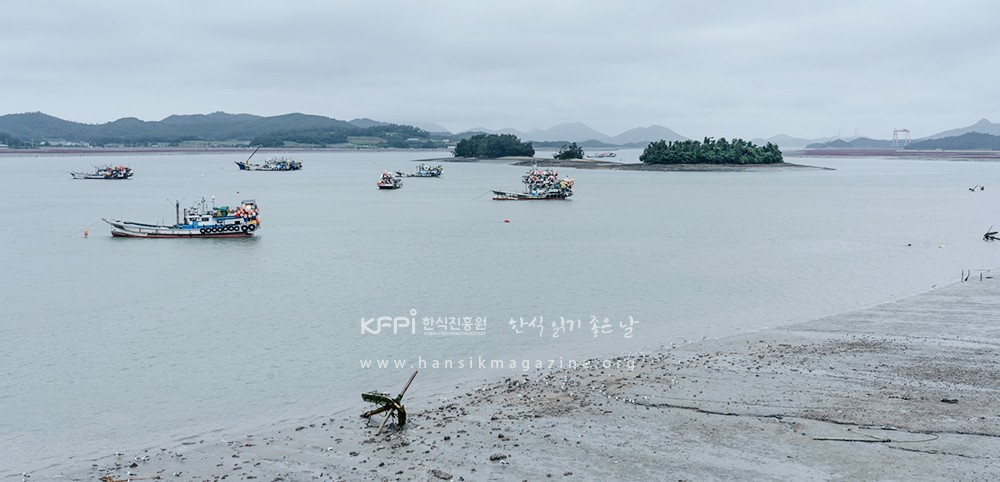
The mecca of Mineo, coastal waters of Shinan
In the late afternoon of pulling out garlic and digging out onions for drying,
10kg male Mineo(croaker) of one meter likely to have grown up for
9 years is placed in an earth-floored room,
the back flesh was put on Makjang(fermented soybean paste with red chili powder)
for eating along with a bottle of Soju brought out by chip-in,
the neck flesh wrapped around by Mukeunji(aged Kimchi) for eating,
the cheek flesh has Oijjanji(pickled cucumber) laid on for eating,
the air bladder, breast flesh and belly flesh are wet by red pepper sesame oil paste for eating,
the rib and dorsal fin flesh may be finely minced and
mixed with refined salt to produce the minced bone for eating,
the intestines and liver are blanched and stir-fried with jeotsaeu gochujang,
the gall bladder with so much extravasated blood is yielded to the friend with a drooping shoulder,
the lip flesh attached to the top of lower jaw produces only two pieces so that I may eat it
- From ‘Song of Mineo’ by Kim Ockjon
Poet Kim Ockjong as the first Korean chef from mixed martial arts(k1) player introduces how to eat Mineo in his recently-published poems <Song of Mineo> as follows. I have never seen a poem that sing about Mineo in such a wonderful way. Since it is the recipe of a chef who lived in Jido as an island near the Songdo consignment market of Shinan-gun as the Mineo’s mecca, it must be the best recipe. While Samgyetang is the general trend these days, the food considered the best to beat the midsummer heat in old days was Mineotang.
That’s how the food talk saying “ Mineotang is the superior article for the summer heat custom, Domijjim(steamed sea bream) the second superior article, and the Bosintang the low-class article “ came into being.
The place for the largest catch during midsummer is the sea in the neighborhood of Imja-do of Shinan. It is because Mineo as the migratory fish stock comes around to warm up for spawning.
The Mineo’s mecca, Shinan
From Taripasi to Songdo consignment market
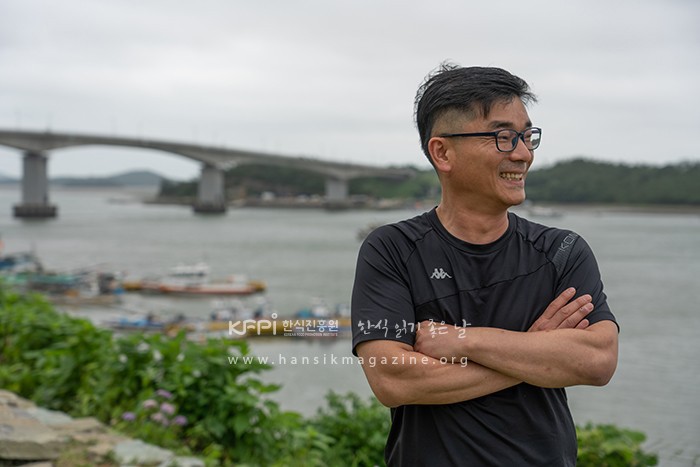
Representative ‘Ju Gwangman’ of Imja Fisheries as the broker for Songdo consignment
market is explaining about Mineo while looking at the sea.
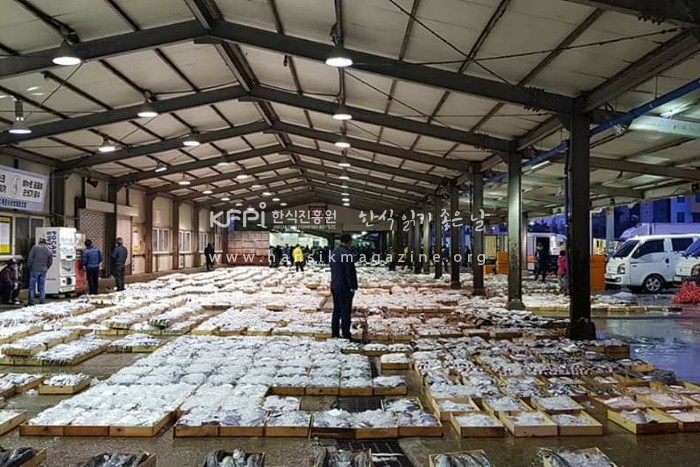
The Mineo consignment market is filled with ‘Mineo’ of the season before Chobok.
Picture of Mineo consignment market ⓒMokpo city hall
Mineo inhabits in this sea water from the end of May through the end of August while feeding on shrimp and departs after spawning. While Mineo is particularly fond of shrimp, 70% of the nationwide production of Saeujeot(salted shrimp) comes out of this sea, making it the best shrimp fishing ground. Mineo’s have put on the weight as much as possible after feeding fully on Ojeot, Yukjeot shrimp which are said to be as expensive as gold prices. In last June, a drum(250kg) of Saeujeot of the best Yukjeot had a successfully bidding at 22.50 million won. 90,000 won per 1kg makes it even more expensive than the luxurious Heo(raw fish) material of the belly flesh of Chamdarangeo. The Mineo fattened by eating such expensive Saeujeot of Ojeot, Yukjoet is truly golden Mineo. Consigned sales of fisheries at the Songdo consignment market is 110 billion won, the first rank of which is accounted for by Saeujeot with a record of 60 billion won, followed by fresh fish such as Mineo, Byeongeo, etc. at 41 billion won. Raw seaweed of consigned sale only during the winter season accounts for 5.1 billion won, Dongbaekha shrimp appearing momentarily in the early winter for 5 billion won. These amounts exclude the sales by merchants of the fishery sale place. The sea is the goose laying golden eggs as expected.
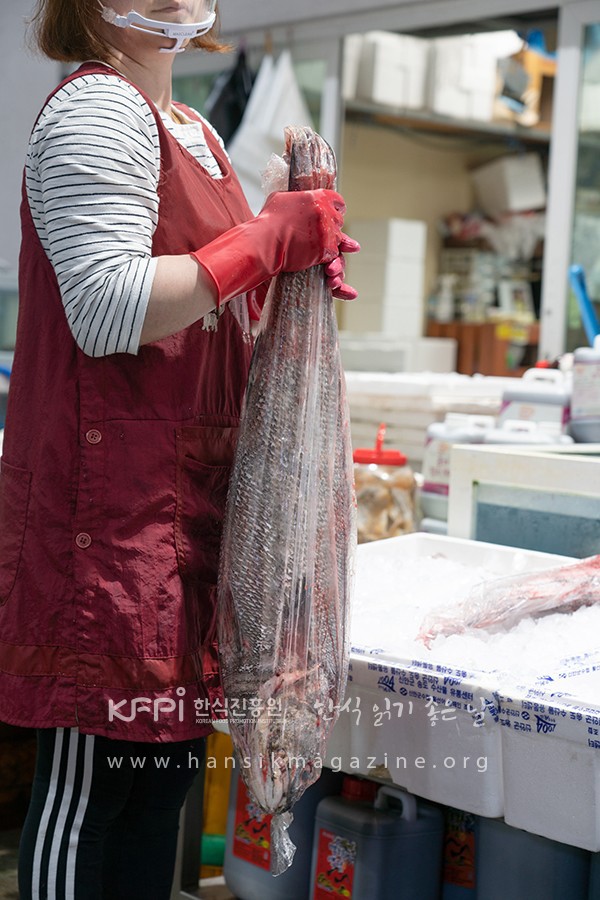
Mineo of the season is being lifted for show at the Songdo fishery market of Shinan-gun. Mineo is comparable in size to that of an adult.
Mineo auctioned at the Songdo consignment market accounted for 376 tons (9 billion won) in 2018, and 384 tons(8 billion won) in 2019. The place with the highest transaction of Mineo nationwide is the Songdo consignment market. Mineo having entered in the Songdo consignment market is distributed among raw fish restaurants throughout the country to be served on the table as a summer healty food. According to the Hanguksusanji(1908), the famous Mineo fishing grounds from old days were the seas at Imja-do of Shinan, Deokjeok-do of Incheon, Shin-do of Pyeongan-do, etc. The coastal waters of Imja-do was also known to Japan to the extent that stow net fishing boats of Japan worked. In Mineo seasons, Mineo pasi was held at Tari island in the coastal waters of Imja-do, being called Taripasi as it was held at Tari island.
Pasi is a temporary market formed at the island or port near the fishing ground at the times when migratory fish such as Mineo, yellow croaker, mackerel, etc. are visiting.
It is similar to the temporary stores popping up on the seashore with nothing in the summer vacation seasons. Like the pulling out after conclusion of summer vacation seasons, Pasi also came to an end when the fish departs the sea. In <Travel memorandum of Joseon Archipelago> published by Japan in 1939, the field of Mineo Pasi at Tari island of Imja-do is vividly described.
Pasi is made up of pubs, inns, restaurants, sundry stores, barber shops,
ship supply stores, salt stores, bath houses, etc.
all of which appear to be doing the business with fishermen from other places.
Those moving along with the Pasi folds up the houses to carry on the ships.
Since not only household items but also houses are folded for carrying,
there are people who collect fares for shipment,
or especially prepare ships to move together with all of the family.
As the needs for Pasi as an intermediate stopover have disappeared as a result of development of storage facilities and high-speed fishing boats, the consignment markets have succeeded and entered at ports of each area. Now, the Songdo consignment market is substituting for the Tari Mineo Pasi. The brokers with winning bids for Mineo at the Songdo consignment market in a summer season fill the ice boxes with the ordered Mineo for shipment through parcel service. There are also many people who personally visit the stores next to the consignment market for purchasing. Still other people have hoe(raw fish) prepared immediately after purchasing of Mineo to take it to a restaurant on the second floor of the stores to taste Mineo dishes. The Mineohoe(sliced raw croaker) tasted here is so special as not to be comparable with hoe of urban hoe restaurant. Tehose who have tasted Mineohoe at a city think that the Mineo originally soft and tasteless. Although Mineo is the soft fish compared with other fish, the hoe of freshly-caught Mineo is never soft nor tasteless. It is gooey and delectable. Aged fish is soft. While some people insists that it is a ripen taste, it is only the ripened taste of what has been passed time since it was caught. When freshly caught Mineo is suitable ripened, it can also be sticky and even gooey. While there are some people insisting that the fresh Mineo tastes better, this is not true, either. Fresh fish has its own taste while live fish has its own taste of the mutually different level. Those who have tasted live Mineo just caught on a boat by fishing rod or brought immediately from the set net, it is known how delectable and suitably sweet. After all, food is the experienced value. What has not been experience must not be prejudged.
Reasons that the ripened Hoe of live Mineo has to be tasty
Representative Ju Gwangman of Imja Fisheries as the No. 21 broker of live & fresh fish at Songdo consignment market is a veteran who has been engaged in auction and wholesale/retail of Mineo for the 16 years. He put his thumbs up saying “For the hoe material, male fish is the best.” Male fish is said to have a good fleshiness with much belly flesh so as to claim the high preference. “For the male fish, belly flesh is the best. People eat the male fish to eat that portion.” Female fish in the spawning season is filled with eggs, leaving almost no belly flesh. Thus it is frequently sold as the material for soup or dried fish. That is why the male fish is more expensive than the female fish by more than 10,000 won per kg. According to the representative Ju Gwangman, ripening of live Mineo by storing in ice for 3~4 hours produces the best taste compared with ripening of fresh fish. Live Mineo is treated as the special class, fresh fish with 3~4 days elapsed in ice after being caught in the boat as Class A, the fish with about 7 days elapsed as Class B, and those with more than that as the lower class.
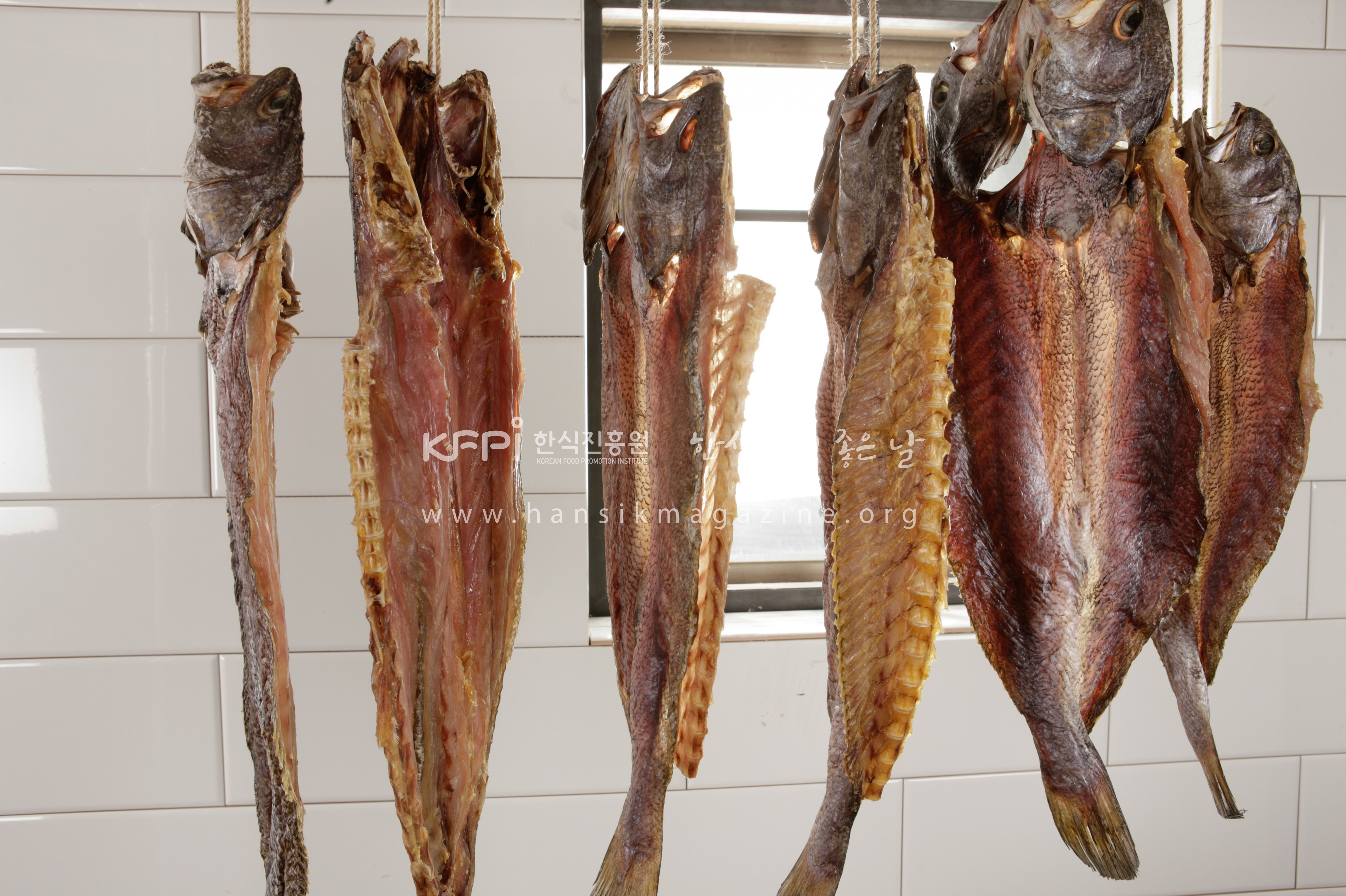
Dried fish of Mineo ⓒShinan county office
While the caught Mineo may be immediately sent for the consignment sale, then the volume is not large, it has the blood removed after capture for collection in the storage room of fishing boat and subsequently transported to the consignment market at one go. Thus, even the very fresh fish has 3-4 days or even about a week elapsed. These fresh fish are moved to Noryangjin fishery market or Garak-dong market of Seoul to undergo another auction followed by dispersion to hoe restaurants. Even Mineo of Class A should have 5-6 days, and Class B more than 7-8 days elapsed before being served on the table at the hoe restaurant. This is why the ripened hoe of live Mineo should taste better than the ripened hoe of fresh fish.
However, the hoe restaurants in Seoul insisting the best makes sure to have the live Mineo transported by parcel service after catching and removal of the blood. Representative Ju tips off that there are hoe restaurants always insisting on the live Mineo even if the prices per kg may be more expensive by 10,000 to 20,000 won. Most of those hoe restaurants are luxury Japanese restaurants in Gangnam, which are restaurants of high-price strategies for luxurious food ingredients. Indeed there are people in Seoul who can enjoy such world of tastes not allowed to be covered by the general ordinary people. If the ordinary people want to taste the fresh live Mineo at reasonable prices, they can visit the Songdo consignment market or have it ordered by parcel service for eating. Upon receiving orders, the brokers may prepare hoe for easy consumption according to the customers’ requests and send it through an express bus. When ordered in the morning, you can taste the fresh hoe of freshly caught Mineo at Seoul in the afternoon. This is the method used by the people who know the Mineo taste when go to dining and drinking or share the costs. Mineo prices are peaked during midsummer, after which they decline rapidly. Although rather more Mineo is caught after Malbok is over, the demands are reduced so that the prices may be dropped to the level of one third. So, you may wait till this time to taste the Mineohoe. Since the female fish filled with eggs or having spawned is less tasty, the male fish is preferred as the hoe material. There is a way to check the freshness of fresh Mineo fish at the store. The freshness is high when its eyeballs are transparent, the gill scarlet, the flesh hard and elastic upon being pressed. These are really super help tips given by the representative Ju.
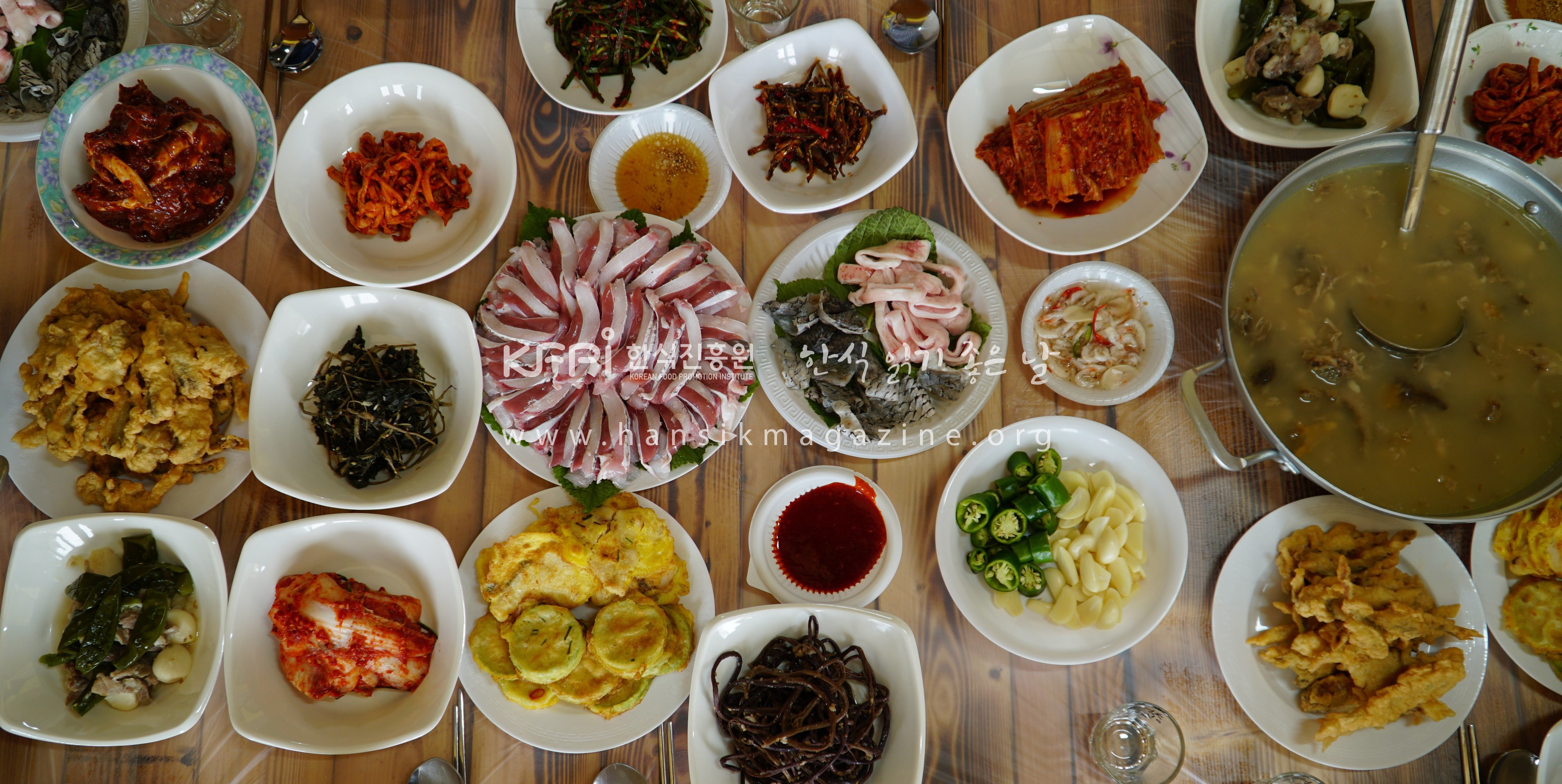
Picture of Mineo dish table at Hanakwol-do ⓒGang Jeyun
Mineo having particularly outstanding taste of head flesh and skin,
all of which is edible except for gall bladder
Mineo 民魚 is a warm-current fish belonging to the Mineo genus of the Mineo family in the bass order. In <Jasaneobo> by Jeong Yakjeon, Mineo was called Myeoneo 鮸魚 with its genus name of Mineo 民魚. It has a habit of staying in the deep sea during day and moving to water surface at night. Mineo is called differently depending on the area or the size. Usually, only the largest Mineo is called Mineo, the mid-size Tongbangmaengi, and the small size Tongchi. In Jeonnam area, the large Mineo was called Gaewoochi, while the fish around 30㎝ in size were called Hongchi at Yeongkwang, and the small-size fish were called Bultunggeori at Wando. At Incheon, the fish smaller than two spans was referred to as Bogulchi, those around three spans as Eosregi, and only those large than four spans as Mineo. Recently, at the Songdo consignment, those weighing less than 2kg are called Tongchi, and all of those more than 2kg, Mineo. The largest fish among Mineo available at the consignment market weighs about 20kg. Most of them are female fish, while the largest male fish weighs around 15kg.
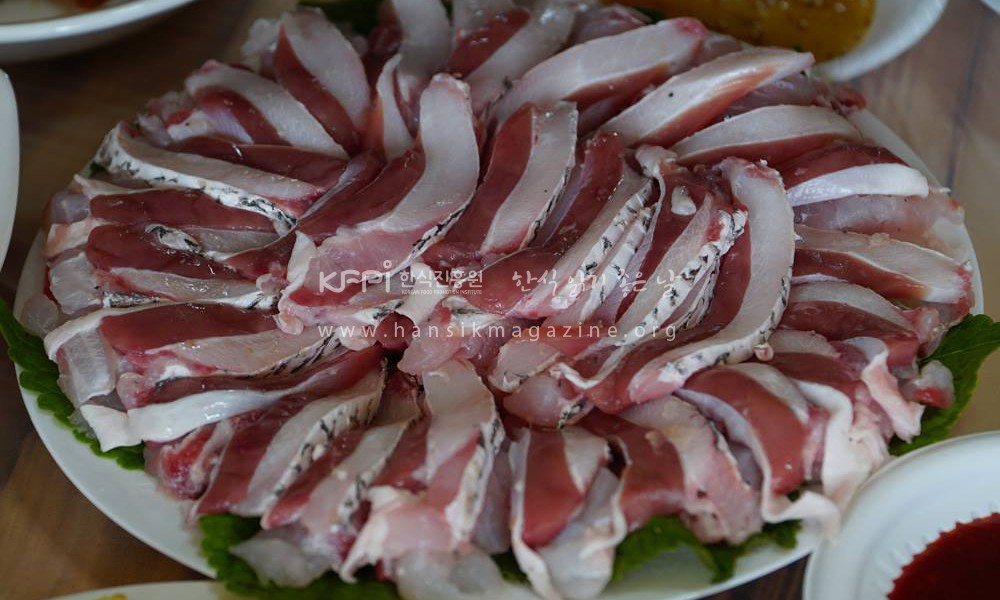
Picture of belly flesh hoe of Mineo Gaetmuraegi
ⓒGang Jeyun
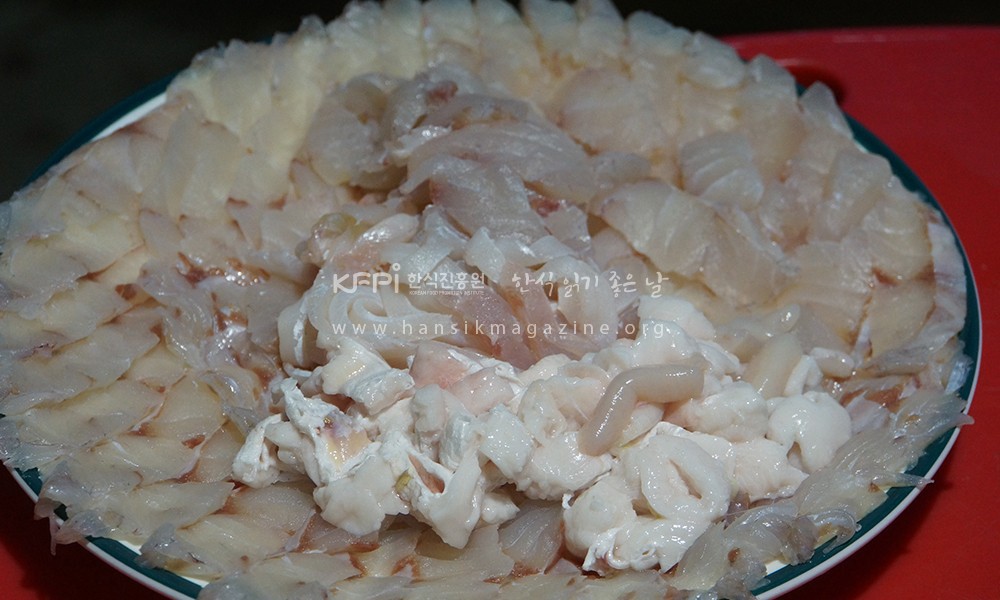
Picture of live MIneohoe at Wuido
ⓒGang Jeyun
Mineo used to be the fish most frequently served on table for memorial service or feast. It was very renowned as not only hoe, soup or baked fish, but also jerky, egg jerky, salted spawn. All Mineo excluding gall bladder was edible. Since it was a big fish, tastes varied from part to part as with tuna so that eating methods varied as well. That is why the poet Kim Ockjong sang “Back flesh was put on Makjang for eating, the neck flesh wrapped around by Mukeunji for eating, the cheek flesh has Oijjanji laid on for eating, the air bladder, breast flesh & belly flesh are wet by red pepper sesame oil paste for eating, the rib and dorsal fin flesh may be finely minced and mixed with refined salt to produce the minced bone for eating” Mineo has particularly outstanding tastes in head flesh and skin. From the old days, the skin has been eaten blanched or raw generating the high popularity to the extent of producing a food talk “The habit of wrapping Mineo skin around rice ended up with selling of both fields and paddies” Mineejeon(croacker pancake) is considered the best among fish pancakes. The soft and delectable Mineo flesh melts gently in the mouth. In the old days when adhesives were rare, the cow hide was dissolved into glue, Mineo’s air bladder boiled into fish glue to be used as an adhesive. Air bladder was also eaten raw so that dipping it in the oil—salt sauce allows proper feeling of its flavor. Only when the air bladder is added to Mineotang(croaker stew), its thick soup flavor is soaked out. By filling air bladder inside, Mineosundae(croaker blood sausage) was also prepared for eating. Imja-do people dried Mineo in summer for the repeated ingestion. Dried Mineo is eaten as steamed dish and stew, where the Mineotang boiled with mountain bell flower added, in particular, was considered as the best health food for mothers who gave birth to a baby. Men added and boiled Deodeok beneficial to the vigorousness energy for eating. Recipes of a special class are hidden in the island.
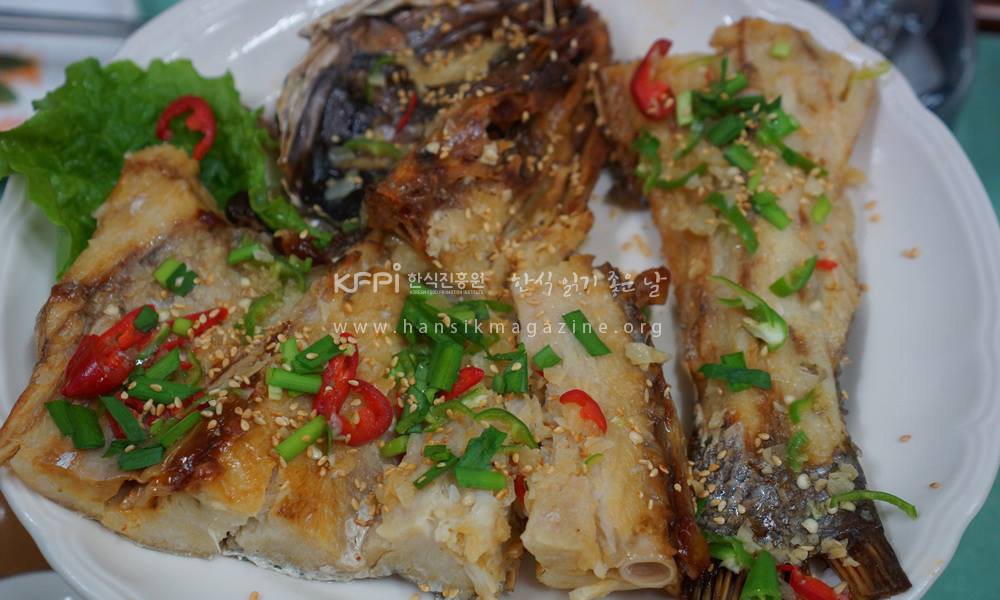
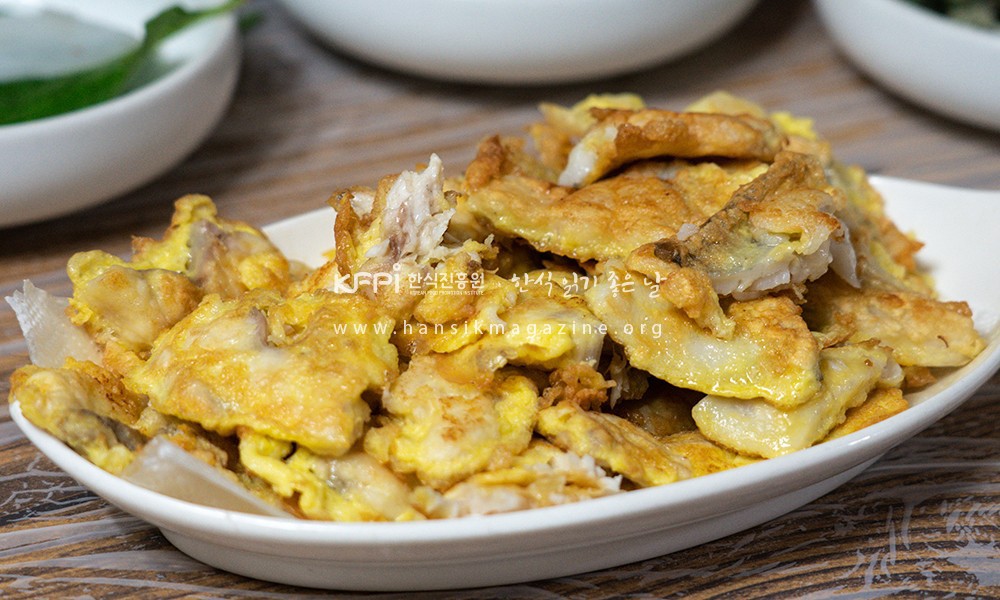
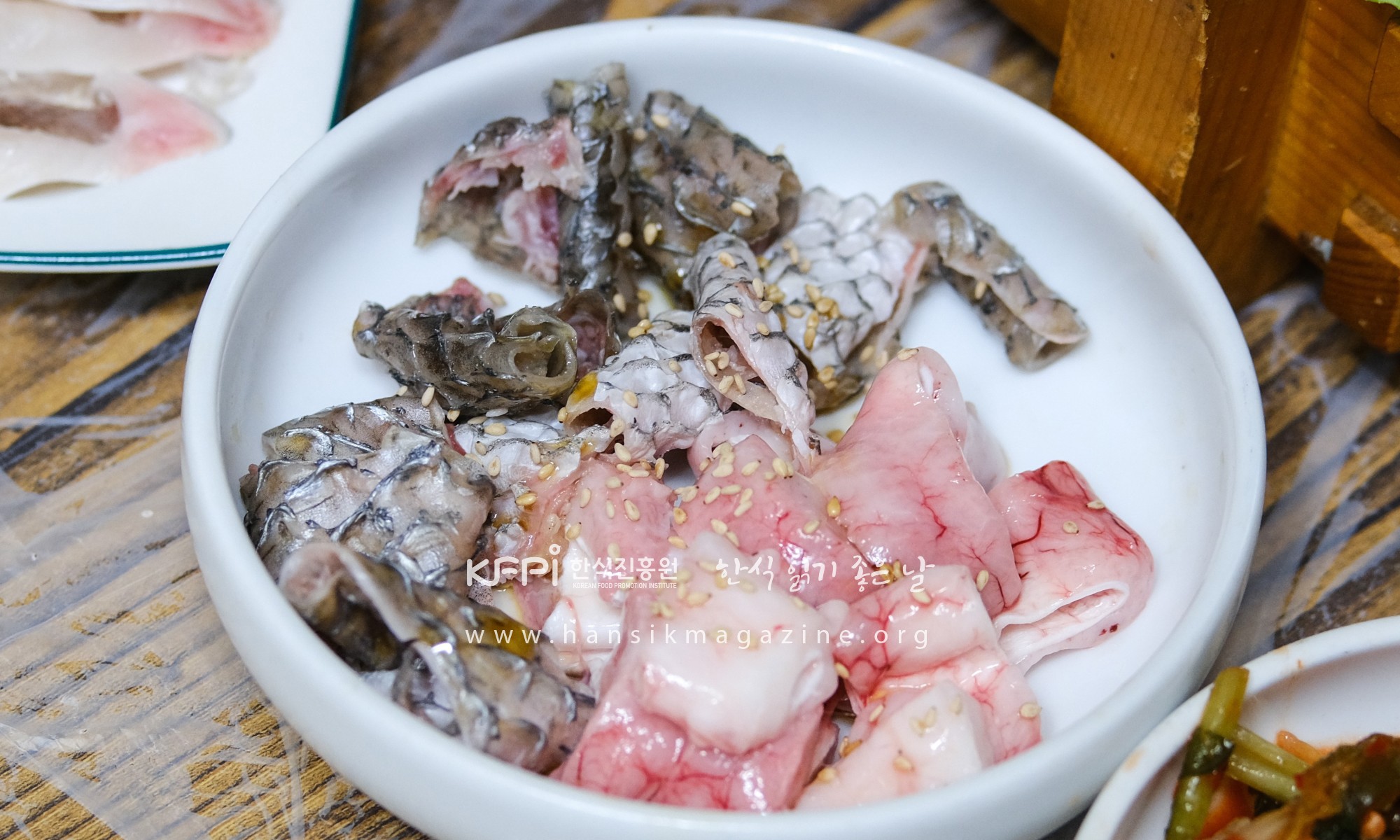
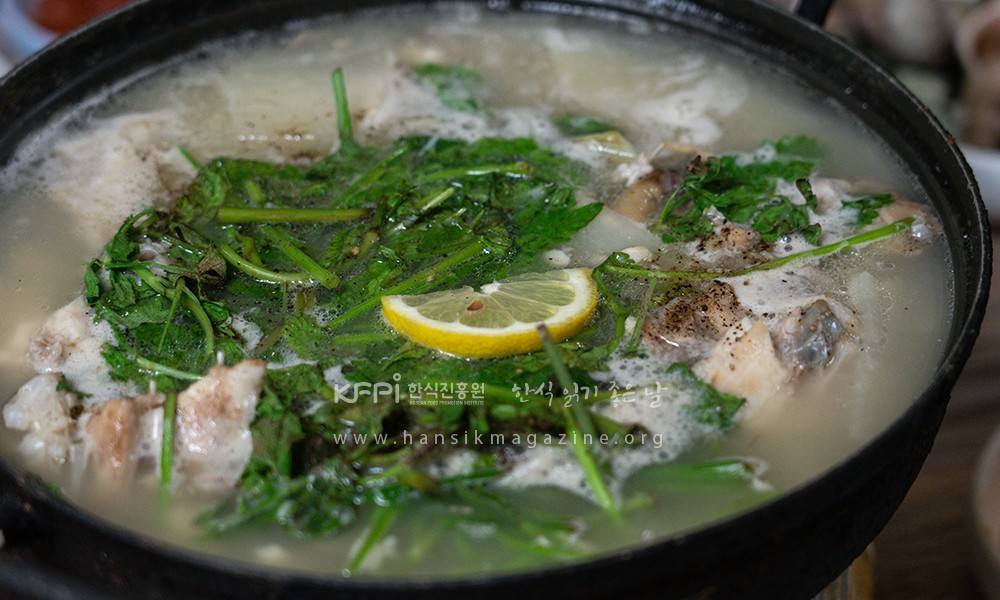
Mineojjim | Mineojeon | Mineo skin and air bladder | Mineotang
Returning of a few Mineo does not mean the end of waiting
Mineo moved around as a legion like the yellow croaker. Old fishermen encountered in Imja-do testify by saying “Red back of Mineo was reflected into the water, coloring the whole sea red” when the Mineo group was gathered in the sea of old Imja-do. Mineo cried out loudly like frogs. To the extent that people could not get to sleep. It was the sound produced by air bladder as the air control organ. Old-day fishermen stuck bamboo barrel in the water to listen using their ears and to find around where Mineo was coming. Since not only Imja-do but also Deokjeok-do and Guleop-do in the coastal waters of Incheon were also the Mineo’s spawning place in the past, Incheon still has the tradition of eating Mineo. This is why there are hoe restaurants specializing in Mineo at Incheon Shinpo market. However, the Mineo production is declining every year. While there is a record of catching up to 20,000 tons in 1924, it continued to decline as the fishing technology is developed and vessels are scaled up, reaching only 3,692 tons in 2017. This is a statistical figure allowing the extent of exhaustion in the sea to be known right away. The fact that the ocean laying golden eggs is dying is attributable to the combined reasons such as all kinds of ocean garbages, pollutants, dense fishing nets catching even fries and large-scale over-fishing of chase and catch using fish finders, reduction of spawning areas due to collection of sea sand, etc. Until when can we taste Mineo produced by this sea? Unless there are no active efforts to recover the fish resources through ocean restoration, we may become unable to eat Mineo anymore. Hence, the song of a poet “Returning of a few Mineo does not mean the end of waiting” is hurting.
Time does not cry aloud,
Returning of a few Mineo does not mean the end of waiting.
From the time of digging up the sand field where shrimps played for building of a house,
we won’t be able to see the pink-colored inner flesh of Mineo singing at the knife tip anymore as it
comes up in the sea where Ojeot, Yukjeot having failed to bear offsprings in the sand field without
plankton make the large-eyed herring cry, yellow corbina babies cry,
butter fish cry and there is no lugworm for smacking your lips.
- From 'Mineo’s song' by Kim Ockjong
Edited by Gang Jeyun Photo by Han Heeseok Published by Korean Food Promotion Institute
Gang Jeyun
Poet and director of Island research laboratory. He has visited and recorded more than 400 islands during more than 20 years.
Authored <Jeolla-do travel for island tastes>, <Golden era of sea. Pasi>, <Shinan, A story on land and people of Korea>, etc.