


한식에 대한 다채로운 이야기를 전하는 온라인 매거진
Vol 28. Bokbunja & Subak - Jeolla-do
Hansik Archive
When did we start eating watermelon?
Hansik glossary
Subak - Watermelon
Subak, the fruit that you think of in summer
Cherry, oriental melon, plum, grape…
There are many summer fruits that make you momently forget
About the sultry summer heat with a sweet and cool taste,
But the most summer-like fruit is subak(watermelon).
Everybody may have at least a good memory related to the subak such as - in the fruit shop,
Tapping multiple subak in order to pick a sweeter subak,
or after cutting a large subak into dices and putting it in the refrigerator and
Having it with the family in the evening together.
The origin of the subak, so familiar to both men and women of all ages,
Is presumed to be tropical Africa.
It was said to have been cultivated even in the ancient Egyptian period.
When did the subak spread from the far African continent to the Korean Peninsula?
Because the eunuch, Han Munjik, who was in charge of the royal kitchen,
Stole and used the subak for himself,
He was penalized by 100 hits and exiled to Younghae.
ㅡ
Annals of the Joseon Dynasty
It is estimated that eating subak in the Korean Peninsula was at the end of the 13th century. According to Heo Gyun's <Domundaejak 屠門大嚼>, which introduced the famous local souvenirs and delicacies of whole Korean areas, "Hongdagu, 洪茶丘(1244-1291), who assaulted Goryeo people by betraying Goryeo and naturalizing in Mongolia, was the first to plant subak in Gaesung". From such a record, subak seemed to be delivered via the Western Regions to China, Song Dynasty and Goryeo Dynasty.
Subak is the summer fruit that can be easily accessible but was a very rare fruit in Josun Dynasty.
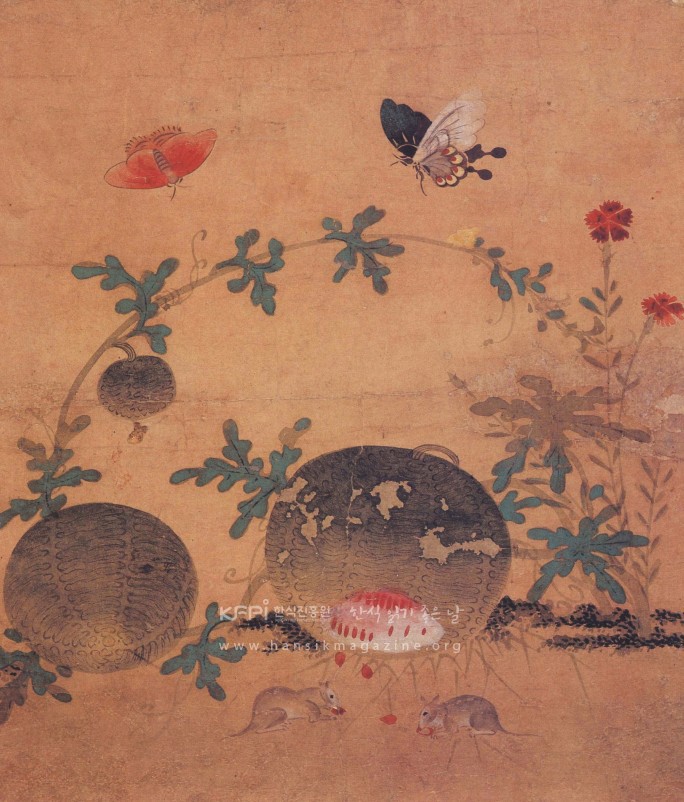
ⓒ Sinsamdang, Suban and Vole, 16th century, National Museum of Korea
There is a subak in the picture, and two voles ate the subak, revealing the red flesh of the subak.
Butterflies also smell subak and gather in. Next to it is a red-flowered dianthus flower.
As recorded in the 5th year of King Sejong's ruling of the Annals of the Joseon Dynasty, thinking of the record saying that a eunuch, working in the kitchen of the palace, was sentenced for a theft crime of 100 hit penalty and exiled to Younghae (old name of Youngduk area, Gyeonsangbuk-do), we can tell subak was a precious eatery not as the usual one in recent time. For this reason, in the mid-19th century, Lee Kyu-kyung, a scholar who studied practical matters in the Joseon Dynastye, emphasized in his book <Oju Hyunmunjangjeonsango 五洲衍文長箋散稿> that if you put the subak peels in a jar and make the pickle, it will be a good side dish like radish kimchi. It was after the middle of the Joseon Dynasty that the subak, which was so precious, was cultivated widely enough to appear as a material for painting.
[Reference]
Encyclopedia of Korean Culture
Editorial Dept.