


한식에 대한 다채로운 이야기를 전하는 온라인 매거진
Vol 59. Tteok, an Age-old Korean Delicacy
Rice Cakes: Steamed with Dedication and Patience
The Wisdom of HANSIK
Today, rice cakes are enjoying a revival in Korea through the spotlighting of these colorful and delicious delicacies as a dessert. There are so many types of rice cake that it defies calculation. Traditionally, nevertheless, rice cakes were grouped into categories based on the way in which they are cooked. This article explores why, of the four major methods, steamed rice cake is the most prevalent.
Article Lee Hyunju (Editorial Team) Sources “Suggestions for quality improvement of rice cakes and traditional Korean rice confectionery from the perspective of cookery science” (Kim Hyangsook, professor at Department of Food and Nutrition, Chungbuk National University), K FOOD: Secrets of Korean Cuisine (Design House)
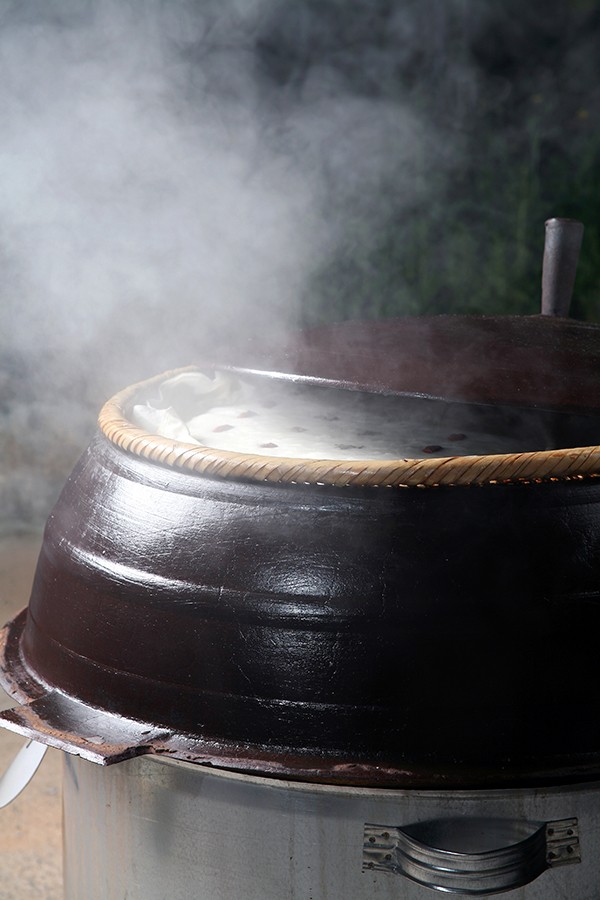
A steaming traditional Korean iron pot, Gamasot (C) Sapyeong Gijeongtteok
The most popular rice cake
There is an infinite variety of rice cakes in Korea—not only because of differences in cooking technique but also the endless number of ingredient combinations. Nevertheless, rice cakes are customarily divided into four categories: steamed, pounded, grilled, and boiled. Of these, steamed rice cakes is the most common.
In Korea, there are over 100 types of steamed rice cakes, which are subdivided according to whether the rice is steamed in a single lump or multiple layers, kneaded, or fluffed up: called baekseolgi, sirutteok, songpyeon, and jeungpyeon.
“Seolgi” refers to rice cakes that are made by mixing rice powder with water or honey and then steaming in a siru. This type can be made with plain white rice (baekseolgi) or with chestnuts, persimmon, honey, or mugwort. “Kyeotteok” is a rice cake that is made up of layers, which usually have various ingredients in between them. The best-known example is sirutteok: the kind often used for ancestral rites has red beans between the layers. Songpyeon, the rice cake eaten during Chuseok, is made by shaping each piece by hand before steaming, while duteoptteok is shaped during the steaming process. Jeungpyeon is made by creating a batter of non-glutinous rice powder and liquor that is fermented, poured into a frame, and then steamed after being sprinkled with jujubes, julienned rock ear mushrooms, or pine nuts. The sheer variety of steamed rice cakes indicates the great passion that premodern Koreans had for making rice cakes.
Cooked with steam
The prevalence of rice cakes today is leading to comparisons with bread. The two are, obviously, different in flavor, but the fundamental difference is in how they are cooked. Bread is baked, while rice cakes are (usually) steamed. In the West, fire is primarily used for baking. In East Asia, fire was used in multiple ways, of which steaming was especially favored and highly-developed.
Steaming is a cooking method with many details that one needs to get right. Its biggest advantage is that steam cooks the ingredients in a way that preserves their natural flavors and fragrances while distributing the heat evenly.
Books from the Joseon dynasty show that diverse methods of steaming were used. In Jeungbo Sallim Gyeongje (Revised Farm Management), which was published during the reign of King Yeongjo, there is a description of a dish for which meat and liquor, vinegar, and jang are placed inside a ceramic vessel, the vessel’s spout is blocked, and the contents steamed over a weak fire. In Imwon Gyeongjeji (Encyclopedia on Rural Living), which was published in the reign of King Heonjong, meat is described as being steamed after adding miscellaneous sauces so that the latter seeps into the meat and only a small amount is left afterward. Gyuhap Chongseo, which was written during the reign of King Sunjo, also mentions steamed dishes (“Braised quail should have just enough broth to coat the entire bird after it is cooked”). These records show that premodern Koreans were well-acquainted with the principles of steaming and how it should be done for each type of ingredient: namely, by applying steam to a siru or pressure pot or double-boiling.
Steamed dishes were always served at banquets. Official royal records of the Joseon dynasty feature various examples. Wonhaeng Eulmyo Jeongni Uigwe (record of the 60th birthday celebration of King Jeongjo’s mother), which was published in 1797, mentions steamed carp, gray mullet, chicken, abalone, quail, beef, and pork. So many steamed dishes were prepared in the palace that there was a position in the royal kitchen dedicated exclusively to boiling water for them.
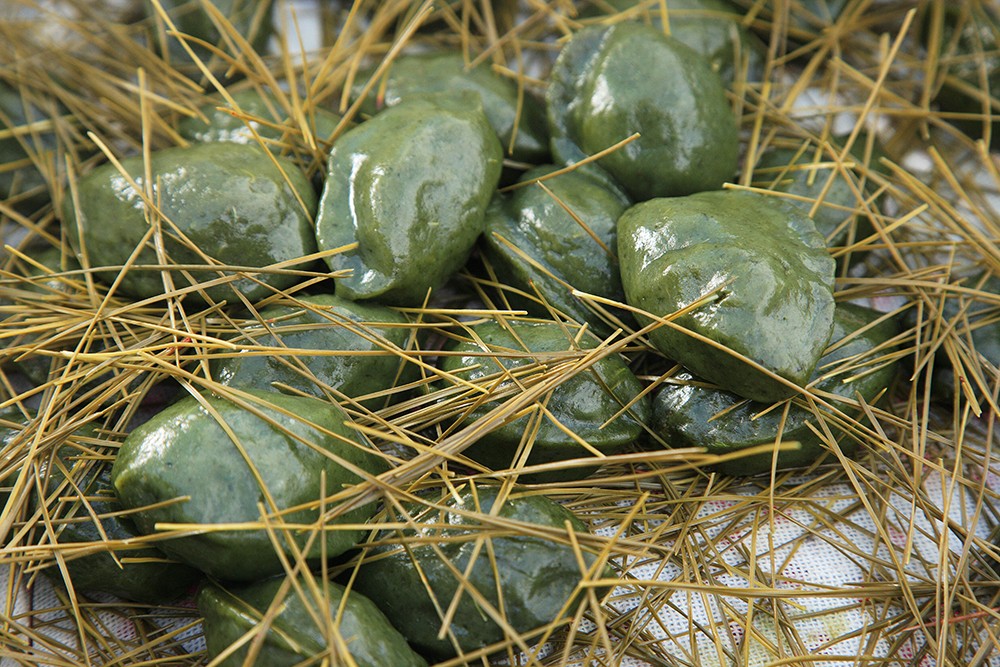
Songpyeon (C) Cultural Heritage Administration
The merits of freshly-steamed rice cake
Let’s return to our discussion of steamed rice cakes. In the past, siru were usually made out of clay or brass. Although they are rarely found in kitchens today, every household had at least one siru until several decades ago. The siru is made up of two parts: a deep pot with holes in the base and a flat dish for holding water that, when boiled, produces steam that goes through the pot’s holes and cooks the food inside. At 100 degrees Celsius, water turns into a gas, which has a lot of heat energy. Of the various types of water-based cooking techniques (boiling, parboiling, etc.), steaming is the method for which the highest temperature is used.
When ingredients are boiled in water, they inevitably break down. One benefit of steaming in a siru is that the food is exposed to only the heat of the steam, allowing it to maintain its shape. More importantly, steaming preserves an ingredient’s flavor and minimizes nutrient loss. Cooking via direct contact with fire or water results in physical or chemical alteration. Steaming, on the other hand, heats with the heat energy of water vapor particles, which intensifies flavors while drastically reducing nutrient loss.
It is easy to assume that steaming rice cakes is easy: all you have to do is shape them nicely and then put them into the siru. What we usually fail to see, however, is the vast amount of time—in other words, dedication and patience—that is needed to make rice cakes. There are many aspects that must constantly be monitored: rice cakes cannot be too hard or moist and must not be too sweet or plain. Because they cannot be “fixed” during steaming (e.g. by adding an ingredient or tasting to check the flavor), rice cakes require even more attention in the cooking stage. It is the combination of all of these efforts that leads to the inimitable perfection of a dish of freshly-made rice cakes. Hopefully, this article will help you better appreciate a piece of warm rice cake on Lunar New Year.
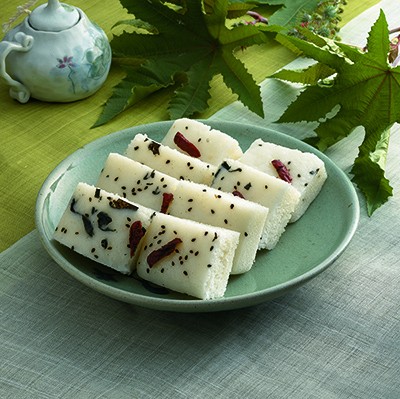
Jeungpyeon, a type of steamed rice cake