


한식에 대한 다채로운 이야기를 전하는 온라인 매거진
Vol 59. Tteok, an Age-old Korean Delicacy
Three Steamed Rice Cakes That Never Grow Old
The Tasteful Table 2
Today, bread is more familiar to younger consumers than rice cakes. Nevertheless, there are some rice cakes that continue to be sought out for daily consumption and as gifts for their sweet flavors, chewiness, and beautiful shape. There are three top-selling steamed rice cakes that satisfy all of these conditions: sirutteok, baekseolgi, and songpyeon.
Article Cha Yeji (Editorial Team)
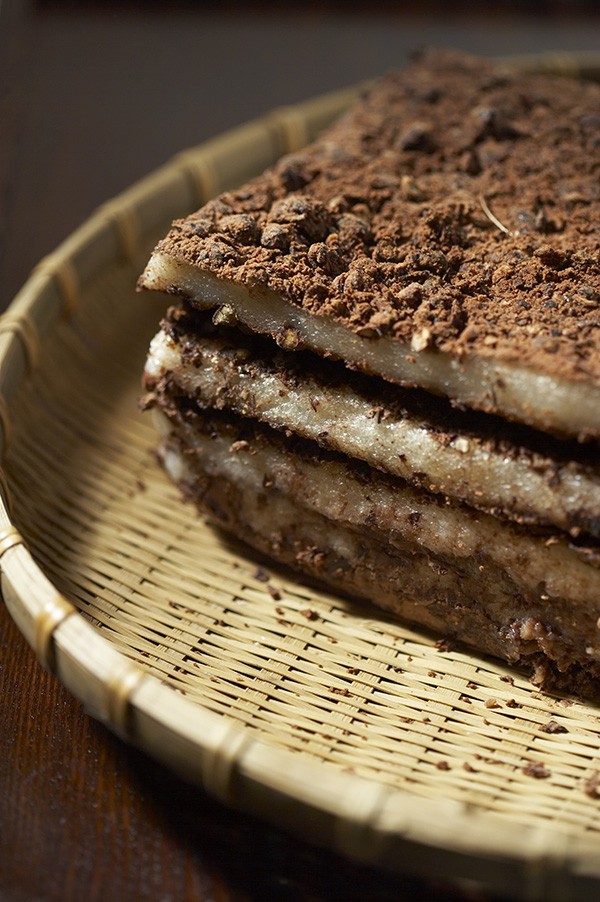
Sirutteok
Sirutteok: A warm greeting
Originally, “sirutteok” was a term that referred to all rice cakes steamed in a siru. Contrary to the image most people have of sirutteok as layers of white rice cake stacked alternately with crushed red bean, Gyuhap Chongseo, a cookbook from the Joseon dynasty, states that there are dozens upon dozens of types of this version of the rice cake. It seems that, centuries ago, sirutteok was made with freshly-harvested persimmons, jujubes, radishes, and various other ingredients. Today, only a few survive: pat sirutteok (steamed rice cakes with red beans) and ones that include pumpkin and beans.
Because sirutteok made in the traditional way was not very sweet, it became customary to add ingredients to sweeten the flavor. Indeed, Gyuhap Chongseo praises the taste of sirutteok made by steaming thinly-sliced radishes with rice powder and red beans. Pumpkin was another natural sweetener often added to pat sirutteok. Pumpkin slices would be dried, soaked in honey or sugar, and then placed in between the rice powder and red beans. The blend of the subtle sweetness of the red beans and pumpkin remains popular today.
Pat sirutteok is the most frequently-consumed of the surviving types of sirutteok—the main reason being the red color of the beans (which was believed to ward off evil and bring good fortune). Because of this, it was served for festive occasions, such as village feasts and weddings. The origin of this connection is believed to be the rituals held for a household’s ancestors or guardian god at the end of the harvest, around October, for the family’s well-being. The modern-day equivalent is the practice of sharing pat sirutteok with one’s neighbors after moving to a new home or, for business owners, with neighboring stores after moving to a new business location.
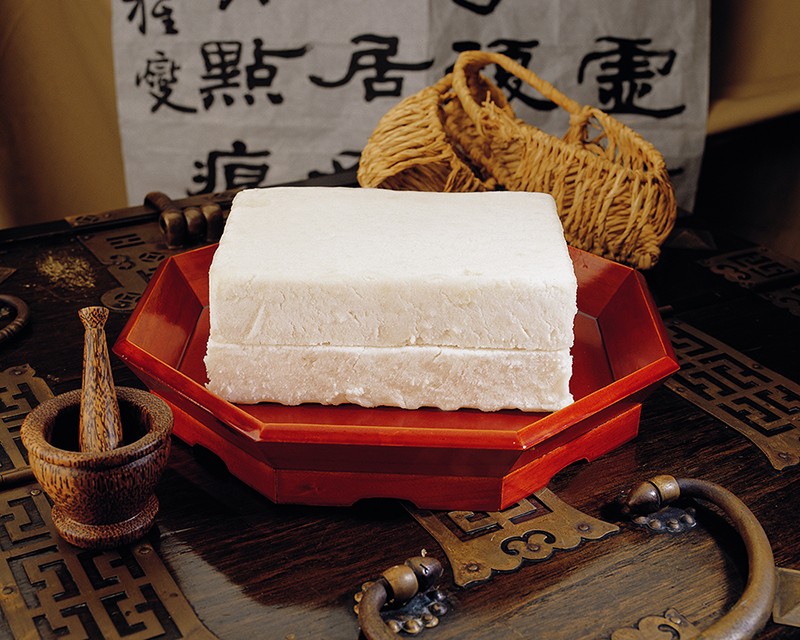
Baekseolgi
Baekseolgi: Hopes for worry-free happiness
In a very broad sense, baekseolgi can be regarded as a type of sirutteok. Characterized by the absence of ingredients other than rice powder, the savory mildness of the rice is as pure as its color.
Indeed, its flavor and color gave baekseolgi a reputation as a “sacred” food early in its history, resulting in it being included in ritual offerings to the gods. Baekseolgi was (and is still) served for a child’s 100th day or first birthday in the hope that the baby will grow up to have a spirit as pure as the rice cake.
Another reason for its popularity is the simplicity of its ingredients. As it is prepared with only one ingredient, baekseolgi is easy to make at home. It also is blessed with a universally-appealing flavor. It is the rice cake of choice for special occasions because it has a white surface that is easy to decorate with images or words and, if desired, can be shaped into a Western-style cake.
The “white t-shirt” of rice cakes (both in the literal and figurative sense!), baekseolgi can be flavored with virtually any fruit, grain, or vegetable. It is called japgwabyeong when mixed with chestnuts, jujubes, and persimmons, which is referred to as “japgwapyeon” in Gyuhap Chongseo and “japgwago” in Jeungbo Sallim Gyeongje.
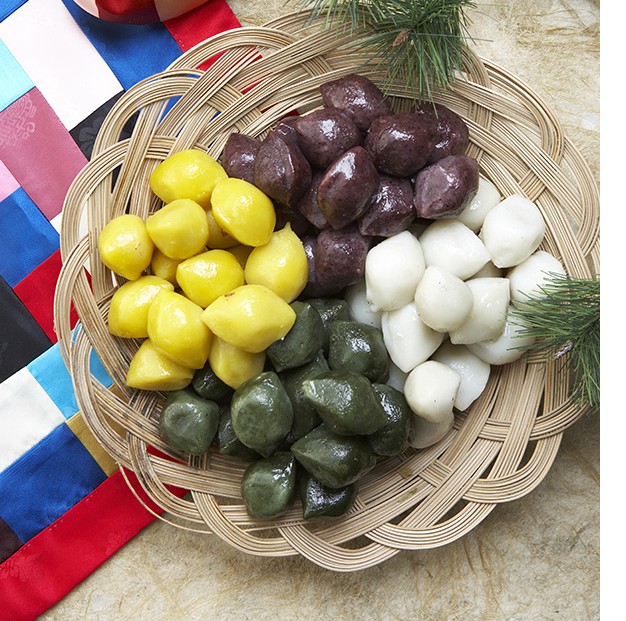
Songpyeon
Songpyeon: Beautiful circles of color
Songpyeon, which is included in the food offering presented to the family’s ancestors every Chuseok, is made by creating a batter with hot water and non-glutinous rice powder and then stuffing it with various ingredients. Today, only a few households make their own songpyeon now that ancestral rites have been simplified. Traditionally, however, a family would make songpyeon together during the Chuseok holiday. Part of the fun was making the rice cakes look as nice as possible due to the belief that well-shaped songpyeon would result in a beautiful baby.
Because songpyeon was made by steaming a batter of hot water and rice powder instead of steaming rice powder directly, the rice cakes often lost their shape or became stuck to one another during steaming. To prevent the rice cakes from sticking, a layer of pine needles is usually laid down before steaming, which also has the effect of giving the cakes a pleasing woody scent.
The most important part of songpyeon is, by far, the filling, which is called “so” in Korean. The filling was usually sesame seeds, chestnuts, beans, red beans, or mung beans that were chopped into very small, thin pieces and mixed with sugar—which melts during steaming, resulting in a bite of songpyeon being as sweet as it is savory.
Songpyeon varies slightly in color and shape by region. In Seoul and most parts of Gyeonggi-do, the batter is made with rice powder and ingredients such as gardenia seeds or mugwort, giving it various colors. In Gangwon-do, the batter includes potatoes, a local specialty. Potato songpyeon is shaped by pressing with the fingers (so that the pressed places are visible after steaming) and translucent because of the starch. In the Jeolla provinces, songpyeon is made by mixing leaves from the ramie plant, which is grown in Goheung-gun, into the batter, giving it its characteristic green color. Called “mosi songpyeon,” it is very chewy because of the ramie leaf’s fibers.