

한식에 대한 다채로운 이야기를 전하는 온라인 매거진
Vol 59. Tteok, an Age-old Korean Delicacy
Chewy with a Subtle Scent of Makgeolli: Rice Cakes Made with a Grandmother’s Recipe
HANSIK Master
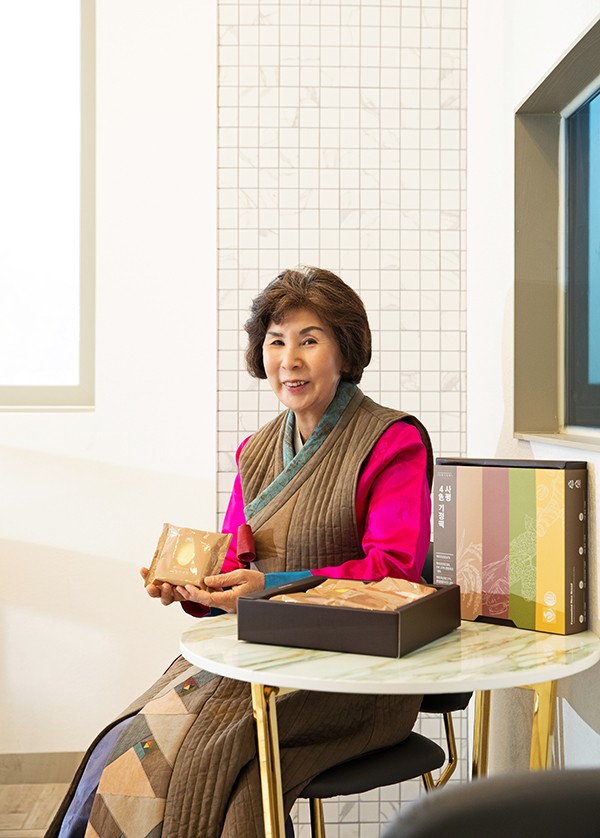
One’s first experience with gijeongtteok (or jeungpyeon) is always special. A bite of Korean Grand Master Ku Kyeongsook’s version was even more so. The steam wafting from the white rice cake, the slightly sour scent of makgeolli, the pillow-like texture, and the fact that the rice cake melts in your mouth almost instantly—all of these factors only accentuate the flavor, an addictive combination of warm rice and the sweet-and-sourish aftertaste of fermented rice.
Article Seo Dongchul (Editorial Team) Photos Lee Daewon (SSAUNA Studio)
Q. Your family has made gijeongtteok for three generations, starting with your maternal grandmother and followed by your mother and then you. You must have a lot of memories about your grandmother.
I was the oldest daughter, and both of my parents worked far from home. My maternal grandmother, who loved me very much, raised me in my mother’s childhood home here in Sapyeong-myeon (Hwasun-gun, Jeollanam-do). I lived with her from when I was a baby through elementary school and until I got married. We were so close that she sometimes said I was more like a youngest daughter than a granddaughter.
My maternal grandmother, who was the wife of the head household of the Jeonui Lee clan, had a special talent for cooking. She was famous in her village: any time there was a feast, she would be asked to oversee the food preparation and table settings. Growing up, I saw on an almost daily basis the foods that are made for the many, many ancestral rites conducted by a jongga (head household of a clan), such as yugwa (deep-fried sweet rice cake), gangjeong (sweet rice puffs), sikhye (sweet rice punch), jocheong (grain syrup), yeot (rice taffy), tteok, and liquor. Whenever my grandmother made rice cakes, I helped out by pounding the batter in the mortar, lighting the kitchen fire, and sprinkling garnish over the cakes. I remember being scolded for stealing bites of the hard-boiled rice set aside for makgeolli or sikhye. I strongly believe that seeing is learning. It is what I learned by observing my grandmother at work that allowed me to become a Korean Grand Master.
Q. You must have seen many types of traditional rice cakes, including gijeongtteok, as a child.
We ate a lot of gijeongtteok in the summer. On a hot summer day, any other rice cake made in the morning would spoil by evening. Gijeongtteok, because it is fermented, could be left at room temperature for three days and be just fine. To be honest, I didn’t really like it because of the alcohol smell. I much preferred sweet and chewy rice cakes. Knowing this, my grandmother would hide some sticky rice cakes and give them to me on the sly.
Her natal family, which was known to be wealthy, fell into difficult financial straits for a reason I wasn’t aware of. This prompted my grandmother to make various types of rice cakes and sell them at the market. Looking back, although her products were obviously not lacking in taste, because she had no business experience, they did not sell very well. I remember that a neighbor who operated something similar to a tavern, upon seeing that my grandmother was struggling, sold her rice cakes for her at the tavern.
Q. I understand your mother operated a rice mill.
In 1982, my father, who had lived in Busan for a long time, retired. He then said that he wanted to return to his home village to farm the land. My mother, on the other hand, wanted to try running her own business instead of going into farming. She ended up taking over a mill that someone put up for sale right around that time. That was the start of our arduous journey of selling rice cakes. My mother didn’t know much about making rice cakes, but she soon caught on. Her rice cakes gained a reputation, which helped keep the mill going. I think the success of the rice cakes was because my mother, like me, had learned a lot by watching my grandmother.
We made and sold almost every type of rice cake that people enjoy, such as kkultteok (honey-filled rice cakes), sirutteok, jeolpyeon, seolgitteok, and injeolmi. We also squeezed perilla and sesame seeds into oil and ground peppers into powder. Eventually, word of my mother’s mill spread beyond Hwasun-gun. People from Gwangju, Naju, Boseong, and Suncheon came by bus and stood in line to buy our rice cakes. It was the result of my grandmother’s recipes combined with my mother’s honesty and generosity.
Q. From 1990, you operated the Jangdeung Rice Mill with your mother. How was the family business, essentially, passed on to you?
When my parents opened the mill in Sapyeong-myeon, I was married and living in a different city. As a result, I couldn’t visit very often, let alone help out. After my mother turned 60, it started getting harder for her to run the business on her own. She suggested that I operate it with her. At the time, Sapyeong-myeon didn’t have running water, so you had to pump water from a well. You can imagine what it was like to live and work there. At the time, I had no clue I would end up making rice cakes for a living. Knowing what her request would entail, I was hesitant. One day, my mother took a bus to Yangpyeong-gun in Gyeonggi-do, where I lived, to persuade me. That’s how I was dragged to the rice mill!
Q. It must not have been easy to operate a mill.
I realized very quickly that helping out for a few hours and managing the day-to-day business are two completely different things. I came over in July, and so we made a lot of gijeongtteok. The work was truly grueling. Nowadays, to have rice cakes ready by 10am, you can start preparing at 7am. Back then, because everything was done manually, you had to start working at 4 or 5am. I worked most days in a sleep-deprived state. While placing the garnish on the rice cakes, my husband and I would both be nodding off. Sometimes, my mother would come to help: on those days, however, there was just one more nodding head! The worst time was just before Chuseok, when it was not uncommon to work for three or four days without sleeping. I ruined many batches of rice cakes by dozing off while steaming, making the rice cakes a dull clay color—they’d burned up because there was no more water. It was physically taxing, but we did well. Our gijeongtteok was famous throughout Jeollanam-do.
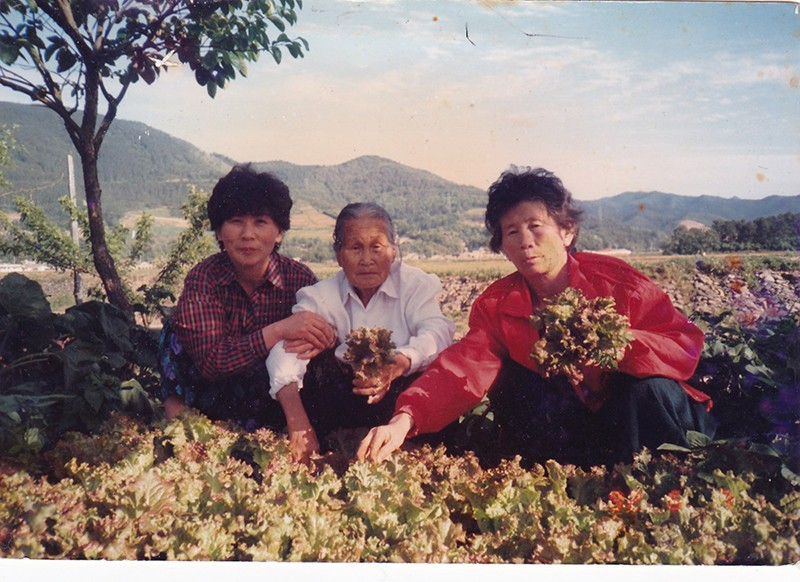
Three generations. Ku (left), her maternal grandmother (center),
and her mother (right). (C) Sapyeong Gijeongtteok
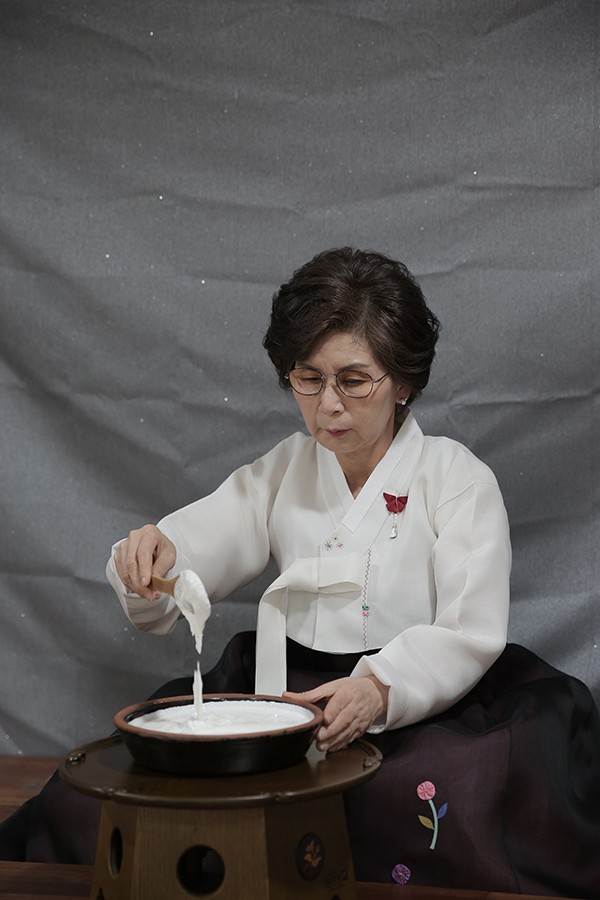
Ku Kyeongsook making rice cake batter (C) Sapyeong Gijeongtteok
Q. You have been concentrating on gijeongtteok ever since changing your company’s name to Sapyeong Gijeongtteok in 2005. Why did you choose this particular rice cake to specialize in?
After years of making, without break, over a dozen kinds of rice cake and ppeongtwigi (rice puffs), squeezing oil from seeds and grinding peppers into powder, I was exhausted. One day, I injured my right hand while using the pepper mill. It made me realize that I needed to narrow my focus. We changed to Sapyeong Gijeongtteok in 2005, as you said, but actually began producing only gijeongtteok in 2002. I chose it because I’m confident in my skills. A lot of customers say that they like our products because they remind them of the rice cakes their grandmother made when they were a child.
Q. Are there any rice cake “tricks of the trade” inherited from your grandmother that you can share with us? What is the difference between Sapyeong gijeongtteok and regular gijeongtteok?
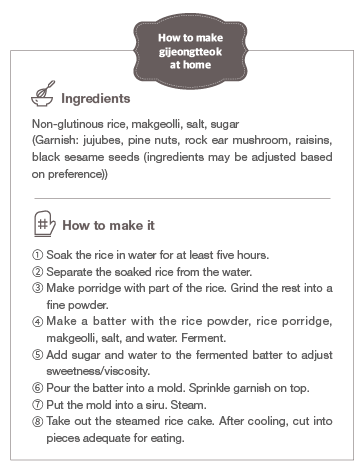
The “secret” of our Sapyeong gijeongtteok is how much we ferment and steam the rice cakes. If fermented too much, the aftertaste is too sour. If not fermented enough, it will not be flavorful. When steaming, you have to keep an eye on the batter to make sure that it puffs up just enough. If the batter rises too much, the rice cake will be full of holes inside. If the batter doesn’t rise enough, the rice cake will be too flat. The timing for both fermenting and steaming vary by the season, temperature, and humidity. This is knowledge that can be gained only through experience.
The biggest difference between Sapyeong gijeongtteok and other types is the fact that we ferment a rice porridge. First, we make a porridge and then mix it with rice powder for the batter, which is then fermented. This makes the rice cakes soft and chewy. Also, as with any other food, it needs to be seasoned just right. Gijeongtteok needs to be seasoned with sugar and salt, which we have quantified to ensure consistency.
Q. You are constantly improving your gijeongtteok, such as by using colorants derived from domestic agricultural produce and reducing the makgeolli scent.
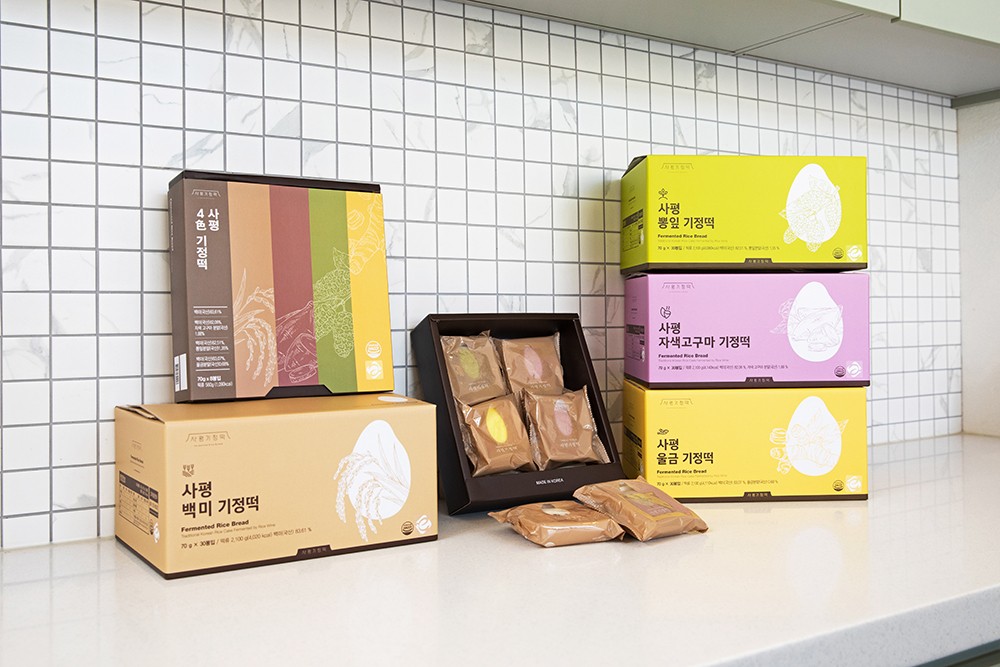
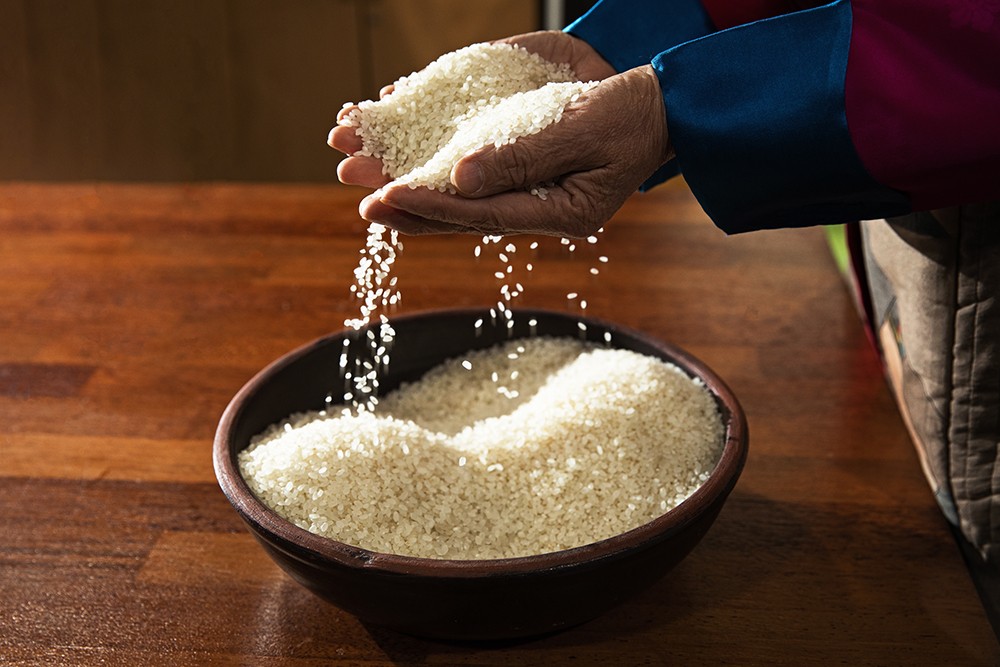
It’s important to have good ingredients. We use only Korean-grown rice and domestically-produced makgeolli (whose yeast has not been heat-treated). Also, we do not use any chemical additives, such as colorants or preservatives. I make rice cakes with the same care that I invest in preparing food for my own family. We experimented with many different kinds of farm produce to create rice cakes that are both healthy and beautifully-colored. We searched high and low for ingredients that dye well and do not brown with time. Today, we dye our rice cakes with turmeric, purple sweet potatoes, and mulberry leaves.
We have also tried very hard to tone down the makgeolli odor for those who are put off by it. Instead of reducing the amount of makgeolli, we decided to adjust the fermentation time. The goal is to make gijeongtteok that is enjoyable for all ages.
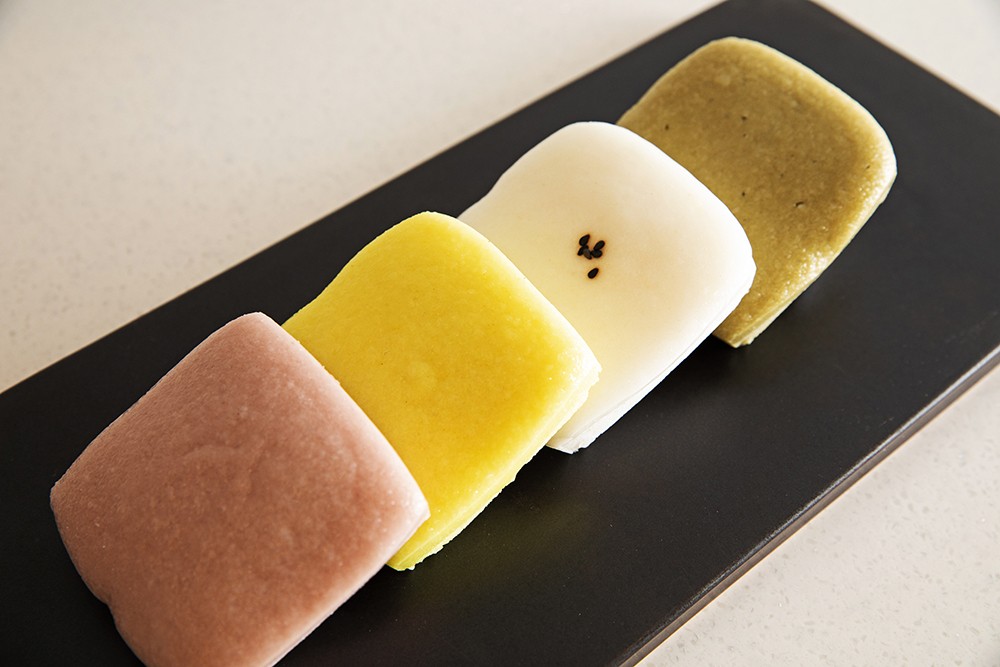
Q. I heard that you are now packaging rice cakes individually for hygiene as well as convenience. How else are you planning to “upgrade” your products?
I’d been wanting to package the rice cakes individually because of the popularity of doing so in the market. We ended up starting in 2008 due to the National Sports Festival, which was held in Yeosu. The organizing committee wanted us to package each piece of gijeongtteok separately so that they could be distributed at the opening and closing ceremonies. With great difficultly, I managed to find a packaging machine online, through which we learned how to individually wrap our rice cakes. That’s how we started selling whole and individually-packaged items. In the beginning, sales of the individually-packaged products were low because of the higher price. Today, demand for them is much higher due to changes in consumption trends. After obtaining HACCP (management system for food product safety and quality from the manufacturing stage until consumption) certification, we stopped selling unsliced rice cakes. Customers also like the dotted line drawn on the paper that we wrap the rice cakes in. Individually-packaged rice cakes are popular because the method is sanitary and makes it easy to eat while walking.
We also try to feature gijeongtteok that reflects the latest culinary trends, such as chocolate or healthy (oat) gijeongtteok. We will continue experimenting with various options using gijeongtteok as the base. You’ll be surprised to know that gijeongtteok is the rice cake whose cooking method is the most similar to that of bread. I’d like to make something that blends these two.
Q. Its similarity to bread seems to be what makes gijeongtteok so versatile. What is the best way to eat it?
Because it is fermented, gijeongtteok is easily digested. It is a good meal substitute or supplement for those who are recovering from illness or, with a glass of milk, a good breakfast alternative for those who are busy in the morning. It can be buttered and grilled, like bread, or grilled and then eaten with salad. It can be sliced into small pieces as a snack for traditional Korean tea and even goes well with coffee. It can be used as a dough/bread substitute when making pizza or sandwiches.