


한식에 대한 다채로운 이야기를 전하는 온라인 매거진
Vol 57. Fermentation and Kimchi
From Soil to Kitchen: “Kimchi Science” Transcends Time and Place
The Wisdom of HANSIK
Kimchi is an undisputed pillar of the Korean diet. Ancient Koreans used two creative methods to keep kimchi fresh and delicious year-round: the onggi (earthenware) kimchi container and the kimchigwang (kimchi storehouse). The principles behind both methods live on today in the modern-day kimchi refrigerator.
Article Lee Hyunju (Editorial Team) Sources Encyclopedia of Korean Folk Culture; “The Science of Kimjang Kimchi” (The Science Times); “What? It’s not a refrigerator?: The Hidden Science of the Kimchi Refrigerator” (JoongAng Ilbo)
Where did that tangy kimchi go?
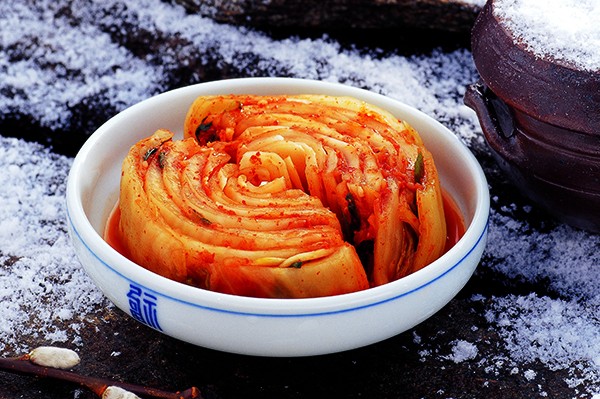
It’s not easy to verbalize what makes kimchi so delicious. Alongside terms such as “sweet and spicy,” “savory,” and “crunchy,” I would like to add jjaeng—a Korean word with no English equivalent that can only be roughly translated as “tangy.” Jjaeng definitely describes the taste of kimchi taken from an earthenware kimchi container in the middle of winter. Today, that perfectly jjaeng taste is difficult, if not impossible, to come by. What was the secret to such delicious kimchi that is so hard to reproduce in the 21st century?
These days, there are not that many families who make their own kimchi. There are two reasons for this shift: the difficulty of making kimchi and the inability to guarantee that it will turn out delicious. Even with the freshest ingredients and after following each step of the recipe, the kimchi needs to be fermented at the right temperature for two or three weeks. It also must be stored well to prevent it from souring: kimchi sours if the temperature is too high and freezes if too low. This is especially important when storing kimjang kimchi to prevent freezing. Even with all of our modern technologies, kimchi is still not easy to make. How, then, did ancient Koreans manage to pull it off? One big part of the “secret” to making great-tasting kimchi was to bury it in the ground.
Ancient Koreans knew the secret to delicious kimchi
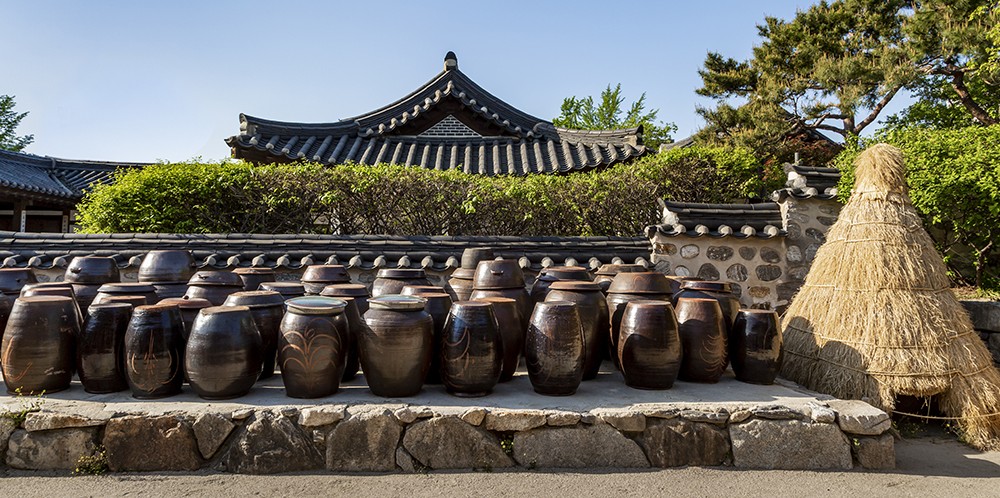
Most people are now familiar with the fact that kimchi’s taste is largely determined by lactic acid bacteria—which is most active at -1 degree Celsius. Obviously, therefore, storing kimchi at -1 degree Celsius will boost its fragrance and flavors. What is fascinating is that ancient Koreans were also aware of this fact, as evidenced by their burying of earthenware kimchi containers approximately 30 centimeters underground (the depth where it is always -1 degree Celsius). After burying the earthenware jar, it was topped above-ground with a hut made of rice straw called a kimchigwang.
Kimchigwang were used primarily in Gyeonggi-do and set up behind the kitchen in an elevated spot (to keep rainwater from entering). After burying the earthenware kimchi jar, three long poles were positioned above it and linked together with a mat of woven rice straw. The entryway was made very small to block cold air and make it impossible to see inside from the outside. All of these conditions allowed the kimchigwang to maintain an optimum temperature for kimchi while keeping out rain and snow. The earthenware jar was, of course, equally important in maintaining kimchi’s taste—namely, through the permeability of the clay, which provided the steady supply of oxygen needed to create an environment conducive to the growth of lactobacilli. Today, the wisdom of the earthenware kimchi jar and kimchigwang continues to provide us with delicious kimchi by being incorporated into the kimchi refrigerator.
Ancient technologies in a modern kitchen appliance
Before the prevalence of apartment buildings, most private homes had their own jangdokdae, or outdoor stand for earthenware jars. After kimjang, the kimchi-filled jars were buried in the ground. After large apartment complexes began being built in Seoul’s Gangnam-gu district in the 1970s, however, the jangdokdae was gradually pushed out of the everyday living space. It is Koreans’ inability to live without kimchi that resulted in the development of a one-of-a-kind storage facility designed especially for it: the kimchi refrigerator.
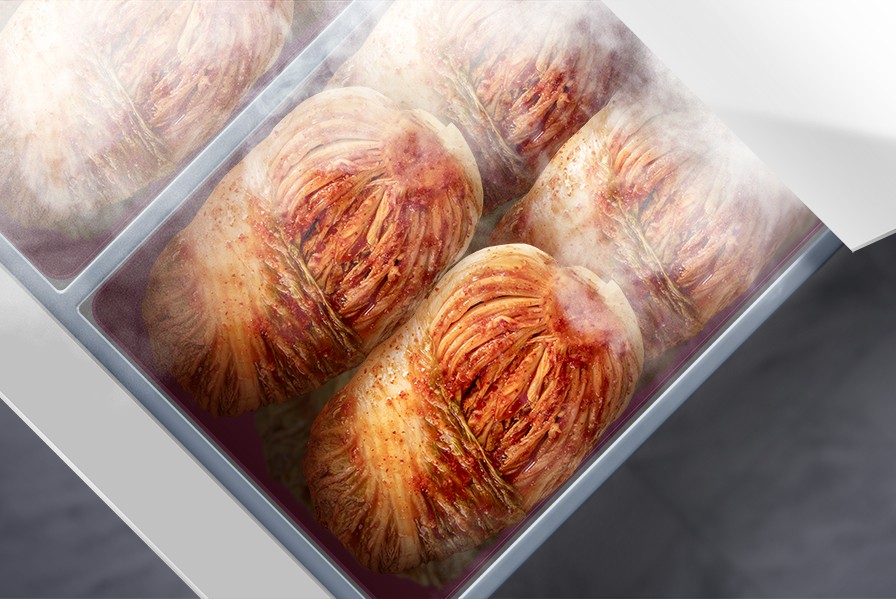
The kimchi refrigerator may seem novel from the outside but is actually based on the principles of the earthenware kimchi jar and kimchigwang. A temperature sensor is used to preserve kimchi at the ideal temperature of -1 degree Celsius. Generally, a household refrigerator undergoes shifts in internal temperature because it is opened many times a day. The average internal temperature of a regular household refrigerator is five degrees Celsius. If left open for 30 minutes, the internal temperature can rise by as much as 20 degrees. A kimchi refrigerator left open for the same amount of time, however, results in a change of only two to five degrees.
As this shows, the kimchi refrigerator is designed to minimize temperature change, even when opening or closing the door. Today, the latest models look like and open like a regular refrigerator. In the early years of the kimchi refrigerator, however, it was designed with a top-opening lid to resemble that of the earthenware jar. Burying the earthenware jar in the ground kept the lid closed under the soil’s weight, which naturally kept air from entering. This minimized the temperature changes that would have occurred if the lid was on the side—due to convection currents.
There is another difference between regular and kimchi refrigerators. The former cools its contents by cooling and moving the air with a fan, while the latter achieves without moving any air. Cooling the refrigeration space without depending on moving the air is a more effective means of maintaining its temperature.
Preserving the flavors of kimchi for eternity
The modern kimchi refrigerator is equipped with, in addition to the wisdom of ancient Koreans, another amazing technology. There is a sensor that detects the air bubbles that form while kimchi ferments, thus providing an indicator of how ripe the kimchi is. The latest kimchi refrigerator models are equipped with even more cutting-edge technologies, including: an air curtain, which minimizes temperature change by keeping cold air circulating inside the chamber and blocking outside air from entering and inside air from leaving; a smart storage function that improves the taste of the kimchi through 24-hour monitoring of the kimchi’s quantity and temperature; and a fermentation mode that is adjustable for different types of kimchi. Expectations for the future of the kimchi refrigerator, therefore, are understandably high.
The size of the Korean kimchi refrigerator market is KRW 1.7 trillion annually, with 1.1 million units sold every year. The desire to keep a cutting-edge kimchi jar in one’s home, which may not be buried in the ground but will definitely keep kimchi fresh and delicious, seems to be here to stay. People lament our loosening grip on tradition, but our love of kimchi will continue for many generations to come.