


한식에 대한 다채로운 이야기를 전하는 온라인 매거진
Vol 55. Flavors of HANSIK Enriched by the Wind
Myeongtae’s Transformation into Hwangtae
Facts about HANSIK
Pollack, or myeongtae, is a marine fish that is a member of the genus Pollachius and called by many names in Korea depending on how it is dried. Hwangtae, bugeo, kodari, meoktae, baektae—the list goes on. Of these, hwangtae is the outcome of a whopping 33 manual processes. However, the preparation process alone is not enough: we can have the privilege of eating hwangtae only with the “help of the heavens.” Let’s see how myeongtae has evolved into the many names it has today.
Article Seo Dongchul Sources Encyclopedia of Korean Culture, Korea Policy Brief
Origin of the name “myeongtae”
Yimha Pilgi, a collection of 39 historical and encyclopedic writings on various subjects authored by Lee Yuwon (who served as prime minister during the reign of King Gojong of the Joseon dynasty), includes a story that suggests an origin for the word myeongtae. A fisherman with the surname Tae lived in a village named Myeongcheon. One day, the fish he caught was served to the local magistrate. The magistrate, delighted with the fish, asked its name, but no one knew it. After hearing that it had been caught by a man named Tae in the village of Myeongcheon, people started calling the fish myeongtae. The name bugeo is said to be derived from the fact that the fish is caught in the North Sea (as bug means “north” in Korean).
Interestingly, however, given the large population of the fish in Korea’s eastern waters at the time, the terms myeongtae and bugeo rarely appear in documents until early Joseon. The earliest mention is through a word similar in pronunciation to myeongtae (無泰魚) in Survey of the Geography of Joseon, a geography book compiled by Lee Haeng and Yoon Eunbo, two civil officials of early Joseon, based on Survey of the Geography of Joseon.
The fact that myeongtae is not mentioned in official documentation from early Joseon despite its plentiful numbers is said to be due to the superstition that one must not eat an unidentified fish, which may be why catches and consumption of the fish increased drastically after it was given the name myeongtae. Some also say that it is because myeongtae was confused with pollack (called “daegu” in Korean).
It was in the 19th century that myeongtae, thanks to being easy to catch, became a favorite Korean fish. According to Survey of Fish in Nanho Region, a treatise on fish written in 1820 by Seo Yugu (a scholar and civil official of late Joseon), “myeongtae” is the fresh version, while “bugeo” is the dried version. The book also notes that, due to myeongtae’s fertility, Korea’s waters were teeming with it, and that it was the most frequently-caught fish along with cheongeo (a type of herring). This suggests that myeongtae fishing was already a major industry in the early 1800s.
Unfortunately, catches of myeongtae in Korea’s waters have decreased sharply in recent years due to the climate change-fueled rise in ocean temperatures. In 1980, 160,000 tons of myeongtae were caught, but this figure dropped to 10,000 tons by 1990 and under 100 tons by 2004. In 2008, no myeongtae were caught at all. The myeongtae that is dried today in places like Yongdae-ri are caught in Russian waters. Nevertheless, hwangtae—in short, wind-dried myeongtae—can be said to be “Made in Korea” as opposed to Russia because the drying is still done on Korean soil.
Hwangtae takes root in Gangwon-do
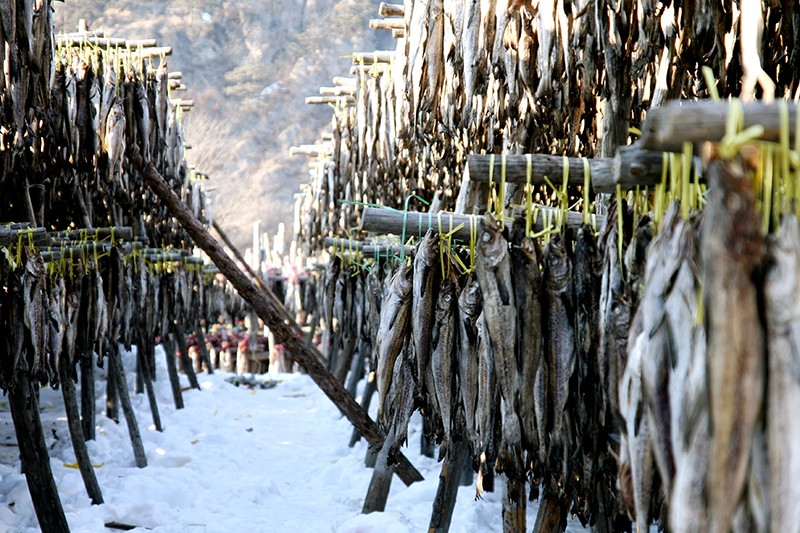
If you visit a mountain village in Gangwon-do in the winter, you will see deokjang (places where myeongtae is hung to dry) lining both sides of the highway. The story goes that deokjang began being made by those who came from Wonsan, Hamgyeongbuk-do (today, North Korea)—a place that was famous for myeongtae—during the Korean War and settled throughout Gangwon-do. After several trial-and-error attempts, these individuals settled down in the 1960s in two areas: Yongdae-ri (Buk-myeon, Inje-gun) and Hoenggye-ri (Daegwallyeong). Yongdae-ri, which is known as the “hwangtae village from the heavens,” is responsible for 70 percent of Korea’s hwangtae production.
Yongdae-ri has all of the conditions necessary to produce hwangtae: subzero winters, high inter-seasonal temperature differences, lots of wind, and lots of snow. Deokjang are usually set up in December by tying logs together, with the task of hanging the fish on the wooden racks begun in January. The hung myeongtae freeze solid at night, when the temperature drops to as low as -10 degrees Celsius, and thaw during the day under the warm sun. This cycle of freezing and thawing continues for three months: it is through the snow that falls on the myeongtae seeping into the fish and then repeatedly freezing and thawing that the dry, slightly-yellowed, and soft flesh of the hwangtae is formed. The saying goes that hwangtae is “a 70:30 partnership of heaven and human.” Indeed, the climate of the place where deokjang are located is more important than any amount of human diligence.
From “myeongtae” to “hwangtae”
As mentioned earlier, myeongtae is a sea fish with many names. Saengtae is fresh myeongtae, while nogari is baby myeongtae. Saengtae is dongtae if frozen, bugeo if dried for about 60 days, and kodari if half-dried for about two weeks. Myeongtae is also called by a different name depending on where it is caught. Fish caught far from Korea (usually the North Pacific or Bering Strait) are called wonyangtae, while those caught in Korea’s eastern waters—albeit virtually extinct today—are called jibangtae.
There are names given to myeongtae for each of the many time-consuming and painstaking processes that must be undertaken to turn it into hwangtae. Myeongtae hung to dry on a deokjang that have turned white because the weather is so cold are called baektae. On the other hand, when temperatures start rising after winter, the fish takes on a blackish hue, leading it to be called meoktae or jjintae. Tongtae is fish hung to dry whose entrails were not removed by accident, naktae is fish that fell off the drying rack due to strong winds, and mudutae is fish that were dried after the head was removed. Patae cannot be sold whole because the body has too many scars/defects, while kkangtae is extremely tough because it has been drained of all moisture. These five types are shredded into small pieces and sold to those who need to conduct traditional ancestral rites.
Hwangtae is also called by several names. Hwangtae that is especially yellow is called norangtae, while ones that are as dry as deodeok (a type of mountain root) are called deodeok bugeo. Hwangtae that has, through the favor of the heavens, avoided becoming baektae, meoktae, naktae, or patae and endured the freezing-thawing cycle all winter takes on a golden-yellow hue and has soft, fluffy flesh. Hwangtae, by being dried on a deokjang, ends up having double the protein found in myeongtae. It is also rich in amino acids, such as methionine, which improve liver function. The high-protein, low-calorie hwangtae is the perfect food for those who wish to watch their weight.
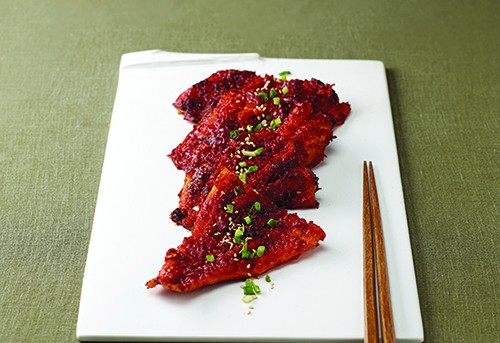
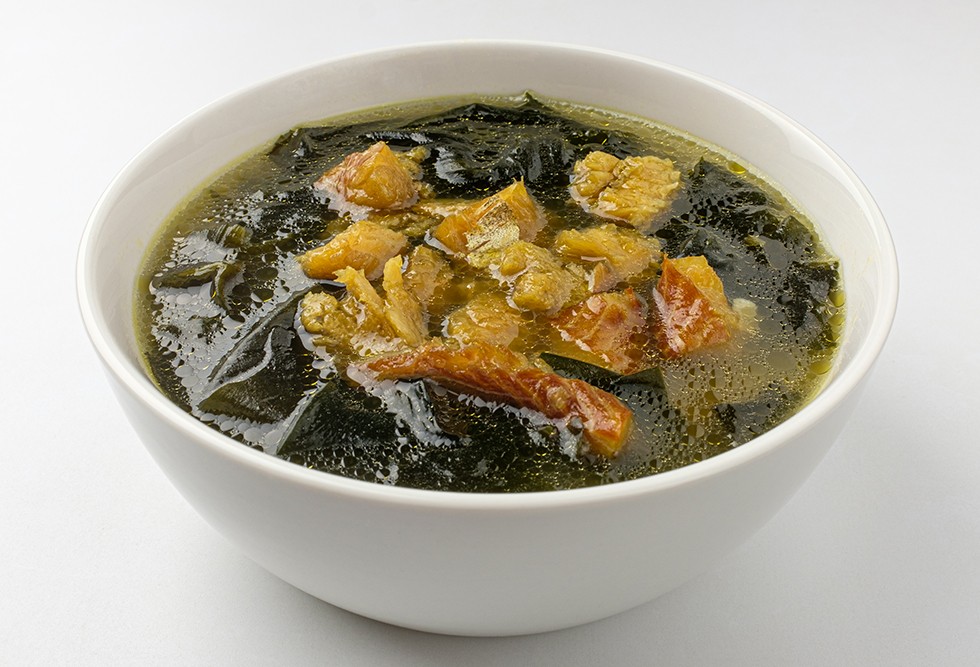
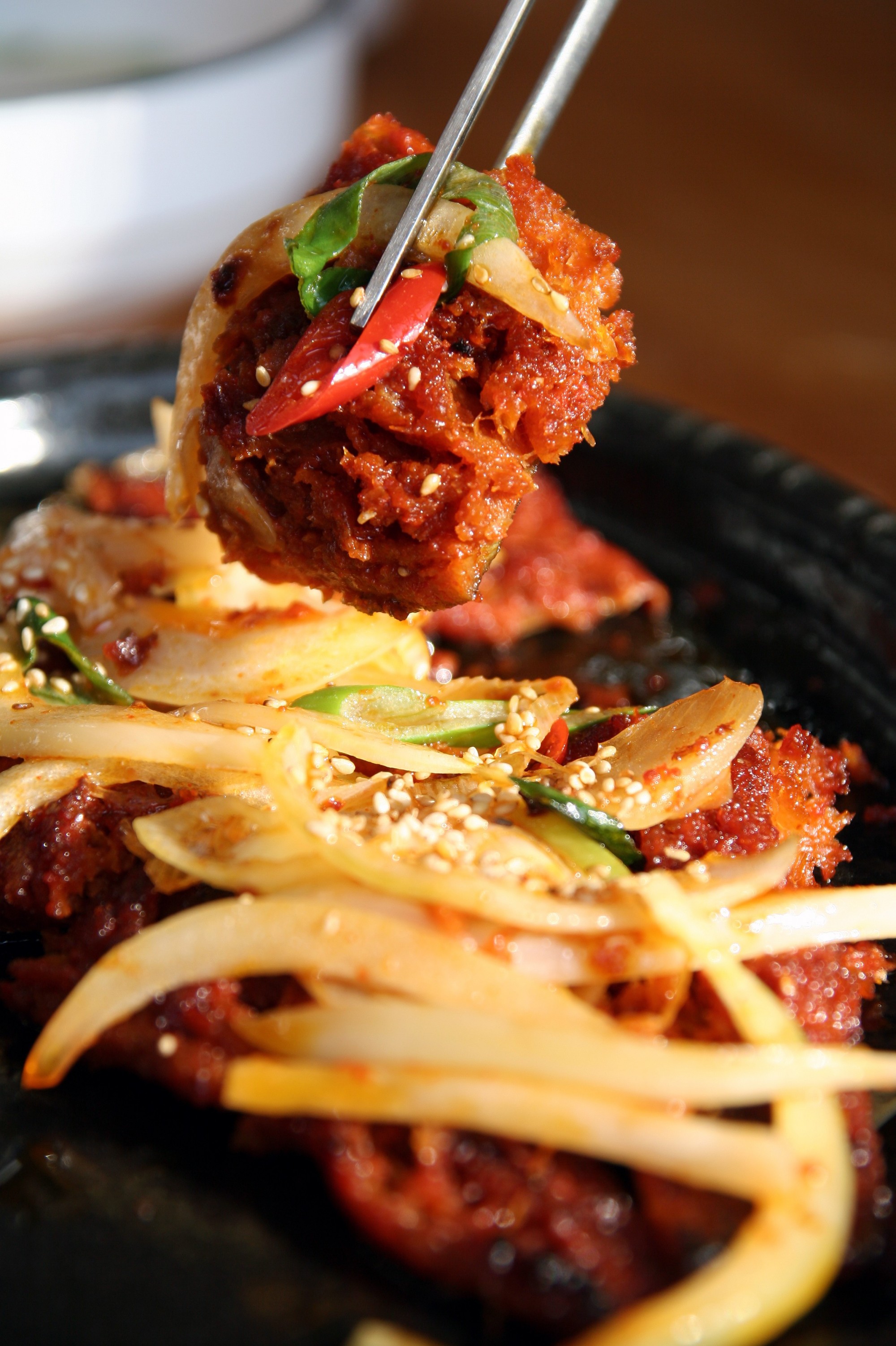
In Korea, autumn has begun, which means that the wind has already become colder. How about a bowl of warm hwangtae soup or hwangtae seaweed soup or a dish of grilled, soft-fleshed hwangtae to revive your appetite?