


한식에 대한 다채로운 이야기를 전하는 온라인 매거진
Vol 54. Ice, the Crown Jewel of Summer
Ice, the Best Way to Beat the Summertime Heat
Ice and HANSIK
Today, there is nothing special or difficult about purchasing ice in the summer. The refrigerator is a near-universal household appliance: it is also becoming much more common to have a water purifier that dispenses ice with the press of a button. Furthermore, every roadside convenience store sells packs of ice. Amid such plenty, we often forget that it was not until the 1980s that the refrigerator became widespread in Korea. Until the 1970s, making something cold to eat or drink at home required children to run to the neighborhood ice store. How, then, did Koreans even further in the past—before the notion of a refrigerator or ice factory existed—obtain ice? How, if at all, were they able to have kongguksu (noodles in cold soybean soup) with cubes of ice floating on the surface? Or cold soups or sikhye (sweet rice punch)?
Article Seo Dongchul (Editorial Team) Sources Cultural Heritage Administration, Korea Policy Briefing, Korea Craft & Design Foundation Traditional Culture Portal

The herculean task of preserving ice until summer
In the distant past, ice was just as essential in the summer as it is today. It was especially necessary for conducting ancestral rites and preparing food for guests. The reason was what you would expect: the amount of food required for a family’s ancestral rites or to serve to company meant that the hotter the weather, the more difficult cooking became due to the accelerated spoiling of ingredients. Ice was also needed to make naengguk (cold soups) and beverages. What is fascinating is that, many centuries before the invention of the refrigerator, ice was available even at the hottest time of the Ancient Koreans had an advanced ice-storage technology that was used to preserve ice collected in the winter. The practice of ice storage in Korea dates back to the Three Kingdoms Period. Samguk Yusa (Memorabilia of the Three Kingdoms) mentions King Yuri of Silla building an ice repository, while Samguk Sagi (History of the Three Kingdoms) notes that, in the 11th month of the 6th year (505 AD) of King Jijeung of Silla, the king ordered ice to be stored. Indeed, the Silla kingdom had a ministry responsible for managing the state ice repositories.
There are also records from the Goryeo dynasty on ice being stored and distributed to those in need. According to the Annals on Pyeongyang, there were two ice repositories, each in a different area of the city. There is mention in History of the Goryeo Kingdom that, during the rule of King Jeongjong, ice was distributed in the fourth lunar month on the first day of summer. It also mentions that, in the third year of King Munjong (1049), high-ranking government officials and retired meritorious officials were supplied with ice from the sixth lunar month until the first day of fall.
In the Joseon dynasty, an ice repository was installed along the banks of the Hangang River in Seoul. As can be guessed from the name “Seobinggo-dong,” a neighborhood in Seoul’s Yongsan-gu district, it was the site of a stone repository (Seokbinggo), called “Seobinggo,” that was built in the fifth year of King Taejo (1396) and managed by the central government. The neighborhood of Dongbinggo-dong, which was named as such because of its location relative to the stone repository (Dongbinggo; with dong meaning “east”), has no connection to the ice repositories of Joseon. The actual Dongbinggo, of which there are no surviving remains, is said to have been located in today’s Oksu-dong district of Seoul at the intersection of the Hangang River and Jungnangcheon Stream. The two repositories differed in terms of where their ice was supplied to: Dongbinggo’s ice was used to keep food used for royal ancestral rites from spoiling, while that of Seobinggo was supplied to the royal palace and merchants affiliated with provincial offices. On the hottest days of the year, ice was occasionally given to patients at Hwalinseo (free hospital for the socially-underprivileged) and prisoners. The repositories were not only effective but large: Dongbinggo could hold up to 10,000 blocks of ice, while Seobinggo could hold over 130,000. There was also a repository called “Naebinggo” on the palace grounds that supplied ice exclusively for the palace. The National Code (Gyeongguk Daejeon) of Joseon included a strict set of rules for how repository ice was to be distributed, suggesting the importance of ice as a national resource.
Eventually, state-operated ice repositories prompted the creation of private ones. After the reigns of King Yeongjo and King Jeongjo (18th century), a private ice repository was established on the banks of the Hangang River, which was a center of trade, to preserve the fish that were shipped from all over Joseon. In 1454, the second year of King Danjong, the Office of the Inspector General (Saheonbu) submitted an appeal to the royal court to allow provincial offices and upper-level government officials to store ice privately because of the “limited nature of the ice that the royal [ice repositories] can hold.”
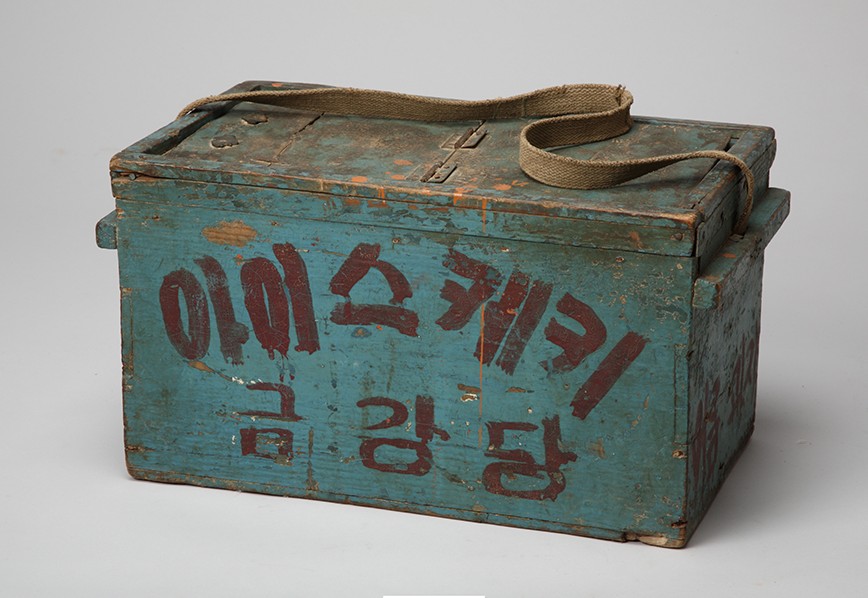
Container for traditional popsicles ⒸNational Folk Museum of Korea
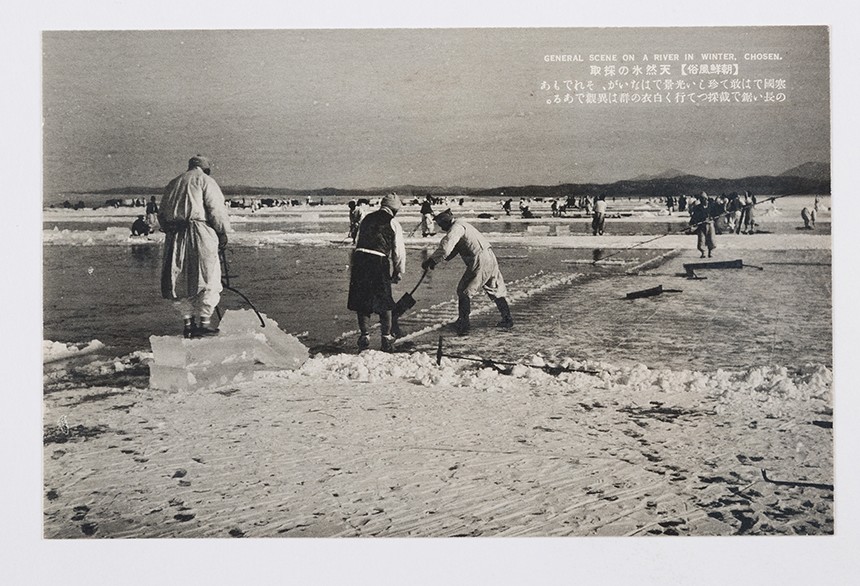
A postcard including a photo of ice being collected ⒸNational Folk Museum of Korea
Ice, a commodity more precious than jewels
The task of collecting ice during winter was a major government initiative that required the mobilizing of many workers for what was, inevitably, hard labor. Indeed, each winter, men who lived near the Hangang River hid from the authorities to avoid having to collect ice to the point that there was a word (氷庫靑婦; literally “ice repository widow”) used to refer to young women whose husbands had run away from the ice collection mobilization. Those who failed to run away (“ice husbands”) had to, on the coldest days of winter, carve out ice blocks approximately 12 centimeters thick and bring them to Dongbinggo and Seobinggo. It is easy to understand how many of these workers, in an age before down-padded coats, suffered from frostbite in their hands and feet. Government officials of Joseon were aware of the hazards of ice collection, leading them to give workers small rice paddies or rice and liquor to enjoy as a snack while working.
The hardships of collecting ice were surpassed only by the difficulties of managing it: if a repository’s ice melted, the government employee in charge of managing the repository was fired. In the 24th year of King Seongjong (1493), a group of military officials were harshly punished for delegating the work of storing ice to their servants while they went out for a drink. Once it was discovered that the water of the melted ice was flowing out of the repository, the enraged king fired all of the employees of the provincial office that had jurisdiction over the region served by the repository. It is said that, in the following year, the newly-hired employees worked assiduously to keep the ice intact, resulting in the repository being full of ice until fall. In the fifth year (1423) of King Sejong, 830 bottles of liquor and 1,650 fish were presented to the military officials responsible for ice management. In the 13th year of King Sejo (1467), the king’s personal eunuch and a middle-ranked ledger official were sent to oversee the treatment of frostbitten soldiers at Dongbinggo and Seobinggo—an incident that clearly shows how valuable ice was to the state.
At the time, the first and foremost function of ice was to preserve food and be included in certain foods. According to the principles of Oriental medicine, using ice stored in winter in the hotter months indicated a restoration of the natural balance due to the repression of the summer’s excessive yang energy. The nation’s ice supply was such a high priority that, just as rain prayer rituals were held in times of drought, similar rituals were held in years when a mild winter kept the Hangang River from freezing over.
Due to the difficulties involved in collecting and storing ice, ice-topped summer beverages were a luxury that could be enjoyed only by members of the royal family and upper class. Boiled noodles were rinsed in icy water (making them chewier) to prepare dishes such as naengmyeon (cold buckwheat noodles), chogye guksu (cold chicken noodles), and kongguksu. Only the wealthiest and most powerful members of society were able to enjoy delicacies such as ice-laden mulhoe (cold raw fish soup), cucumber naengguk (cold soup), seaweed naengguk, hwachae (punch), and omija tea. Older Koreans will remember the “ice cake” merchant, who sold popsicles from a wooden box filled with ice that he carried on his shoulder, and the widespread use of ice boxes made from wood or Styrofoam in lieu of refrigerators. Before the Korean summer comes to an end, why not enjoy the ancient luxury of ice through delicious summer foods—such as a bowl of patbingsu (shaved ice with sweetened red beans and other toppings)?