

한식에 대한 다채로운 이야기를 전하는 온라인 매거진
Vol 53. Korean Food from the Oceans and Rivers
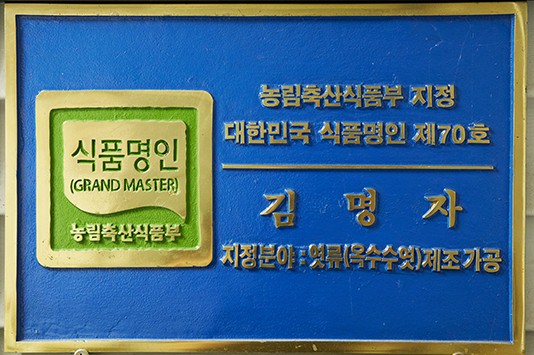
Korean Food Master No. 70: Kim Myungja (corn yeot)
HANSIK Masters
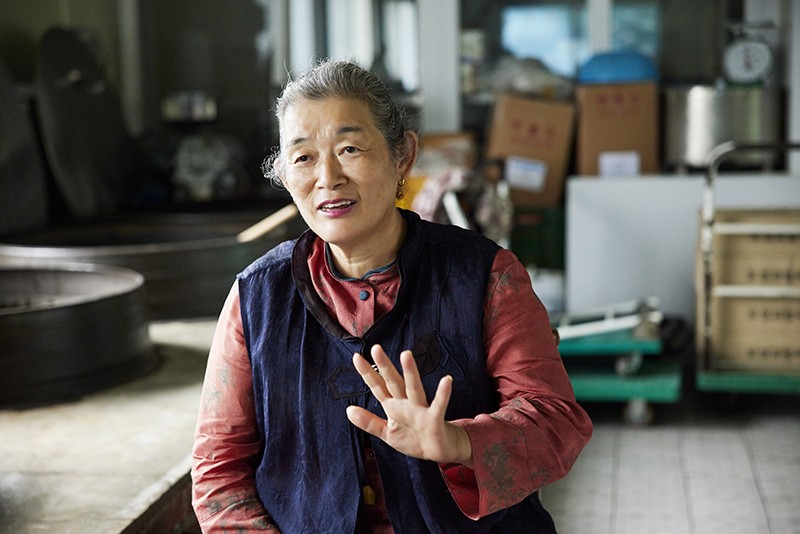
A bite of gaengyeot, a reddish-black taffy that is made by boiling corn for many hours, turned my expectations upside-down: having expected a hard and sticky texture, the yeot soon grew soft, leaving a pleasantly sweet aftertaste. To my surprise, the sweetness was not overpowering. The gaengyeot (unpulled taffy) was sweet and had a depth of flavor that I kept thinking about long afterward. I asked Kim Myungja, a master of corn yeot, the secret to such deep sweetness.
Article Seo Dongchul (Editorial Team) Photos Kim Seongjae (SSSAUNA Studio)
Q. Hwanggol Village has been famous for its corn yeot for centuries. How did you come to know the village?
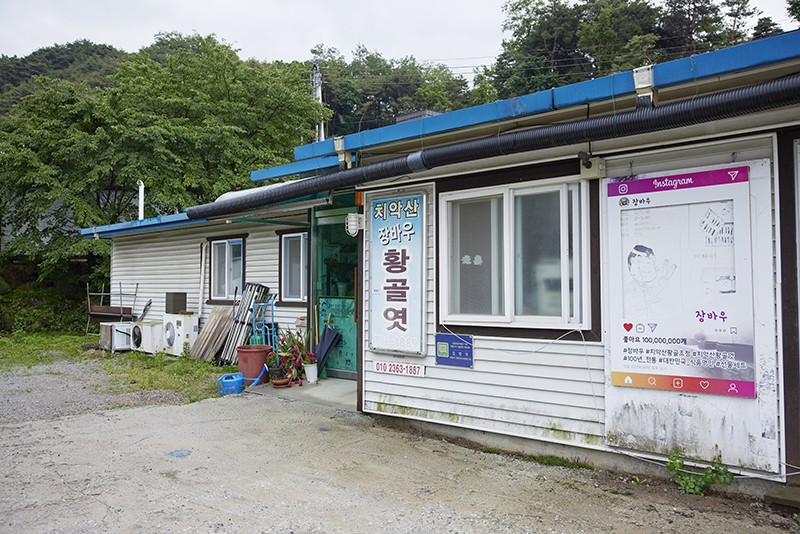
The corn yeot of Hwanggol Village, which is located at the western edge of Chiaksan Mountain, has a long history. There is a record that the teacher of Lee Bangwon (second king of Joseon), Won Cheonseok, enjoyed yeotsul (makgeolli made with yeot and several other ingredients)—meaning that our yeot is at least 600 years old. I am from Beolgyo-eup, Boseong-gun, Jeollanam-do, and I got my first job in Busan, which is where I met my husband, Kim Chanyeol. I was about 30 when I moved here. We took a train from Busan, got off at Wonju Station, and took a taxi along the dark, winding roads to Hwanggol Village. I was shocked by my surroundings the following morning: the village was surrounded by mountains. It was so remote that I wondered how we managed to get here at all. My first impulse was to run, which I was unable to do because there were very few buses: therefore, no way to leave!
Q. What was life like in Hwanggol Village in those years?
Being a mountain village in Gangwon-do, residents made their living in one of two ways: dry-field farming or making corn yeot or grain syrup. People grew corn, potatoes, sorghum, and perilla. In the spring and fall, a lot of people also raised silkworms. November through spring was yeot season: this time of year is not only the idle season for farmers but also the time of year when the temperature and humidity are right for making good-quality yeot. Hwanggol Village still has about 10 hwanggolyeot manufacturers and sellers other than Jang Bawoo Chiaksan Hwanggolyeot. The village has changed a lot over the years: it now has cafes, pensions (small-scale accommodations), and restaurants. Its signature brand, however, is still hwanggolyeot.
Q. Wasn’t it difficult to learn the recipe for corn yeot, which we understand has been passed down for a century?
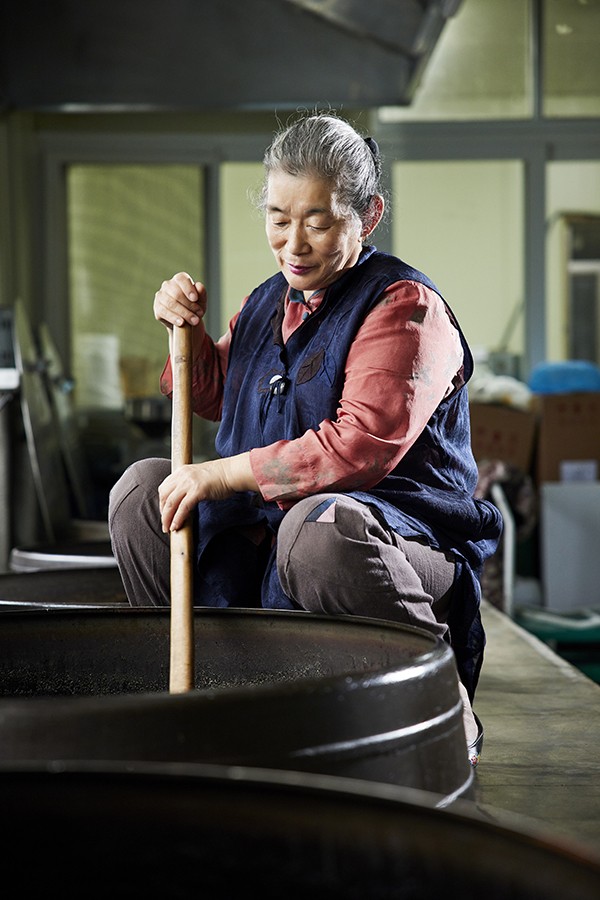
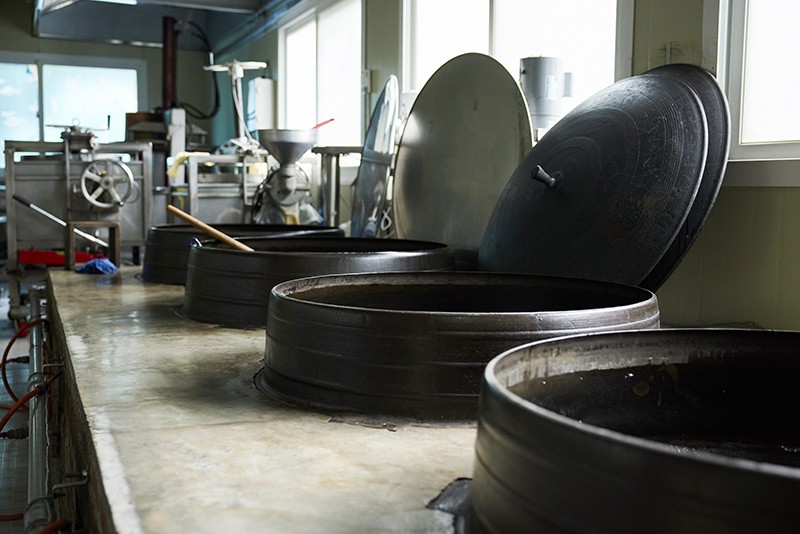
The hardest part was that I didn’t get enough sleep. After making dinner, I went to sleep at 10pm and had to wake up at 1am. Because I had to stay in front of the cauldron until morning, I dozed throughout the day because I was so tired. After breakfast, we had to do the packaging. After lunch, the yeot-making process started up again. The cauldrons, which were filled to the brim with liquid yeot, had to be stirred constantly with a long ladle. Needless to say, my shoulders and arms always ached. I briefly considered purchasing some machines to take over the manual labor. I quickly dropped the idea, however, because I knew that, in addition to being an embarrassment to my mother-in-law (who passed the recipe down to me) and everyone else in the family who had come before me, I would not be able to produce the same level of flavor through mechanized stirring.
Q. We heard that hwanggolyeot, because it is so soft, can be eaten as gaengyeot without having to shape it into sticks.
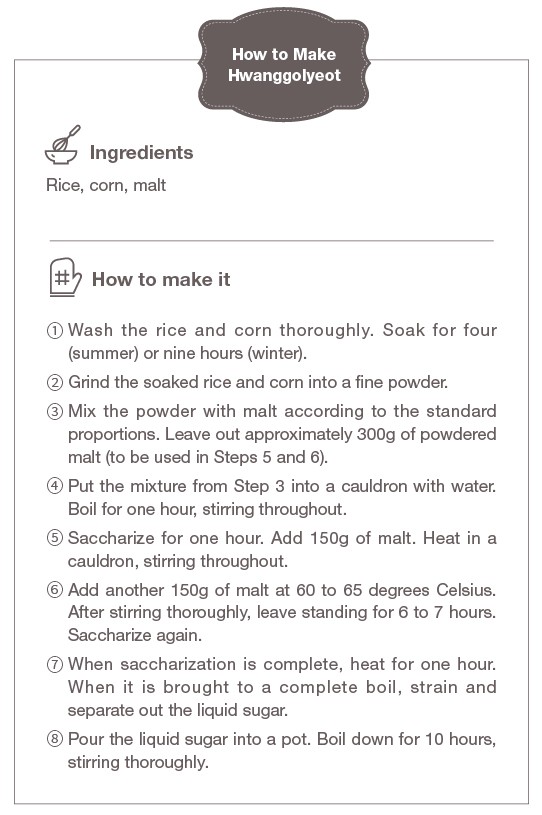
Generally, yeot is made by adding yeast to grain, and then boiling down the saccharized liquid yeot. This liquid version is called jocheong. Jocheong that is boiled down for longer takes on a dark reddish-black color: this is called gaengyeot. Gaengyeot turns white if it is pulled several times (due to the infiltration of oxygen). Garaeyeot, the kind that is sold in stores and supermarkets, is a stretched-out version of this white yeot. The southern provinces (Jeolla, Gyeongsang) make yeot with rice or millet, which makes the gaengyeot extremely hard and thus conducive to pulling. But yeot, like hwanggolyeot, from corn-growing northern regions is eaten as gaengyeot (yeot that is reddish-black because it has not been pulled/stretched) because the corn makes it soft. Hwanggolyeot is made by adding yeast and water to grains that have been soaked in water and then ground. The mixture, called aegijuk, is cooked in a large cauldron—a process that is not, as far as I know, done in other regions. Because corn produces a bitter flavor, one of Hwanggol Village’s traditions is to remove this bitterness by soaking crushed corn kernels in clean water for several days. It is in this way that we make corn yeot, which is known for its soft texture and sweet, rich flavor.
Q. Hwanggolyeot has a nice balance of the savory and sweet flavors of the grains with which it was made. I am guessing that the other ingredients used to make yeot also have a hand in how the final product tastes.
The three main ingredients of hwanggolyeot are corn, rice, and yeast. Once I entered the yeot business, we stopped growing everything but corn, which we still farm each year. We use rice from Wonju, Gangwon-do. We do not make yeast with store-bought enzymes: instead, we bring barley from Beolgyo-eup, Boseong-gun, which we germinate ourselves. We also use only clean groundwater from Chiaksan Mountain. Of course, a lot of time and effort can be saved by buying powdered or liquid enzymes, but I prefer to stick to good-quality ingredients to maintain the taste of hwanggolyeot, which cannot be replicated with saccharine or sugar.
Q. You also do a lot to promote awareness of hwanggolyeot.
We began making hwanggolyeot in a more systematic, organized manner in 1999. Thanks to the help of the Wonju Agricultural Technology Center, we were able to get a business license quickly and easily. We knew how to make good yeot, but had no knowledge of how or where to sell it, resulting in ever-increasing debt. We refused to give up and decided, literally, not to waste any effort in advertising our yeot. We went to every local event and festival to promote hwanggolyeot. I also made a lot of visits to distributors, and these efforts gradually began to produce results. Today, we sell hwanggolyeot through Korea Post and at highway rest stops.
Q. What are the benefits of traditional yeot? What was the role of yeot in traditional society?
According to the Donguibogam (Treasured Mirror of Eastern Medicine), eating gaengyeot restores one’s energy levels and can alleviate phlegm/coughing. It also helps with digestion: older Koreans took yeot with sikhye (sweet rice punch) as a natural digestive. Yeot was also believed to clear the mind: in the Joseon dynasty, yeot was served to the king as a nighttime snack, and the crown prince was served jocheong before starting the day’s studies. It is probably also why those going to Hanyang (capital city of Joseon) to take the civil service exam were given a supply of yeot before their journey. Of course, the stickiness of yeot [translator’s note: based on the Korean way of expressing passing an exam (literally, “stick to the exam”)] was likely a part of its superstitious charm. Yeot was also included among the foods given as the ibaji (gift) from the bride’s family to the groom’s family and the pyebaek ceremony (held at the groom’s home on the day after the wedding for the groom’s parents to wish good fortune for the newlyweds). It embodied the bride’s parents’ hope that the groom’s parents would not speak ill of their daughter.
Q. You make several flavors of yeot, such as peanut, perilla, and ginger, in addition to gaengyeot and jocheong. What are your plans for the future?
After extensive research, we patented buckwheat jocheong and pear and bellflower jocheong. Our plastic tube-packaged jocheong is also popular. It was born from the idea that young consumers may find it easier to use jocheong if it is in a squeezable tube rather than a glass jar. Our two bestselling items are black rice yeot, which is even darker than gaengyeot, and corn yeot. Five years ago, my son (Kim Giseok), who used to be an office worker in Seoul, returned to Hwanggol Village, saying that he wanted to be the one in his generation to continue the hwanggolyeot tradition. He is experimenting with several ideas. We are also working on building an overseas sales network and, for the purpose of increasing production quantity, coming up with a plan for incorporating an automated system that does not interfere with traditional yeot-making methods. My dream is to allow more people to experience and appreciate the good, rich sweetness of hwanggolyeot.