

한식에 대한 다채로운 이야기를 전하는 온라인 매거진
Vol 53. Korean Food from the Oceans and Rivers
Okcheon, a Refreshing Destination for Body and Mind
Foodie Travels
July is the height of Korea’s summer: this year, as in previous years, we are experiencing a “great heat.” News reports at this time of year are always accompanied by footage of citizens at bodies of water to beat the heat. Past and present, water activities were the highlight of summer. In a time before modern air-conditioning, Koreans endured the summer months by fishing. This month, we explored Okcheon, Chungcheongbuk-do, which has long been known for its clean rivers and copious amounts of fish, to forget (albeit, briefly) about the heat.
Article Lee Hyunju (Editorial Team) Photos Kim Seongjae (SSSAUNA Studio)
Fun in the water at Bocheongcheon Stream
Okcheon-gun is a county of Chungcheongbuk-do that is lined by the Sobaek Mountains and Sangju (Gyeongsangbuk-do) to the east, Daejeon and Geumsan-gun to the west, Yeongdong-gun to the south, and Boeun-gun to the north. Cheongsan-myeon, an eastern district of Okcheon-gun, is home to Bocheongcheon Stream, which originates from the Songnisan Mountains and flows into Geumgang River. The presence of Bocheongcheon Stream has made this district famous for its clean water and fish and, eventually, foods made with these fish.
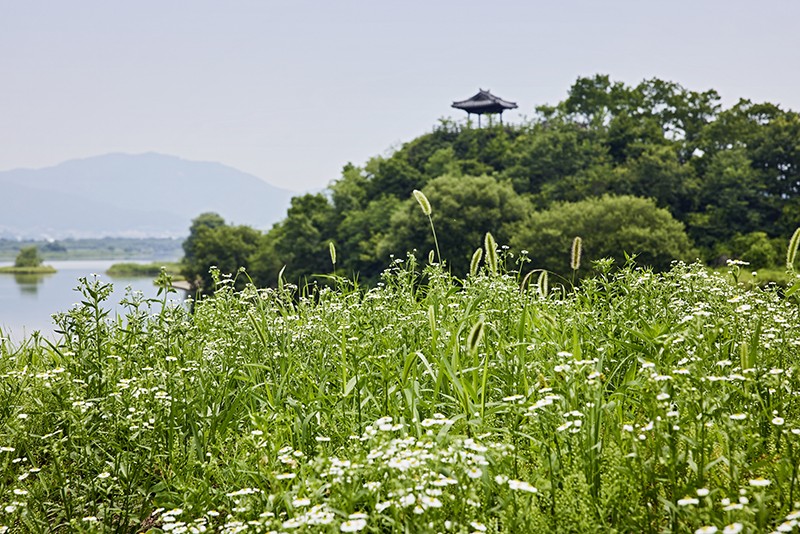
The first place I went was Bocheongcheon Stream. I wanted to see whether the water was as clean and the food as delicious as I had heard. My preconceptions were soon confirmed: the road to the stream revealed a view that was beautiful even from far away. At one spot along the stream, there is an upright, mountain-like hill that is topped with a small, picturesque pavilion called Sangchunjeong. It was constructed in the 1970s by Park Chunsik, the governor of Cheongseong-myeon at the time, who gave it a name that means “these surroundings are permanently beautiful, like spring.” I later learned that the hill, because of its resemblance to a mountain, is called “Doksan” by the locals.
There is an interesting backstory to Doksan. As the story goes, Doksan was originally part of Songnisan Mountain but flowed to its current location due to flooding. The head monk of a Buddhist temple at Songnisan Mountain, insisting that Doksan was still the property of Songnisan Mountain, sent someone each year to collect a tax. One day, a new magistrate arrived. After learning about the situation regarding Doksan, the magistrate told the head monk that, because the hill had come to the village of its own accord, he could take it back if he wanted it so much. Eventually, the village residents no longer had to pay a tax to the temple.
The presence of Doksan and Sangchunjeong over the gently-flowing waters of the stream enhances the stream’s beauty. The area is pristine and blanketed with silence. It is a scene that no one would want to fade from their memory any time soon. Sangchunjeong is also famous for its beautiful view of sunrises as well as stars and the Milky Way. Visitors who wish to stargaze or see a sunrise are encouraged to come to this spot at the appropriate times of the year.
Delicacies born from clean water
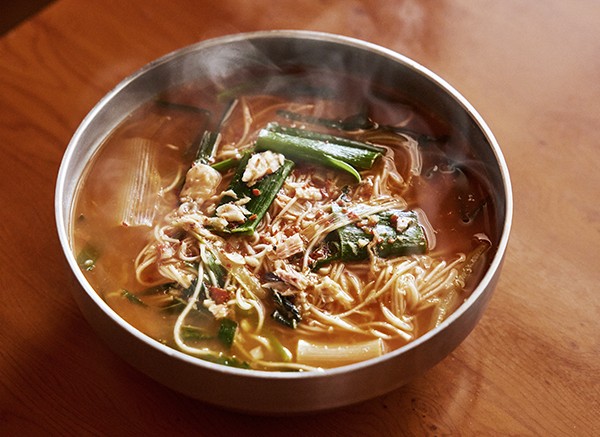
After the feast for the eyes, it was time to have one for the stomach. I headed to Cheongsan-myeon, a small locality that is located at the eastern end of Okcheon along Bocheongcheon Stream. My destination was Cheongsan Fish Noodle Street. The residents of Cheongsanmyeon had a tradition of going to the stream to fish after the rice saplings were planted. The stream, which is still so clean that you can see the pebbles on its floor, teems with fish. The fish caught by pre-modern Koreans were made into maeuntang (spicy fish stew) simply by adding vegetables and seasonings. Saengseon guksu (fish noodles) started to be made in the 1960s, when the rice that was usually enjoyed with maeuntang was replaced with noodles.
Restaurants that specialize in fish noodles are grouped together in Jijeon-li and Gyopyeong-li of Cheongsan-myeon. In 2018, Okcheon-gun Office collectively named these districts “Cheongsan Fish Noodle Street.” Fish noodles can also be found in Yeongdong, Geumsan, and Muju.
According to Okcheon-gun, Cheongsan-myeon is the birthplace of the dish, implying that it tastes better here than in other cities. Fish noodles, which are noodles in a soup broth made by boiling freshwater fish whole (including the bones), are rich in protein, calcium, fat, and vitamins—making it the perfect food to restore people’s energy that has been depleted by the summer heat. Fish noodles also dispel the notion that, for anything to be healthy, taste must be sacrificed. The fish noodles that I ate far exceeded my expectations: the rich broth had a refreshing aftertaste and was devoid of unpleasant fishy odors. Even with noodles as the carbohydrate (as opposed to rice), the taste of the broth was such that it felt as “healthful” as any other restorative food.
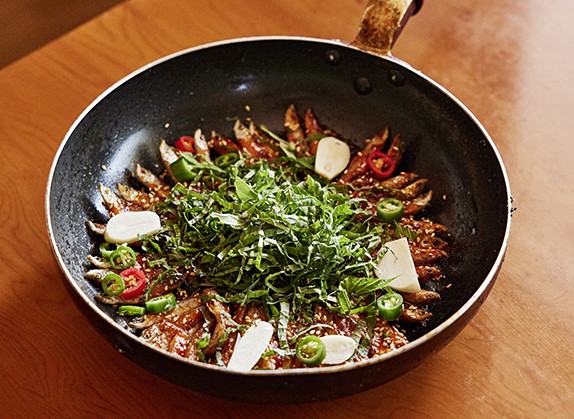
Another local food that is a must-try is doribaengbaeng (spicy braised freshwater sprats). Once you have tried it, you will be hard-pressed to forget the dish’s appearance, which is as unique as its name. It is a dish that pairs deep-fried smelt or minnow with generous coatings of seasoning.
It has a similar crunchy texture and sweet-and-sour taste as gangjeong (rice puffs). No one knows who first thought to arrange the small fish slices into a circle, but it seems to have been because of the dish’s name, a compound of dori, which refers to the long piece of wood in a traditional Korean building that supports the rafters, and baengbaeng, which means “to spin” (in the manner of an amusement park ride). As such, doribaengbaeng is a delicacy that embodies several pleasures: the fun of saying the name, the dish’s delicious flavor, and its unique appearance.
If you need a little more to be satisfied after having had fish noodles or doribaengbaeng, try ordering a side of whole fried fish. The clear, mild flavors of the small freshwater fish will be refreshing for both your body and mind.
Other attractions
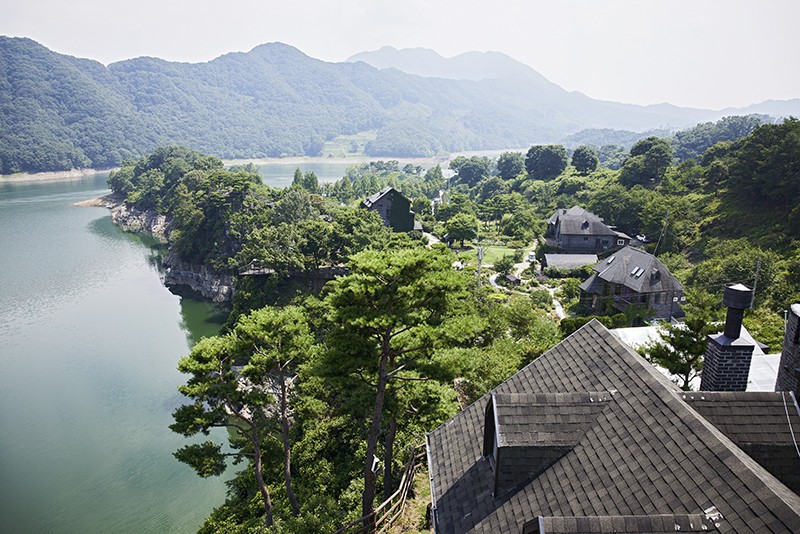
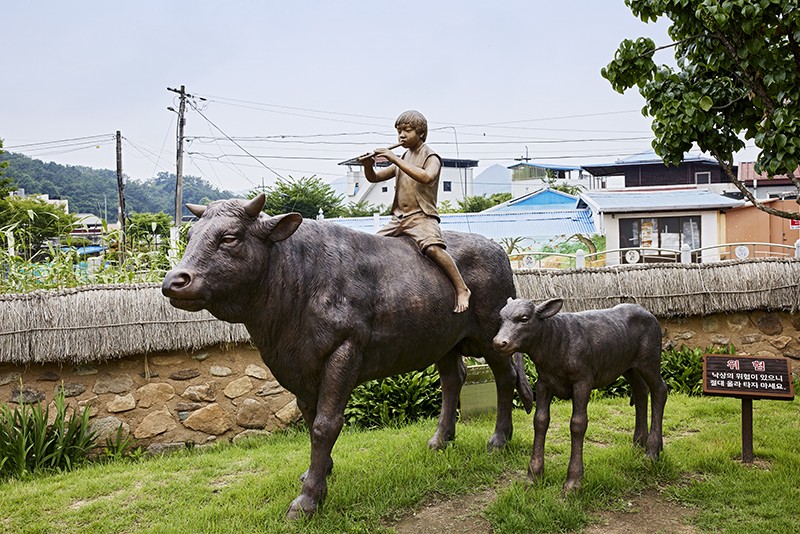
Making things even better, there is a lot more to do in Okcheon-gun besides natural attractions and food. One such location is the birth home of and literature center dedicated to the beloved Korean poet Jeong Jiyong. Like in his poem, “Nostalgia,” Jeong’s birth home is located next to “a small brook that babbles.” The beautifully-arranged stone gate with a door made out of sticks, thatched roof, well, and jangdokdae (flat place for earthenware jars) take the visitor back in time to the poet’s childhood. There are several other historical sites nearby, including Okcheon Hyanggyo (traditional private Confucian academy) and Okju Samaso Lecture Hall (where individuals who had passed the early stages of the civil service exam taught students and discussed politics), as well as the Old Town of Okcheon, which is full of restaurants and hipster cafes.
Those looking to be emotionally rejuvenated by the beauty of nature should visit the Aquatic Plant Learning Center (APLC). Boasting an exotic setting made up of flowers, trees, and an artificial lake, the APLC is located in Gunbuk-myeon, which is in west Okcheon-gun. It has aquatic plants that are native to Korea and tropical regions. Having begun as a farm for ornamental plants, the APLC was designated as an interactive learning center in 2008 by the Chungcheongbuk-do Office of Education. There is also the Heavenly Garden Walking Trail, which, befitting its name, offers a scenic view of Daecheongho Lake that will make you forget about all of your everyday worries.
One of the biggest advantages of the APLC is that visitors can see plants, such as the water lily, lotus flower, water hyacinth, and water poppy, with which they are familiar in name only and that are rarely accessible in our daily lives. Please note that the APLC can be visited only with an advance reservation (available on the website).