

한식에 대한 다채로운 이야기를 전하는 온라인 매거진
Vol 49. Namul, Food for People, Food That Spares
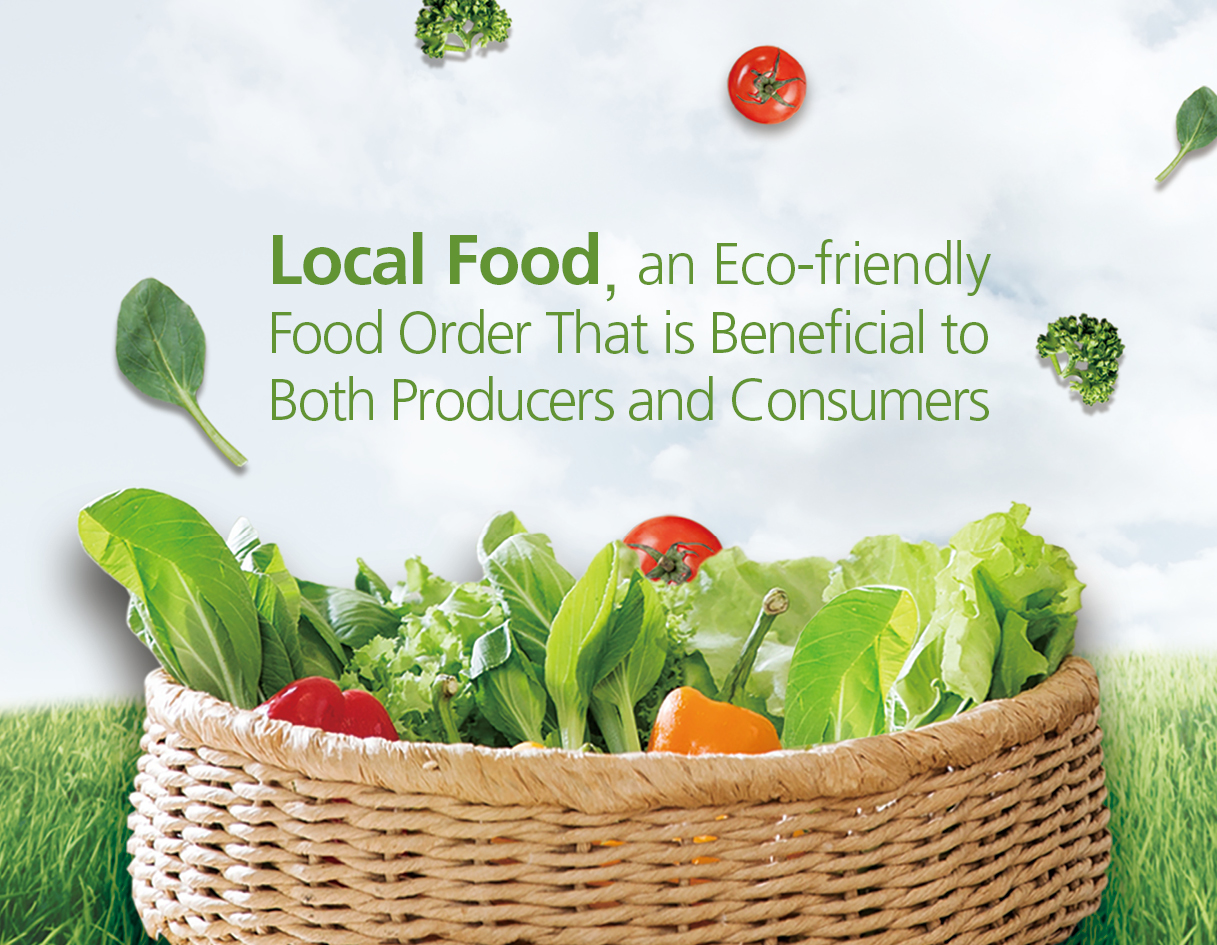
Local Food, an Eco-friendly Food Order That is Beneficial to Both Producers and Consumers
Rediscovery of Korean Food
The food market is diversifying. The efforts to re-explore the value of ingredients contained in each leaf and to preserve the vegetable culture are taking shape in various markets, both online and offline. This article will examine local food, an eco-friendly food order that we see within our region.

As the awareness of the global climate crisis increases, interest in local food has also been increasing. Local food is a new food distribution culture that consumes locally produced food directly in the region, and often refers to agricultural products produced within a radius of 50 km. In general, agricultural products emit a large amount of carbon energy the farther they move from the place of production to the place of consumption. Since local food does not go through long-distance transportation and multi-level distribution process, it can significantly reduce carbon emissions compared to the existing distribution method. According to the Korea Environment Corporation, consuming local food can reduce carbon dioxide emissions by 130.8 kg per person per year. Considering that about a quarter of the world’s greenhouse gas emissions come from food, it’s easy to guess how great local food is for the environment.
Unlike general agricultural products, which take an average of three to six days for distribution, local food is based on the basic principle of same-day harvest and sale. Because of this development, consumers can trust and purchase freshly harvested agricultural products. Moreover, since the producer personally determines the sales price of local food, producers can increase their income by selling the product at the desired price. According to the analysis of Nonghyup Agribusiness Group Inc., in the case of farms that produce local food, an average of 11.5 million won in additional income per person was generated.
Thus, foreign countries have been exerting efforts to revitalize local food early on. In the case of the US, the federal government is supporting projects that link farmers' markets, community-supported agriculture, and farm schools, and in the UK, the London Food Board has been established to connect producers and consumers directly. Since the 1980s, Japan has been actively promoting local food through the “Local Production and Consumption” system, which aims to consume locally produced agricultural products.
Following these examples, in Korea, local governments are operating various direct food stores. Local Food Direct Store is a direct-transaction store where agricultural products produced by local farmers are directly packaged, set prices, and displayed and sold by the producers. The stores sell a variety of products, including agricultural products and livestock products, as well as local specialties and traditional foods, and processed foods made with local foods. The Local Food Direct Store, which first opened in Wanju, Jeollabuk-do in 2012, exceeded 100 stores in 2016, and expanded to 660 in 2021. Sales are also rising rapidly. In 2013, sales were only 19.3 billion won, but in 2020, it recorded 460.4 billion won, a whopping 2,385% growth over seven years. As such, local food is making its mark near us as a new food order that considers the environment, and benefits both producers and consumers.

Nonghyup Local Food Direct Store is a direct store that sell agricultural products by producers through Nonghyup stores, accounting for 87.5% of all local food direct stores. Nonghyup local food stores are operated in three types. The first is an independent store, which is operated in an independent building or in a space divided into floors. An independent store mainly sells local agricultural products and processed foods, and it also has auxiliary facilities that use local food such as farmhouse restaurant, café, and instant side dishes. The second is a complex store, a direct store operating in parallel with Hanaro Mart. It is convenient as a local food zone in Hanaro Mart that is marked and operating, and you can shop for local foods at the direct store and industrial products in Hanaro Mart in one stop. The third is a local food corner, in which a local food sales zone is installed and sold in spaces such as agricultural and livestock cooperatives, NH Nonghyup Bank, government offices, and distribution stores. Based on these three types of direct stores, Nonghyup is promoting the development of various types of stores that can expand the sales of local food. Nonghyup Local Food Direct Stores have been raising the responsibility of farmers by providing regular training for farmers and granting sale qualifications only to those who have completed the training. Moreover, it has been striving to sell safe agricultural products at all times by strictly complying with the PLS(Positive List System) standards and establishing a safety inspection system in advance.
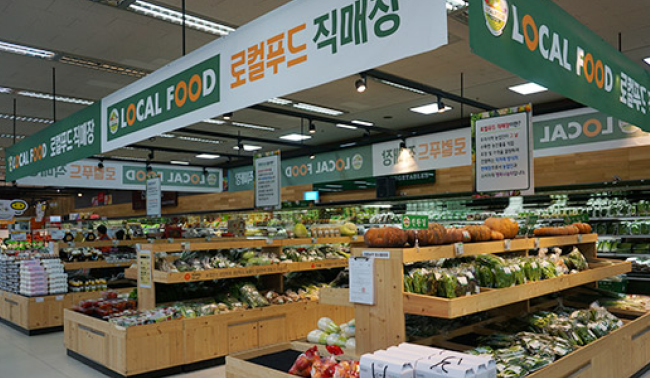

Fresh Market is a local food direct store operated by Sejong City, which maximizes the characteristics of an urban-rural complex where urban and rural areas coexist. Starting with the first Dodam branch in September 2015, Fresh Market has been operating the Fresh Market Cultural Center and the Areum branch, the 2nd store, and achieved cumulative sales of 100 billion won in August 2020. Fresh Market has been visiting nearby marts, traditional markets, and wholesale markets every Tuesday to conduct a price survey of agricultural products. Through this process, it has been exerting efforts to understand market trends, provide agricultural products at stable prices to consumers, and for farmers to set reasonable prices for their products. Moreover, to ensure the safety of local food, Fresh Market is conducting a total of three inspections: soil and water quality inspection in the first stage, safety inspection before shipment in the second stage, and safety inspection at the distribution stage, which is the third stage. If these analysis results are inconsistent, the quality of agricultural products is managed through follow-up measures such as shipment delay, discarding of agricultural products, and imposition of fines, and with the introduction of the strikeout system, strong measures are being taken to permanently remove the farmers, whose products are assessed unsuitable for more than three times, from Fresh Market. Furthermore, it operates a local food processing support center to provide processing training on agricultural products for farmers, and provides product development and management training to enhance the competitiveness of agricultural brands, revitalize the local economy, and support farmers to steadily produce safe and high-quality processed foods.
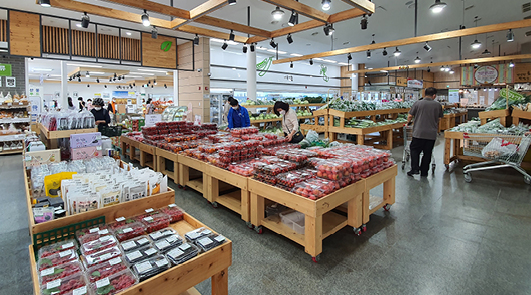
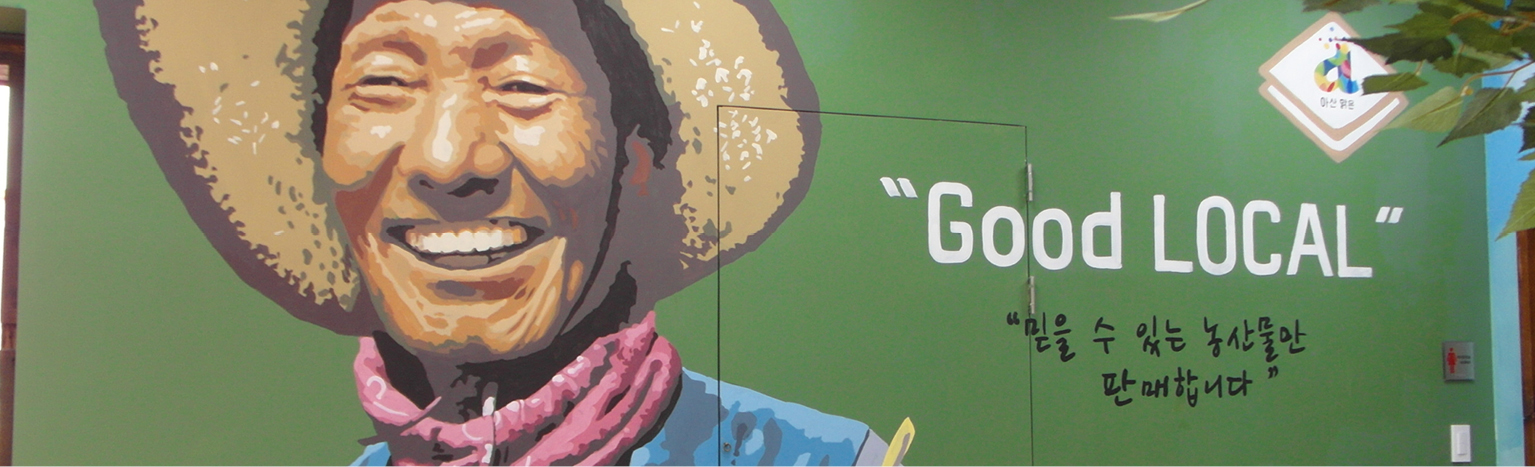
First Village Local Food is a local food direct store established in the largest outdoor village space in the Chungcheong area in March 2016. As a direct store established in collaboration by First Village Co., Ltd., a local company in Asan City, it has been enhancing the value of local agricultural products and contributing to revitalizing the local economy. It gained popularity by operating a restaurant by using local food, guaranteeing the income of producers, and providing consumers with healthy seasonal food and a rest area.
First Village Local Food has been established and has been operating a pesticide residue testing lab to enhance the stability of agricultural products. Only the producers who have completed three or more training sessions are eligible to sell their products in the store. Moreover, it increases credibility by having farmers sell agricultural products under their own names as their own brand, and provides a stable market for elderly farmers and small-scale farmers and fishermen, who had difficulties in securing sales and distribution channels.
Wanju Local Food Store is the first local food direct store that opened in Korea in 2012. Since then, Wanju Local Food has been leading the domestic local food culture as the first and the mecca of local food stores. The greatest feature of Wanju Local Food is that it is operating simultaneously as a direct store, farmhouse restaurant, and online shopping mall. Wanju Local Food Direct Store has created and is implementing the Wanju local food certification system, which is more complicated than the Good Agricultural Practice certification system, to improve the quality of its products. It also conducts shipping training and competency-strengthening training, and offers food education and experiences to consumers. Moreover, it operates a public meal service business that supplies local agricultural products produced on the same day to daycare centers and schools in Wanju-gun. Furthermore, it has been promoting a win-win relationship between local farmers and consumers by conducting a farm experience tour in connection with local villages, providing education on agricultural products and creating memories for participants. The farmhouse restaurant, which is operated by local farmers, has secured credibility by disclosing the information on producers and agricultural products, and has been working hard to ensure that consumers can meet a wider variety of agricultural products through a planned production system based on same-day shipping and sales. Also, it established a system so that consumers can conveniently find local food online through its online shopping mall, Happy Station. Based on these efforts, Wanju Local Food was selected as the best local government for two consecutive years from 2020 to 2021 at the “Local Food Index & Excellent Local Government Awards” conducted by the Ministry of Agriculture, Food and Rural Affairs..