


한식에 대한 다채로운 이야기를 전하는 온라인 매거진
Vol 47. A New Day, Clean Color
When Did We Start Eating Cooked Rice? ─ The History of Korean Ssalbap
Discovery of Korean Food
The phrase, “Eating cooked rice due to ancestral rites,” is a metaphor for the income earned through a good opportunity. If we look at the expression as it is, we can guess the difficult situation of our people, who could only eat cooked white rice during ancestral rites. Now, when we think of “bap(rice),” we naturally think of white rice, but it wasn’t long ago that white rice appeared on our table. Rice is not just a meal to fill one’s stomach, but is a vessel containing the long history and culture of the nation. Let's look back at the history of rice in Korea, which has experienced the ups and downs of the times, from rice symbolizing wealth and power to becoming popular as it is now.
Source / Reference. Encyclopedia of Korean Culture, <Humanities of Rice>(Jung Hyegyeong, Tabi)
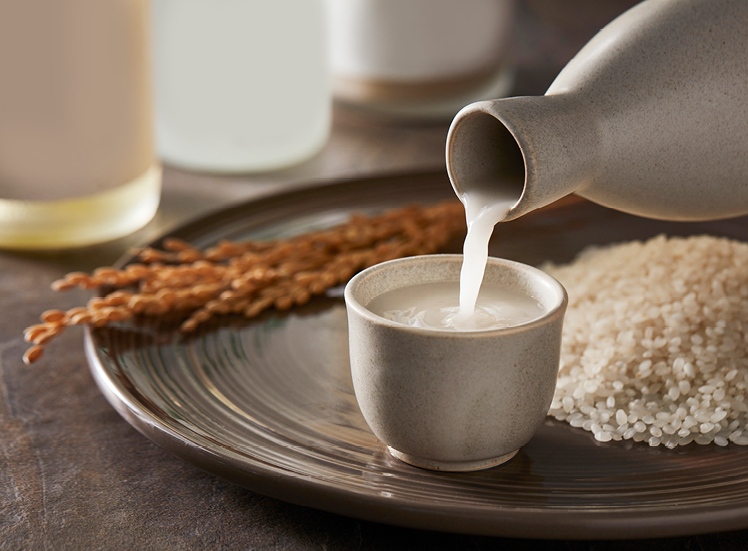
Rice and cooked rice that brought people together
When did our ancestors start cooking and eating rice? Grains were eaten as staple food since the Neolithic period, when agriculture began about 5,000 years ago. Grains, such as proso millet, foxtail millet, echinochloa, sorghum, etc., were consumed first, and with the introduction of barley and then rice, the diet of our people changed significantly. After this period, the rice and side dish culture, with the grains including rice as the staple food, began to form, and people started making and using earthenware to boil and store grains.
Rice is a crop that requires plenty of water, time, and labor. These characteristics naturally attracted people, and united the labor force. The form of public labor was later formed into common labor organizations for villages, such as durae(farmers’ cooperative group) and pumasi(labor exchange), and began operating and developing over time. Perhaps the growth of the sense of community also affected the food culture. Unlike now, where “honbap(eating alone)” has become a common daily routine, our people did not enjoy eating alone in the ancient times. This is because eating alone meant separation and isolation from the community. As “sikgu(people eating together)” is an expression meaning family, rice served as a medium is meant to strengthen the sense of community.
The staple of the nobility, a criterion that divided the class
Agricultural culture had settled in the society, and rice was listed as a staple food. However, it did not mean that everyone could eat rice. Since the production of rice was insufficient for all people to enjoy, rice was the food of the nobility from the Three Kingdoms period of Korea, when the class system became stronger, until before the 1960s. Almost all farmers endured starvation by going out into the fields in the early spring of the following year when the food they harvested in the fall ran out, digging up all the edible roots and bark. It was only in the summer, after overcoming difficulties and barley became ripe and could be harvested, when farmers were able to fill their empty stomachs. The “barley hump,” which refers to the time of starvation that was equivalent to death, is a bitter expression that was derived from this period. Even in the Goryeo period, after the Three Kingdoms period, the people’s hunger remained a serious problem. The gap between the classes widened, and rice was still the property of the nobility. Ordinary people had to eat meals filled with coarse grains.
During the Joseon Dynasty, which was the period of the greatest change in history, the diet also underwent rapid changes. During the early period of the Joseon Dynasty, Korean food was developed, and completed during its later period.
However, even in the Joseon Dynasty, when rice recipes developed significantly and tteok was introduced, the lives of the farmers did not improve. Rather, due to the disorder in the land system, land was concentrated in some classes, and peasants experienced even more severe poverty, wandering around the country and often becoming slaves. Yu Hyungwon, a scholar from the mid-Joseon period, harshly criticized the reality of the time in <Bangyesurok> by stating, “The land of the rich has no end as the borders touch each other, whereas the poor has no land to put even an awl in.” The life of the peasants in the Joseon Dynasty was always hard, and they were starving. They could only possibly eat white rice, which could only be tasted on feast days, in a dream.
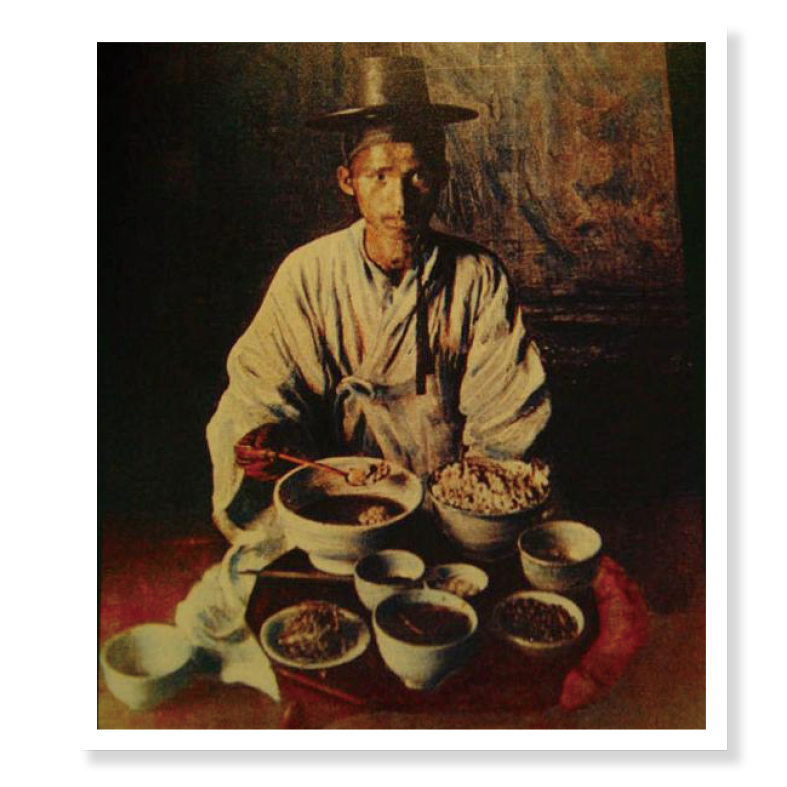 |
| Photo source. Academy of Korean Studies / Table Setting in the Joseon Dynasty - The amount of rice in the Joseon Dynasty is more than twice that of modern people. |
People who did not put down their spoons until they were full
When we went to our grandmother’s house during our childhood, we used to be given a bowl that was overflowing with white rice. Our experiences are similar because we share our people’s sentiments that being full is a virtue, and serving others until they are full is affection. Gobong(heaped) bap or meoseum(farmhand) bap is characterized by putting the cooked rice in a bowl, resembling a mountainous hill. The name was derived from the eating habits of the nobles during the Joseon Dynasty. At the time, the nobles considered it a virtue to eat only the portion of the rice above the bowl, and leave the rest in the bowl. It was a consideration based on the situation at the time in which the slaves could eat only after the nobles left rice.
In the late Joseon Dynasty, a day's meal was called “joseok,” and eaten only in the morning and in the evening. Lunch(jeomsim) was literally eating the leftovers from breakfast, as if to mark a dot(jeom) on the heart(sim). People were able to do hard work all day in the field with only two meals a day because they ate plenty for each meal. Foreigners who visited our country at the end of the Joseon Dynasty called Joseon, “daesikguk(country with large meals). However, rice production was still insufficient to fill the hunger of the “big eaters,” so many people ate barley or mixed grains rather than rice.
On the other hand, the Japanese colonial period is considered as the most severe period of food deprivation, in which rice production increased but also brought about the most serious rice shortage in the history of rice farming, following expropriation. Our farmers could not stock up on food for a year, so their staple food changed according to the season. Even mixed grains were not available, so they made a living by boiling porridge with all edible ingredients from the mountains. If they couldn’t even eat this, they often filled their empty stomachs with water, so the sad word, “mulbae(stomach filled with water),” was coined.
Achieving 100% self-sufficiency with Tongil Rice, “a miracle rice”
After the liberation, large-scale food aid from the US in the 1950s brought about a change in the rice-oriented diet. Among them, wheat flour has had a ripple effect enough to shake the rice-oriented diet structure that the Korean people have maintained for 5,000 years. To this day, it is still exerting its influence. However, even at that time, the people's resistance was stronger than expected because changing the deep-rooted dietary habits of our people would shake the foundation.
The government chose strong regulation to tackle the widespread food shortage. Schools inspected children's lunch boxes to check the ratio of rice and barley mix, and actively promoted mixed grain and flour-based meals by controlling the sale of rice by food vendors, grain traders, and grain processors through policy.
The government also focused on the development of rice varieties. As a result, Tongil rice was born in 1971. Tongil rice was distributed to farms from the following year, and after repeated trial and error and research, Korea achieved rice self-sufficiency in 1976. It was only then that most of the people were able to eat rice. Tongil rice led to the abolition of the “No Rice Day,” which was the rice-saving policy at the time. Various policies to curb demand for rice were also relaxed. In December 1977, the ban on the production of rice makgeolli was lifted after 14 years. At that time, the appearance of rice makgeolli was an important event, drawing the attention of the whole nation to the extent that it was included in the top 10 news.
Korea is the only country that has changed its status from a recipient country to a donor country. Starting with the donation of 50,000 tons of Korean rice through the World Food Program(WFP), an international organization specializing in food aid under the United Nations, in 2018, Korea has been disseminating “bapsim(power of rice)” to many countries, such as Yemen, Uganda, Kenya, and Ethiopia. The warm heart that always pacified a hungry stomach, while worrying about the other person's hunger and asking for their regards, is now facing the world.
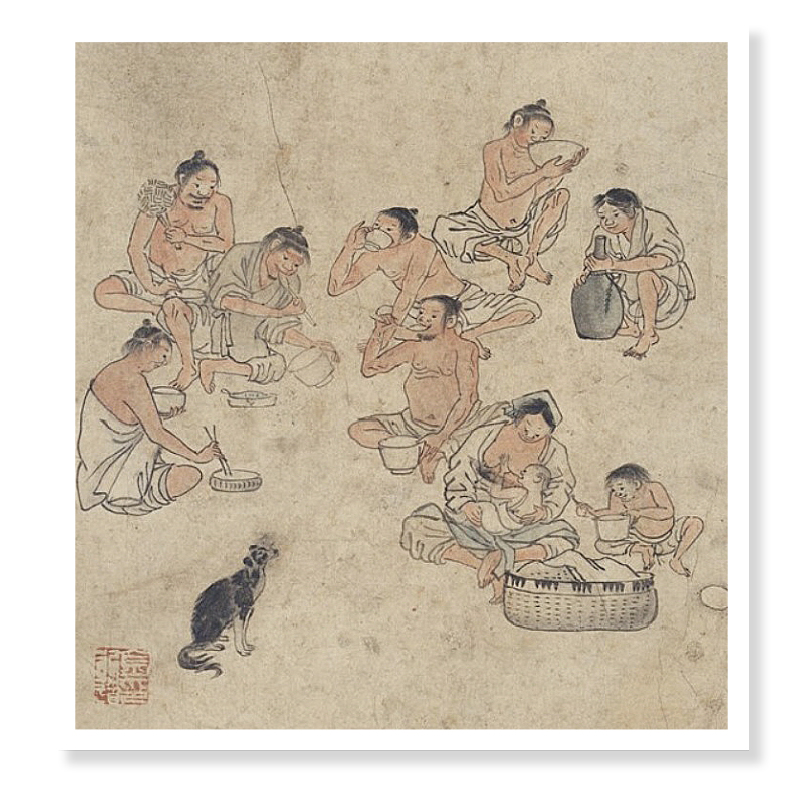 |
| Picture source. National Museum of Korea / Kim Hongdo’s <Saecham(communal meal while farming)> - The size of a big bowl that provides an idea of the size of a rice bowl in the Joseon Dynasty |