

한식에 대한 다채로운 이야기를 전하는 온라인 매거진
Vol 46. Rediscovery of Pat
Perfect with Pat A Journey to Discover the Tradition of Our Tteok
Korean Food & Grand Master
Jecheon, with Charyeongsan Mountain and Sobaeksan Mountain in the background, is famous for many medicinal herbs that grow native in the mountains since ancient times. When you arrive at a deep corner following the winding mountainside and river, a special and valuable dish welcomes the unfamiliar visitor. Yakchotteok(herbal rice cake) made with aromatic herbs and the neatness of red bean paste filling the inside to the brim create a rapture in your mouth. We heard a story about tteok(rice cake), which goes well with red beans, and the rice cake tradition that was passed down in a traditional way from Grand Master Lee Yeonsoon(Korea Grand Master No. 52)
Article. Lee Jongcheo, Photo. Kim Jae
Q. Red beans seem to make a dish special when we look at their use in our food. It is widely used in rice cakes. What do you think is the reason?
For rice cakes, red jeokdoo or grayish geodoo are mainly used. Jeokdoo is more commonly used nowadays because it is easy to sweeten them, and geodoo is considered as a high-quality red bean with its nutty and clean flavors. Red beans double the texture and taste of rice cakes and prevent them from sticking together. Red beans also make the dish stand out more visually. When the red beans are boiled and used as rick cake fillings, they spoil quickly; however, you can prevent the dish from going bad and enhance its taste by adding honey to the red beans. It is an ingredient that appeals to both the eyes and the palate.
Q. What are the advantages of consuming red beans?
In traditional fairy tales and legends, red beans appear to ward off ghosts and prevent bad luck. It is a good food ingredient that supplements the nutrients that we need during winter when we are less active. It warms the body, gives energy, and removes waste products from the body. It has recently been suggested that it is good for dieting because it is filling even in small amounts. It is considered as good for skin care, so it is a really good grain.
Q. What should I look for when selecting good red beans?
The most important thing to look for when selecting red beans is the color. It is recommended that the color is dark and the skin is thin. Good red beans have a clear white band in the middle and an even surface. It is recommended to store them in a cool, well-ventilated place in order to avoid insects.
Q. What is Seunggeomcho danja? How is it made and passed down by a grand master?
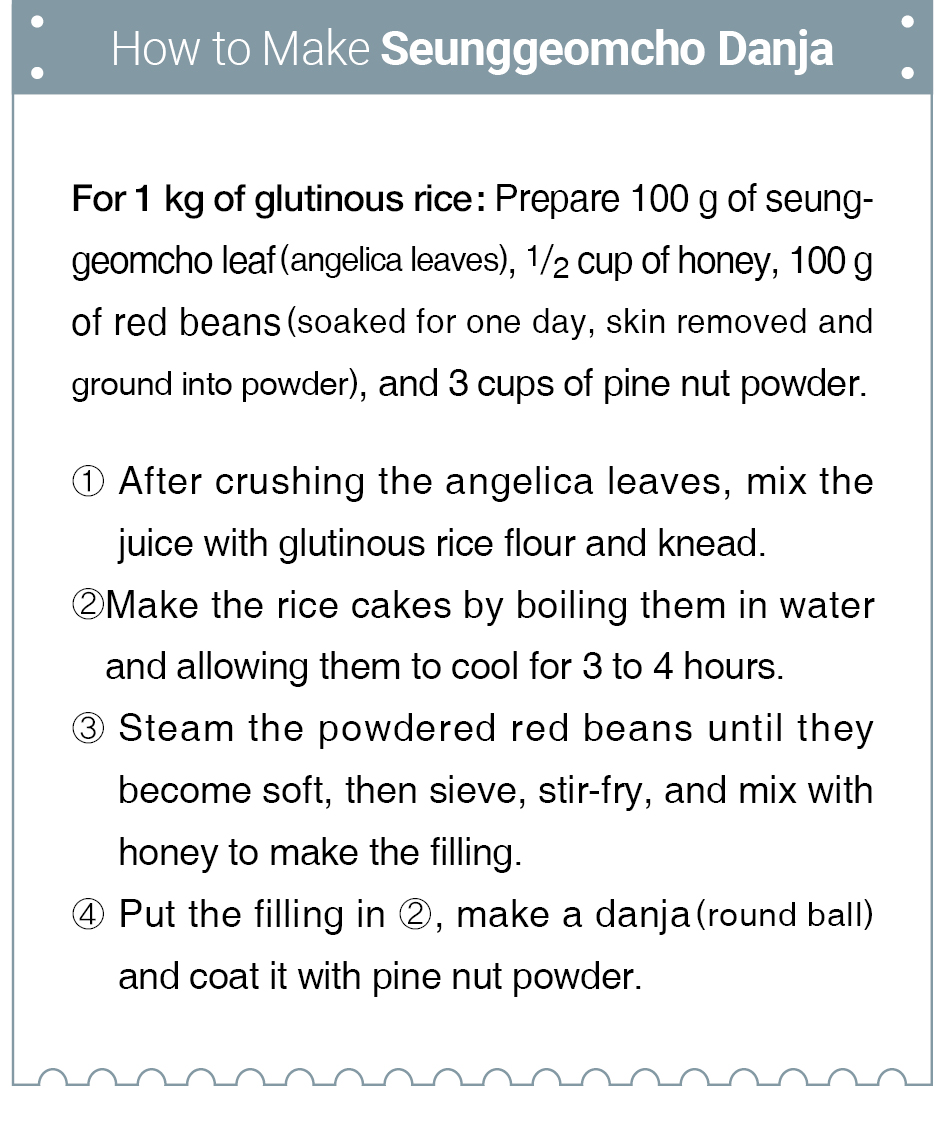
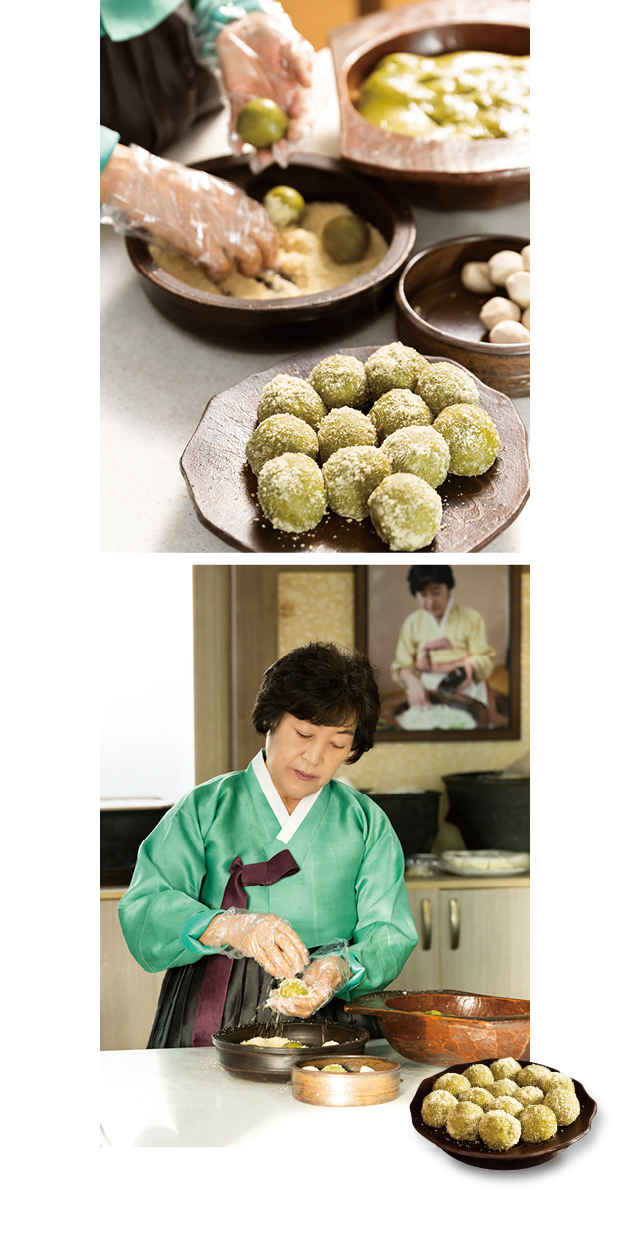
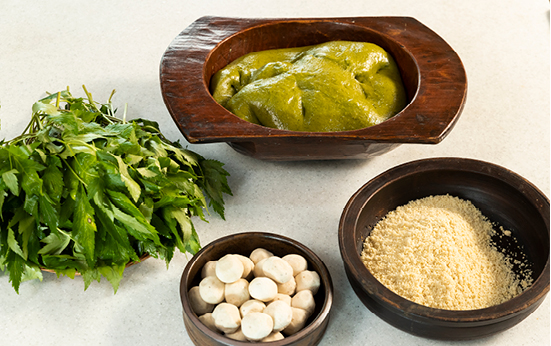
Seunggeomcho refers to a leaf of the angelica plant. Danja refers to a rice cake that is large in shape, has a filling inside, and is covered with gomul(grainy powder). It is a traditional rice cake that our ancestors often made and ate to the extent that it appeared in <Gyuhap Chongseo>, an old recipe book, <Buin Pilji>, <Siwin Jeonseo>, and <Joseon Yori Jebeop>. Angelica is a medicinal plant that is often consumed as ssam(wrap). It has been shown to improve excellent blood circulation and to be effective in women's diseases and dementia. It has a strong bitter taste and a strong scent by nature, so it does not seem to be compatible with rice cake. However, our ancestors made rice cakes by mixing red beans, pine nuts, and honey with angelica. The bitter taste of angelica is covered by red beans and honey, and the rice cake is covered with pine nut powder to enhance its flavor and texture. It is a very harmonious food. For a while, there was no place to make angelica rice cakes like seunggeomcho danja, and I feel very sorry for allowing it to be forgotten. So I reproduced it by referring to old cookbooks, and I am now introducing it in a new shape, size, and packaging.
Q. We heard that the Jecheon area has many dishes related to medicinal herbs. Why are these dishes developed in the Jecheon region?
Since Jecheon is surrounded by Sobaeksan and Charyeongsan mountains, it is said that many medicinal herbs have been produced since ancient times. It was famous for the high quality medicinal herbs, thanks to its favorable climate and soil quality. As a result, herbal-related foods have also developed a lot. This is why, as a native of Jecheon, I had no choice but to become interested in food made with medicinal herbs.
Q. When you think about it, there seems to be a difference between our rice cake culture and the rice cake culture of other countries. What are these differences?
In Korea, rice cakes have been made and eaten both in good and sad times. Even today, there is still the custom of making rice cakes for moving, ancestral rites, and feasts. I think this is a special culture that no other country can imitate. In addition, each cake has a different meaning. Soosoogyeongdan(sweet sorghum rice balls) served on the 1st birthday table is said to protect the baby from harm and misfortune, while baekseolgi(snow white rice cake) means wishing for the baby to grow up clean and upright, and mujigaetteok(rainbow rice cake) means wishing for the baby to fulfill one’s dreams. It is a digression, but in some regions, throwing red beans to the baby or making the baby hold red beans will not cause the baby to be hurt or trip. In any case, tteok has been passed down with a very unique and special meaning in our culture. Even though changes occur over time, traditions and basic ingredients remain the same, so if we try not to forget, we can continue it as our culture in the future.
Q. What kind of effort is needed for our rice cake culture to be recognized as the most valuable asset to today’s people, as well as a global food?
A few years ago, I traveled to India to teach at a local hotel for 15 days. People who made our rice cakes were among the attendees of the lecture at the time. I was both overjoyed and grateful. In my opinion, the nutritional advantages of our rice cakes – the functionality improved by utilizing a variety of legumes that are good for the body and great additions to food– were attracting attention from other countries. In fact, rice cakes can be combined with any ingredient to suit any taste. It is not an exaggeration to say that anything can be transformed into a rice cake. I hope that Koreans learn how to value our rice cakes. When I go to an experience program for children, they love to hear stories about our rice cakes as part of a unique Korean culture, their nutrition and functionality, and how easy it is to make them. Even children who dislike rice cakes are surprised when they eat the rice cakes they made and found them delicious. Lately, as the delivery culture has become common, more and more people enjoy rice cakes in small quantities and packaging. Kits that allow you to easily make and eat rice cakes at home are also being sold. I hope that these efforts to enjoy new rice cakes will continue.
Q. Nowadays, when people are reluctant to go out due to COVID-19, what is the best way to make and eat rice cakes at home?
It is not difficult to make rice cakes at home if you know how to cook rice. All you need is a steamer to make small batches of rice cakes. There are over 180 known ingredients that are used for rice cake fillings. It means that rice cakes can be made with commonly used ingredients. I hope that you will not think of making rice cakes as difficult and cumbersome as you only need to prepare a steamer and your choice of ingredients.