


한식에 대한 다채로운 이야기를 전하는 온라인 매거진
Vol 43. Harmony The Flavor and Beauty of Hansik
Chuseok, Songpyeon, and Poetry
Our Chuseok scenery is connoted in the poet's ample melody, and its richness has grown even greater. The now-fading Chuseok holiday scene is alive in the poem.
Source. Encyclopedia of Korean Culture
Making Songpyeon on the Moonlit Night before Chuseok
- Seo Jeong-ju -
Sitting on the floor on the moonlit night before Chuseok
All family gathering around making songpyeon
When I put green beans inside
The moon light becomes brighter
Deer cry in the hill behind having fun
“The flower will bend from the moonlight!”
Said Mother while looking at the moon
And a night owl in the bamboo grove also laughs
The moon breaks into laughter.
And the moon breaks into laughter.
A Warm Scene of Making Songpyeon Together
As the poet Jeon Youngae described in her poem, “The scene of people sitting around and making songpyeon,” Chuseok was a festive occasion for us. When it was Chuseok, there was a “noisy party atmosphere in the neighborhood.” On this bountiful feast day, the “smell of jeon frying on the pan” and “the scene of people sitting around making songpyeon” are essential.
The poem <Making Songpyeon on the Moonlit Night before Chuseok> by Seo Jeong-ju, depicts a beautiful scene of an entire family sitting around making songpyeon on the night before Chuseok. The cheerfulness that even “the moon break into laughter” is the abundant present that the Chuseok holiday gives us. This wonderful scene did not just stay at home. The poem <On the Morning of Chuseok> by Hwang Kum-chan describes the compassion and the warmth of Korean food culture’s sharing songpyeon with neighbors.
This kind custom is a memory now, and Hwang Kum-chan also lamented the fact that this custom was disappearing in his poem <On the Morning of Chuseok>.
However, just because a custom disappears, it doesn’t mean its culture is also disappearing. As we have done, our descendants will read about the footsteps and the excellence of Korean food in old literature and old cookbooks written in the contemporary time.
Songpyeon, Moon, and Chuseok
When we think of Chuseok, the first thing that comes to mind is “songpyeon.” Songpyeon is a seasonal dish that symbolizes Chuseok. It is made by grinding new rice, kneading it with hot water, and adding stuffing like sesame seeds, chestnuts, and beans.
It was steamed with pine needles to prevent songpyeon from sticking to each other. The scent of pine needles seeped into songpyeon to enhance the taste, and the naturally carved pine needle pattern adds to the style of songpyeon. Moreover, since pine needles have a sterilizing effect, they have done a fantastic job of preventing songpyeon from spoiling on a hot day.
Songpyeon, a Chuseok holiday dish, also caught the eyes of many poets, and became a subject of a poem. When I read <Songpyeon> by Poet Choi Byungyup, “Chewy songpyeon steamed glossy in a full moon shape with soft rice powder,” it feels like these songpyeons are spread out in front of my eyes, making me feel warm-hearted. From this poem, you can imagine this “glossy” taste and style of songpyeon with the scent and the pattern of pine needles as they were steamed.
Songpyeon also contains the taste of bountiful fruits from last summer. In the poem, “Made with the Gratitude to a Bountiful Harvest,” you can fully feel the sincerity of the person who makes songpyeon.
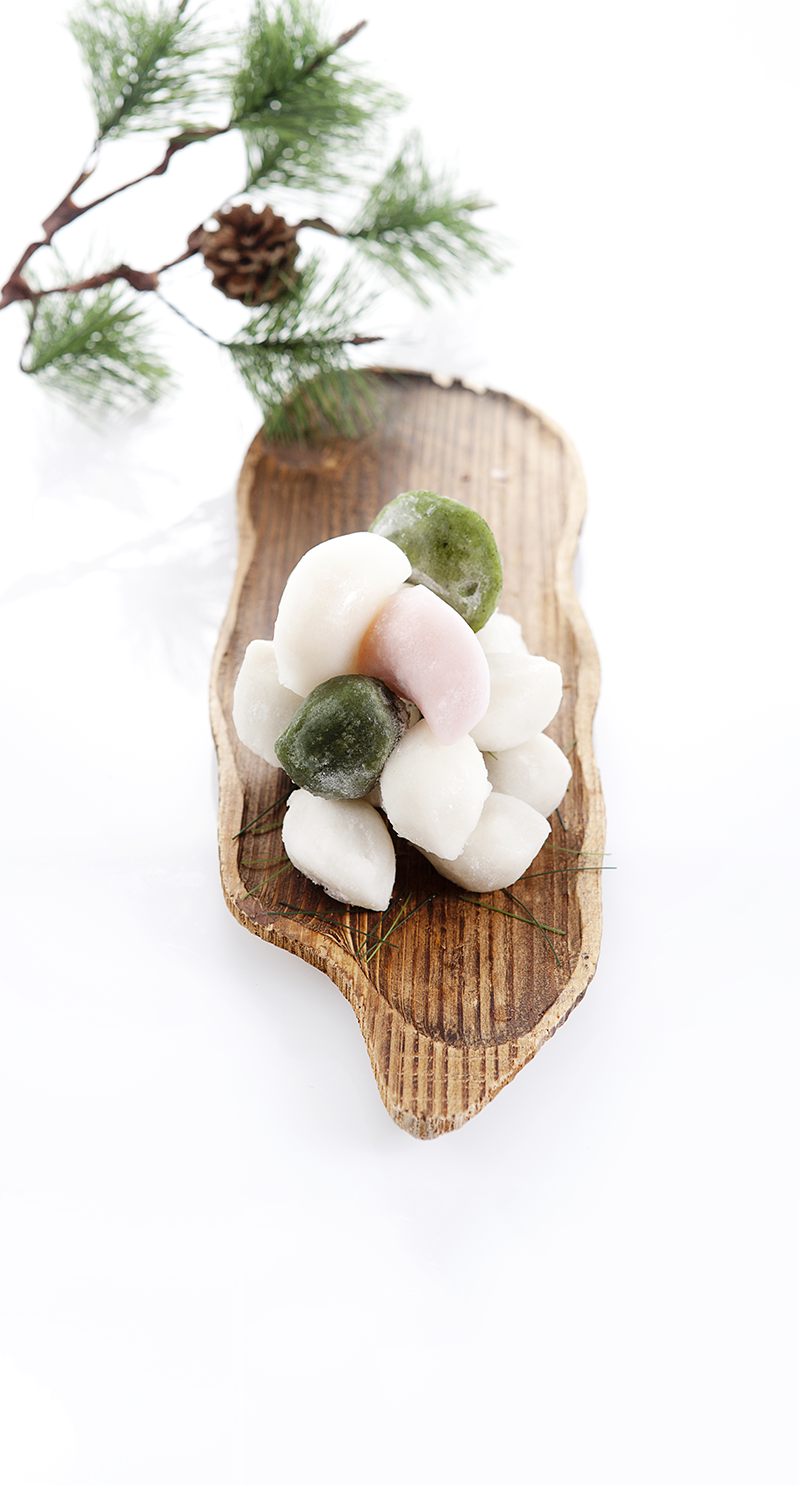
Songpyeon Generalized in the Goryeo Dynasty
There are two types of songpyeon that are eaten as a seasonal dish, but they have one thing in common: the heart of a “good year.” The first one is “oryeo songpyeon,” which is made with newly harvested rice and eaten on Jungchujeol(the mid-autumn day on the lunar calendar), and “oryeo” means “olbyeo(early-ripening rice). The first day of February is Junghwajeol, when farmers cleanse their body and mind before starting the year’s farming activity. On this day, the songpyeon in the size of one’s palm was made, and given to servants according to their age with the wish of good luck in farming. This songpyeon was called “nobi(servant) songpyeon” or “nayi(age) songpyeon.”
We don't know exactly when we started eating songpyeon. Jong and yeol mentioned in <Qimin Yaoshu> and glutinous rice cake with red bean stuffing mentioned in <The Collected Works of Mogeun> are presumed to be songpyeon, so it is believed to be generalized during the Goryeo Dynasty. Here, jong is millet wrapped in the leaves of wild rice and boiled in thick ash water, and yeol is glutinous rice flour kneaded with honey, spread to 1 cheok(=about 30.3 cm) by 2 chons(1 chon = about 3.03 cm), and cut into quarters.
Each piece is then attached with jujube and chestnuts on the top and at the bottom, coated with oil evenly, wrapped in bamboo leaf, and steamed to be cooked.
Songpyeon is also called songbyeong(松餠), and it is believed that this name was used in the 17th century. In <Yorok>, which was written around 1680, “songpyeon is a rice cake made with white rice powder, and steamed on pine needles in layers.”