


한식에 대한 다채로운 이야기를 전하는 온라인 매거진
Vol 42. Seasonal Foods
Seasonal Korean Food Ingredients
What Today’s Generations Shop Nowadays
In the “2020 Food Consumption Behaviors Survey” conducted by the Korea Rural Economic Institute, consumers’ interest in whether food ingredients are domestic agricultural products was high, and their willingness to pay for domestic agricultural, livestock, and fish products was higher than their willingness to pay for imported products.
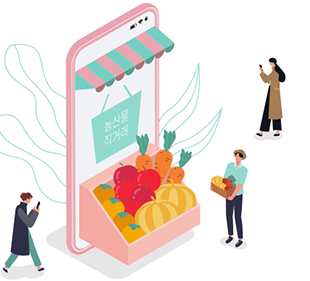
Let’s consider that A is on a diet. To lose weight, A regularly orders seasonal vegetables directly from the farm for A’s diet menu. Not only are the vegetables fresher than when A buys them from a local supermarket or mart, but they are also delivered to A directly from the farm, which is very convenient for A.
A says, “I didn’t know how to choose fresh, high-quality vegetables or fruits, and where to buy them. Now, I have these fresh seasonal vegetables directly delivered to me regularly, so it’s great.” A can also order the vegetables in just the right amount.
Like A, more and more consumers are ordering seasonal agricultural, fish, and livestock products delivered directly from the production areas.
 We “Like” “Domestic”
Agricultural, Livestock and Fish Products
There was a time when Koreans believed in sintoburi (the belief that domestic farm products are the best). However, it was also the time when imported products were recognized as the high-quality food ingredients. Today, however, the word sintoburi is hardly heard, and domestic food ingredients are being recognized as high-quality food ingredients. With the increased awareness of the importance of national food security after the outbreak of COVID-19, domestic food ingredients are gaining popularity.
Belief and trust in the quality of domestic agricultural, livestock, and fish products have been steadily building up, and the fact that eating seasonal domestic vegetables reduces food mileage and our carbon footprint besides benefiting the environment has also captivated millennials who pursue eco-friendly consumption.
 Direct Delivery of Agricultural,
Livestock, and Fish Products to Your Door
With the diversification of online and offline distribution channels for buying domestic seasonal food ingredients, their accessibility has improved, which has raised preference for domestic seasonal food ingredients.
When it comes to direct sales from the producer, we think of offline markets that are regularly held in specific places.
The advantage of this direct trading market, where agricultural, livestock, and fish producers and consumers meet and buy and sell fresh products, is that the producers can sell products at a reasonable price, and the consumers can buy fresh products at relatively low prices. This is why this offline direct trading market has become steadily popular.
Of course, there are limits to accessibility. It is not easy for people other than locals to visit offline direct trading markets. However, as more promotions of seasonal food ingredients sent directly from producers are held in large marts and department stores, the problem of access to seasonal ingredients is gradually decreasing.
Moreover, the number of online shopping malls that deliver agricultural, livestock, and fish products directly from producers and of platforms that connect producers and consumers has increased, and the emergence of new distribution channels, including live commerce sites where the agricultural, livestock, and fish producers can sell directly online, and of subscription services that regularly deliver necessary vegetables and fruits, etc., is also encouraging. There are also a number of online markets operated by provinces, cities, and counties to expand the market for regional specialties, and they are reliable because the specialty products are certified by the provinces, cities, and counties. In addition, with the establishment of a distribution system such as a cold chain system and the development of delivery systems such as early morning delivery and rocket delivery, the infrastructure needed to distribute agricultural, livestock, and fish products in a fresh state are now available. This is why many companies are now selling “super fresh” products beyond just “fresh.”
 Non-contact Consumption of Agricultural,
Livestock, and Fish Products is Trending
Consumers' psychological threshold against online direct sales of agricultural, livestock, and fish products has also significantly dropped. The culture of non-contact and online-contact consumption that emerged after the outbreak of COVID-19 has had a positive effect on the sales of online agricultural, livestock, and fish products.
According to National Statistical Office data, the amount of online shopping for agricultural, livestock, and fish products increased by 71.4% from 3.53 trillion won in 2019 to 6.06 trillion won in 2020. Moreover, the increase in the number of people who are making home-cooked meals due to COVID-19 is also raising interest in domestic seasonal ingredients. Consumers’ need to cook with good ingredients, even if they cost slightly more, has increased, and this is leading to interest in domestic seasonal ingredients.